Massachusetts General Hospital
Doctor SleepMassachusetts General Hospital is where Dan Torrance reaches Concetta Reynolds at the end of her life and where, after her death, he tells Lucy Stone that they share a father. Its significance lies in the way a hospital visit becomes both a final act of care and the setting for a revelation about family: in Room 9, Dan cannot cure Concetta, but he can help her return to consciousness long enough to speak and say goodbye.
The late-night visit
Dan and John Dalton arrive shortly after ten thirty at night. Concetta is scheduled to be transferred to Helen Rivington House, and Dan presents his hospice identification while describing himself as a staffer there. He introduces John as the family doctor, though the description stretches the truth. Dan explains that family members will soon join them and that they need to assess Concetta before the transfer. The carefully assembled explanation gets them access, but the nurse’s account makes clear that the visit comes at a grave moment: Concetta has slipped into a coma, and the nurse does not expect her to provide any input.
The nurse nevertheless speaks of Concetta with warmth. She has read her poems and calls her special; she also praises Lucy for attending closely to her grandmother. This testimony places the medical crisis within a history of care and attention. Dan’s arrival is not simply an attempt to enter a hospital room. He is coming to someone whose family has stayed near her, and whose writing has made an impression on the people caring for her.
Room 9 and the return to awareness
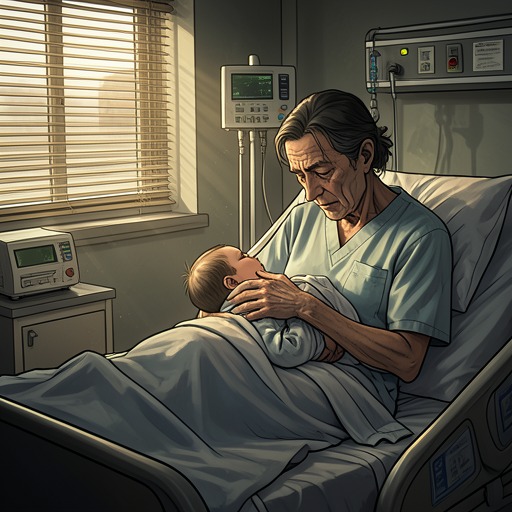
Concetta’s name is on the door of Room 9, a single room at the end of the hall. The empty slot for medical orders and the monitor offer little hope of recovery. Photographs cover the walls, including images of Abra at different ages and a picture Dan associates with the family’s Day of the Spoons. These photographs make the room a record of a life still held in family memory, even as Concetta lies unconscious. Dan notices that she is receiving saline and understands that the hospital has no medicine that can change her condition.
He straightens Concetta’s displaced cannula, sits on the bed, and takes her hand. Rather than a medical treatment, what follows is an act of attention and connection. He reaches toward her inwardly, asking her to return because Abra needs her and he does too. At first there is no visible response. Then Concetta’s eyes move beneath her lids, her breathing catches, and her eyes open. Dan recognizes the change as a return to consciousness, a moment that leaves him wondering where awareness comes from and where it goes when it departs.
Concetta’s hand tightens around his, and she smiles. She speaks mostly in Italian, and their brief conversation brings recognition and affection into the room. Dan asks whether she is ready; she answers that she is. He kisses her forehead, tells her she only needs to sleep, and waits beside her for her final breath. At Massachusetts General Hospital, the visit cannot reverse the illness or prevent her death. It gives Concetta time to awaken, recognize Dan, and meet the end with someone holding her hand.
Death and family disclosure
Lucy arrives after Concetta has died, followed by her husband, Dave Stone, and John. Her fear and anger are directed at Dan, whom she believes has no right to be with her grandmother. Dan asks her to lower her voice because they are in the presence of death. He then takes her hands and leads her across the room to the open bathroom, where they face each other in the mirror. There he tells her that his father was also her father and that he is her half brother.
The revelation gives the hospital room a second kind of threshold. Concetta’s death closes one relationship, while Dan’s disclosure opens an unexpected one. The bathroom mirror provides a plain, immediate frame for the recognition: Lucy and Dan can see themselves together as he names their connection. The scene does not turn grief into an abstract lesson; the discovery arrives amid the practical and emotional aftermath of a death, while Lucy has come to mourn the woman who raised her.
After notifying the head nurse that someone on the floor has died, Dan and Lucy go to the hospital’s small nondenominational chapel. Lucy already knows it from the hours she has spent there thinking and remembering as a loved one neared the end. The chapel gives them a quieter place in which to remain with what has happened. Their conversation continues beyond the bedside, but the hospital remains the setting where the immediate facts of loss and kinship come together.
A place of care, not cure
Massachusetts General Hospital is shown through specific acts and limits rather than as a full account of its institution. Its staff assess Concetta, monitor her condition, and prepare for a possible transfer; the nurse communicates what the family can expect. Yet the empty medical-orders slot, the saline drip, and the absence of an effective medicine mark how little conventional care can offer at this stage. Dan’s role is different from the hospital’s: he can attend to Concetta, speak to her inwardly, and remain present, but he cannot make her well.
That distinction connects the hospital scene to Dan’s wider work as Doctor Sleep. His care does not depend on promising a cure; it consists here of noticing, touching, listening, and staying until the end. The scene also binds his private history to that practice. As he sits beside Concetta, he becomes the person who can help her face death; afterward, he must tell Lucy that their own family history is not what either of them knew. The hospital thus holds two forms of passage at once: Concetta’s final departure and the beginning of a newly recognized sibling relationship.