Rose the Hat Intrudes into Abra’s Mind and Falls into Her Trap
Doctor SleepRose the Hat’s attempt to enter Abra Stone’s mind becomes a reversal of the hunter-and-target relationship: Rose believes she is following a trace into a child’s thoughts, but Abra has prepared the encounter as a trap. The intrusion ends with Rose forced to retreat, physically injured and newly aware that her confidence led her to underestimate Abra.
Preparation and the route in
At one thirty on a Monday morning, Rose continued meditating while most of the True Knot slept. She held a computer-printed picture of downtown Anniston, New Hampshire, in one hand and a canister in the other. The canister held almost no steam, only a faint remnant, but Rose believed it would be enough to reach her target. Her preparation thus rested on two linked assumptions: that the remaining steam could carry her, and that she had found a usable path into Abra’s mind.
Rose released the last steam and inhaled it before fixing her attention on the picture. She imagined Abra asleep near a lane that Rose thought might be Richland Court, while acknowledging that she did not yet know what the girl looked like. Instead, Rose relied on a different kind of recognition: Abra knew what Rose felt like, and Rose remembered what she had seen at Sam’s Supermarket the day before. That remembered glimpse became Rose’s marker, the point of entry she followed toward the child.
The search began with an auditory trace of supermarket music and the presence of a shopping cart. Rose followed those fragments as the darkness gave way to the supermarket aisle and then a hallway, signs that she believed she was nearing her destination. The sequence makes her approach seem gradual and methodical, but it also shows how much depends on her interpretation of what she encounters. She treats the fragments as a route she controls; the scene’s reversal reveals that the apparent access is part of a prepared encounter.
The apparent child and the ambush
Rose first encountered Abra in a childlike form, riding a bicycle with training wheels that flickered in and out. The image suggested a dream of learning to ride without them. Rose took the child’s apparent innocence as cover for her own investigation, expecting to learn about Abra while the girl remained unaware of her presence. That expectation is central to the reversal: Rose believes she is the one observing, while Abra is already waiting for her.
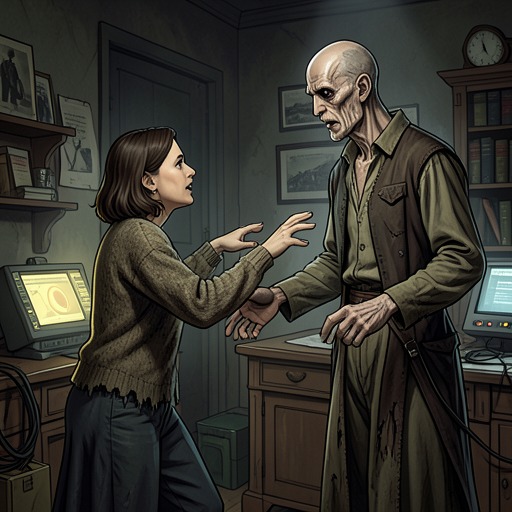
Moving confidently, Rose opened a drawer. At once, an alarm sounded and spotlights came on around her. The drawer shut on her hand before she could pull it free, catching Rose completely off guard. The room’s sudden change turns her exploratory movement into a trap: what appeared to be an ordinary feature of the mental space becomes the mechanism that stops her and makes her vulnerable.
The child’s image then gave way to a young woman dressed as a warrior, with a dragon on her leather jerkin and a blue band holding back her hair. The bicycle had become a white stallion, and the warrior carried a lance. The transformation makes Abra’s concealed readiness visible to Rose. The story does not present the lance as the means of the counterattack; rather, the warrior image gives form to the danger Rose has belatedly recognized. Abra had lain in wait and meant to kill her, and Rose understood that her own vulnerable state could make the attempt succeed.
The reversal reaches Rose
Rose fought back through force of will, using a blunt mental assault rather than the warrior’s imagined weapon. As she struggled, she also felt a fluttering sensation in her head, an indication that the encounter involved more than the trap and the threatened attack in the first room. She pulled her hand free just before the drawer could close on it again. The immediate escape did not end the intrusion: the flutter intensified, and Rose realized that Abra had entered another part of the mental space.
Rose found the girl in a room filled with file drawers. This discovery changes the meaning of the earlier movement through the supermarket and hallway. Rose had thought of herself as the intruder searching Abra’s mind; now she recognized that Abra had reached into Rose’s own mental territory. The encounter’s reversal is therefore not simply that Rose has been caught. The direction of access has changed, and Rose is no longer the only person navigating the other’s inner world.
As the sensation subsided, Rose initially tried to explain the failure by insisting that she could not have known. The narration corrects that self-exculpation: Rose had come to Abra and walked into a trap because she underestimated her. Her recognition identifies the error more precisely than the claim that the trap was unforeseeable. Rose had trusted her experience and her reading of the signs, but she had mistaken Abra’s apparent vulnerability for an absence of preparation.
Aftermath and significance
Rose woke in her camper, where the canister lay empty on the carpet. Her Sidewinder T-shirt was damp, and her hand was scraped, bruised, and swelling; she thought she might lose at least two fingernails. She had to steady herself on objects as she made her way to the door. The mental encounter had crossed back into her waking body, leaving a consequence she could not dismiss as an imagined defeat.
The clock on the dashboard showed ten to two: the entire episode had taken about twenty minutes. Rose left the camper, which now felt confining despite its size and luxury. Her retreat marks the immediate outcome: Abra has survived Rose’s attempt and has forced the older, more experienced intruder out of the encounter. Rose, in turn, leaves with evidence of the cost of underestimating her target. The scene establishes that Abra’s mind is not merely a place Rose can enter; it can also be organized to meet and resist her.