The True Knot’s Steam Shortage Crisis
Doctor SleepThe True Knot’s steam shortage crisis turns a member’s death into evidence that the group’s long decline may have become an immediate survival emergency. Tommy’s sudden death, a rise in minor illnesses, and a nearly empty supply of stored steam converge on a stark reckoning: the True Knot must find a substantial new source of nourishment soon, or face the consequences of living on too little.
Tommy’s death and the first warning
The crisis sharpens when Crow Daddy tells Rose the Hat that Tommy died in his sleep. He had cycled once before dying, and the passing was quick. Crow Daddy reports that Heavy Mary was beside him; she woke as he was in distress, but the episode was over before she understood what was happening. Walnut, the True Knot’s healer, thinks a bad cold may have contributed, along with Tommy’s long-standing smoking. The cause remains uncertain, but the death arrives amid a broader pattern that Rose cannot dismiss.
The loss carries a particular weight for Heavy Mary. She and Tommy had been together for almost ninety years, reaching back to when he was known as Tommy the Wagon. Mary had cared for him after his Turning and given him his first steam when he woke the following day. Now she is heartbroken and speaks of taking her own life. Rose is shocked: the True Knot has not previously had a member express such a wish. Tommy’s death therefore registers not only as a loss but as a rupture in a group whose continued existence has seemed inseparable from its will to live.
A pattern of weakness
Crow Daddy adds that, although members of the True Knot do not usually catch colds, several have recently developed sniffles that come and go. Walnut suspects malnutrition, though he has no firm diagnosis. The symptoms connect Tommy’s death to the group’s scarcity without proving a single medical cause: inadequate steam is a plausible explanation, not a confirmed one.
Rose initially points to a recent supply of steam taken in Delaware. The child they fed there, however, had not provided much, and the group’s nourishment may have been insufficient even though Tommy seemed to recover and gain weight afterward. That contrast unsettles the idea that any recent feeding has restored the True Knot. Rose also considers whether people capable of providing the nourishment the group needs are becoming harder to find, comparing the possibility to dwindling schools of tuna. It remains a fear rather than a demonstrated fact, but it widens the crisis from a temporary shortage to a question about whether adequate supplies will remain available.
The canisters and the arithmetic of scarcity
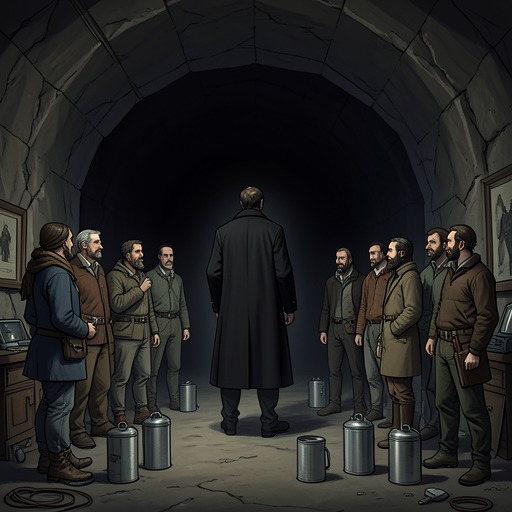
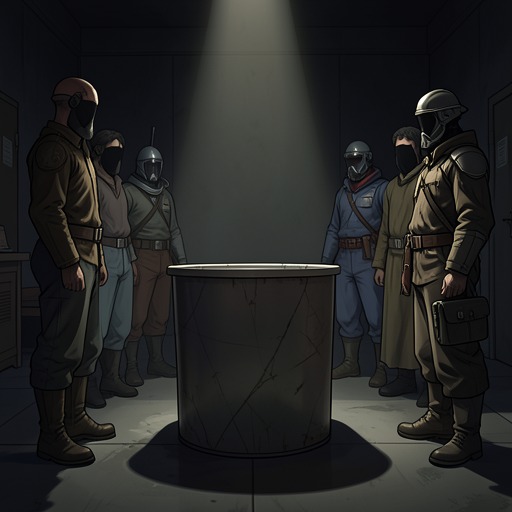
The storage inventory gives the concern its most concrete measure. On a May morning in Kentucky, Rose checks the safe, which is lined with Styrofoam to protect its canisters in a road accident and has forty built-in cradles. Thirty-seven cradles are empty. Crow Daddy has estimated that only fifteen or twelve full canisters remain, a deliberately low estimate intended to reassure Rose; her own inspection shows that the situation is worse. She lifts one of the remaining full canisters, checks that its valve seal is intact, and places it carefully on the counter. After that night, only two full canisters will remain.
The canisters make the shortage visible as a finite reserve rather than a vague anxiety. Their protective housing and orderly cradles speak to a group accustomed to moving and preserving its supplies, but the empty spaces now dominate the inventory. Checking a seal can preserve what is stored; it cannot replenish what has been used. The reserve therefore gives Rose a countdown with practical consequences: the True Knot needs to obtain a substantial supply of steam and refill at least some of the empty canisters, and it needs to do so soon.
A crisis of survival and confidence
Rose and Crow Daddy approach the danger from different angles. Rose measures what remains and considers possible explanations; Crow Daddy presses her to acknowledge what the whole group is thinking, even if no one has said it openly. His warning makes the shortage collective: the deaths and illnesses are not isolated matters that Rose can manage privately. As her second, Crow Daddy is also the one willing to insist that the stored supply be examined rather than treated as adequate.
The episode ends with the True Knot’s back not quite against the wall, but only inches from it. That qualification preserves a narrow margin for action while making the urgency unmistakable. The group has not yet run out, and the precise cause of Tommy’s death is not established; nevertheless, the combination of a death, recurring sniffles, possible malnutrition, and two remaining full canisters makes the danger impossible to treat as remote. A group accustomed to endurance now faces a material limit: its survival depends on finding enough nourishment before its reserve is exhausted.