The True Knot’s fragmentation
Doctor SleepThe True Knot’s fragmentation is a crisis of both allegiance and survival: after a run of losses, the group no longer moves as one, and illness makes its remaining members suspect that staying together may itself be dangerous. Rose the Hat tries to turn fear into renewed pursuit, but dissent, sickness, and departures expose the difference between her determination to hold the group together and its members’ desire to escape. She ultimately recasts the split as a strategy, though the smaller faction she keeps has lost a trusted leader and much of its former security.
A group under strain
The fracture is first visible in an ordinary shared activity. Steamhead Steve, Baba the Red, Bent Dick, and Greedy G are playing canasta in the Bounder shared by Greedy G and Dirty Phil when shrieks interrupt them. All four are already on edge, as is the wider True Knot. They abandon the game and run for the door. The abrupt break from cards to alarm gives the group’s tension a concrete form: even its routine communal life cannot hold when danger intrudes.
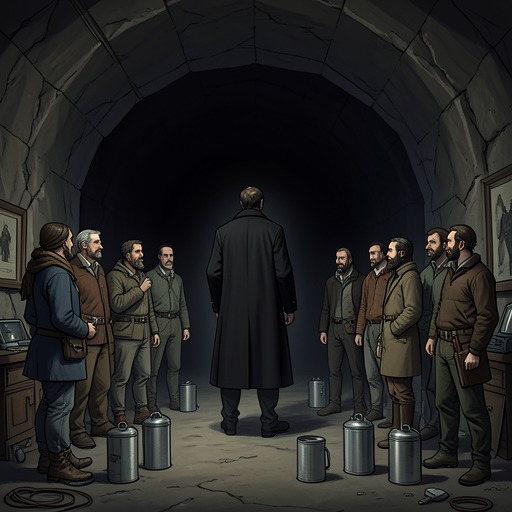
Rose responds by calling for the scattered members to regroup. She wants to reach Diesel Doug and have him, Dirty Phil, and Apron Annie turn back; the group, she insists, needs to be together, take a great deal of steam, and pursue the girl. Her plan links solidarity to replenishment and revenge. The urgency of the appeal, however, also makes the group’s weakness plain: gathering and feeding are presented as prerequisites for action, not as evidence that the True Knot remains secure.
Dissent and illness
Steamhead Steve challenges Rose’s plan carefully. He does not deny her authority, but suggests leaving the girl alone. His hesitation is shaped by the scale of the recent losses: if Crow Daddy is gone, five members have died in one day, a toll the True Knot has never suffered before. His unfinished warning registers a limit in the group’s experience as well as his reluctance to confront Rose directly.
Rose answers the doubt as a test of loyalty, framing withdrawal as cowardice before an ordinary girl. No one openly backs Steve, yet Rose reads their silence and their retreat as evidence that they do want to run. Her account of the divide is personal as well as strategic: the group has enjoyed good years and easy hunting, but now faces an opponent who knows what they are and what they do. The survivors’ reluctance to avenge Crow Daddy, who had helped Rose through good and bad times, feels to her like a repudiation of their shared past. They, in turn, move farther away as she confronts them, making their fear visible without resolving it.
The threat of sickness sharpens the disagreement. Rose takes Big Mo’s arm and displays the red spots covering it, asking whether Mo can escape that condition. She then invokes Grampa Flick’s warning that the girl may be the only chance to stop the sickness from spreading through the group. Rose’s appeal makes pursuit seem not only a matter of revenge but a possible means of survival. Yet it also rests on uncertainty: she asks whether anyone knows better, and no alternative answer is supplied. Big Mo’s visible illness turns the danger from rumor into a problem the group cannot simply dismiss.
Departures and division
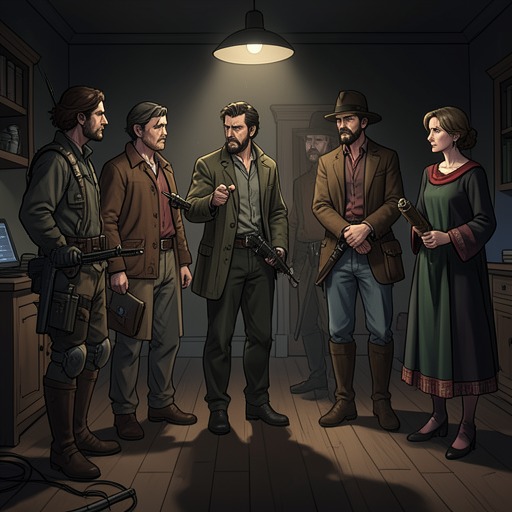
The defections unfold in a sequence of departures that Rose hears during the night. At a quarter past two, Steamhead Steve and Baba the Russian start an engine and leave. At twenty to four, the Little twins, Pea and Pod, depart with Sweet Terri Pickford, who watches nervously through the back window for any sign of Rose. Big Mo had begged to go with them, but they refuse because she is carrying the disease. The separations therefore do not produce a clean escape for everyone: the group’s sickness affects who can leave with whom, while fear of Rose shadows those who do go.
Rose could stop the departures but chooses not to. She expects those who leave to discover what life in America is like without the True Knot’s protection in camp or on the road. She also plans to have Toady Slim cancel their credit cards and empty their bank accounts. That decision makes the split more than a temporary scattering: Rose intends to withdraw both communal protection and access to money from the departing members. Toady is less capable than Jimmy Numbers, she recognizes, but she trusts him to carry out the task and remain with her.
The break is not limited to the first engines. Dirty Phil, Apron Annie, and Diesel Doug do not return; they vote to head south instead. Diesel Doug has told them that Rose can no longer be trusted, and that it is time to cut the True Knot. The disagreement thus becomes an explicit contest over leadership and continued membership. Rose’s claim that the group must stay together is answered by a faction that has chosen both a direction and an end to its association with her.
Rose’s arithmetic of survival
Rose regards the split as a terrible idea, but treats the loss of weaker or sick members as an advantage. She expects that once the girl is dead and the group has taken her steam, the roughly twenty-five members who remain will be stronger. She has abandoned the hope of keeping the girl prisoner. In Rose’s calculations, the True Knot’s immediate future depends on eliminating that threat and making the most of the survivors and supplies still at hand.
Her reckoning does not erase grief. Rose mourns Crow Daddy and knows that no one can take his place. Token Charlie may do the best he can, as may Harpman Sam, Bent Dick, Fat Fannie, Long Paul, and Greedy G, whom Rose considers loyal even if he is not bright. Naming those she expects to rely on gives the reduced group a provisional structure, but it also emphasizes the absence at its center: a replacement can contribute, yet cannot become Crow.
Rose further reasons that with the others gone, the steam already in storage will stretch farther and make those who remain stronger. This logic converts separation into resource management. Earlier she had called for the whole group to gather and take more steam; now she accepts fewer members as a way to concentrate what remains. The shift is a measure of the True Knot’s decline as much as a survival calculation: its resources, its leadership, and its members are all being counted against mounting danger.
Significance of the fragmentation
The episode marks a change in what holds the True Knot together. Shared history and protection no longer guarantee obedience; the departure of Steve and the southbound vote show that members can judge Rose’s leadership unsafe and choose separation. At the same time, illness limits solidarity even among those seeking to leave, as Big Mo is refused a place with the departing group because of her condition.
Rose’s response is not reconciliation but selection. She permits some departures, threatens their financial independence, and imagines the survivors growing stronger by dividing what remains among fewer people. Her mourning for Crow Daddy sits beside this hard arithmetic without resolving it. The True Knot still has a leader, a reduced roster, and stored steam, but its claim to endure as a single community has been broken.