The True Knot's identity, endurance, and steam-feeding oath
Doctor SleepThe True Knot’s creed is a collective oath that binds its members to an identity of chosenness and endurance while openly defining their survival as taking nourishment from others. Its words are not left as abstract declarations: at Kozy Kampground, the group recites them before inhaling the steam of a murdered child, making the creed both a statement of belonging and a ritual justification for predation. When grief later gathers the group at Grampa Flick’s deathbed, a related chant shows how the same language also holds the True Knot together in loss.
The oath at Kozy Kampground
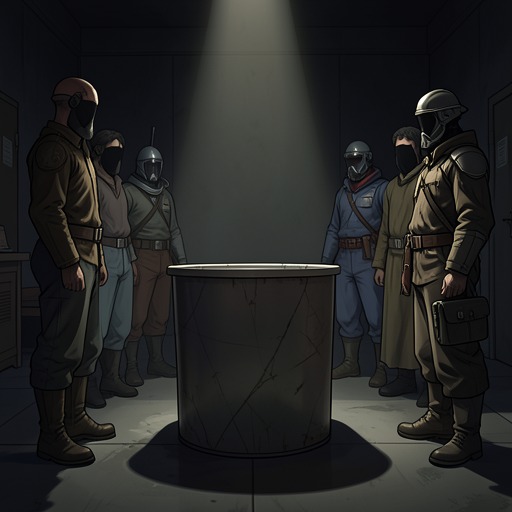
The creed is spoken at a night gathering in the picnic area of Kozy Kampground. It is fully dark, and the members are hungry; Rose the Hat arrives last, carrying the canister. Their small, greedy murmur at its appearance makes the ceremony’s material stakes plain before anyone speaks. Rose mounts an initial-scarred picnic table, looks over the group, and declares, “We are the True Knot.” The others repeat the words, solemn in expression but avid and hungry in their gaze.
The exchange unfolds as a call and response rather than a speech delivered to silent listeners. Rose names the group, and the members answer with the same name before invoking its binding principle: “What is tied may never be untied.” Rose then asserts, “We are the True Knot, and we endure,” and the group answers, “We endure.” The sequence joins identity to permanence: membership is imagined as a knot that cannot be undone, and endurance becomes the group’s shared claim about itself. The repeated responses make that claim communal, spoken into being by both its leader and its members.
The oath next presents the group as exceptional and favored. Rose calls them “the chosen ones” and “the fortunate ones”; the members answer, “We are chosen and fortunate.” The reciprocal phrasing turns privilege into a collective self-description. It is followed by a stark account of the True Knot’s relation to those outside it: “They are the makers; we are the takers.” The group replies, “We take what they make.” The language offers no mutual exchange. It casts outsiders as producers of what the True Knot consumes and presents taking as an established division between the two groups.
Creed made material
The ritual’s next exchange connects the spoken creed directly to the canister Rose has brought. She instructs the others, “Take this and use it well,” and they respond, “We will use it well.” The object is not explained as a symbol; it contains the steam they have gathered from Richard Gaylesworthy, a gifted boy who disappeared after his mother was murdered. When Rose opens the valve, his essence rises from the canister as silver mist. The members watch expectantly, some trembling and several weeping.
Rose tells them, “Take nourishment and endure,” then beckons with her raised hands. The mist descends over the waiting members, who breathe it deeply for five minutes. Several hyperventilate and swoon. The scene thus gives physical consequence to the oath’s central pairing: nourishment sustains the group, and endurance is what that nourishment is meant to secure. Rose feels physically swollen and mentally sharpened; the lines around her eyes and mouth fade, and the white strands in her hair darken. The True Knot’s claim to endure is tied to a renewal that can be seen in her changing body.
The feeding also exposes the cost hidden inside the creed’s language of fortune and chosenness. The members inhale Richard until the mist thins and disappears; the narration makes clear that he is “really and truly gone.” Those who have fainted sit up smiling, and Grampa Flick dances with Petty the Chink. Their renewed liveliness follows the boy’s complete consumption. In this sequence, the creed does not merely describe what the True Knot believes about itself: its promises of endurance are fulfilled through the destruction of the person whose steam they take.
Repetition in grief
The language of the creed returns at Grampa Flick’s deathbed, where its function shifts from preparing the group to feed to helping its members face a loss. After his eyes disappear, those present are left with the shape of his vanished head, hair-tonic stains, and his deflated, stained boxers. The scene preserves the physical indignity of death rather than turning it into a clean or triumphant passage. Those gathered are uncertain that the old man will not appear again, and Rose expects that his eyes will recur in their dreams.
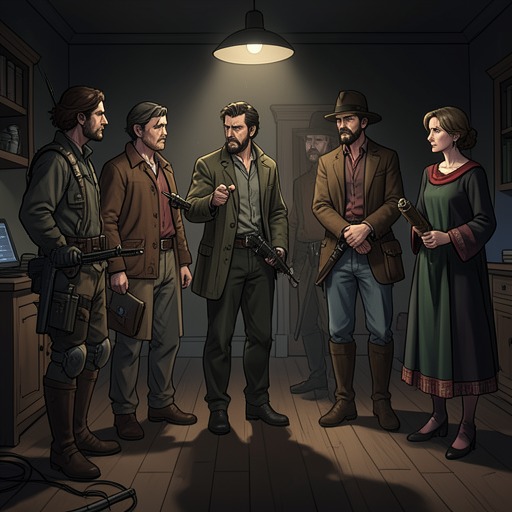
Mo breaks into wild sobs and buries her head in Apron Annie’s bosom. Outside, one member begins to speak, then others join until those gathered are chanting under the stars. Rose feels a chill and reaches for Crow’s hand, which she squeezes. Annie joins, then Mo, Nut, and Crow; Rose takes a deep breath and adds her voice. The words are “Lodsam hanti, we are the chosen ones.” The earlier ceremony’s language of chosenness is thus heard again amid mourning. Here it does not announce an impending meal; it gives the bereaved a shared utterance, taken up one voice at a time, while Rose and Crow hold hands.
Endurance and collective identity
Across these two scenes, the creed links the True Knot’s self-image to a repeated practice. Its claims of being tied together, chosen, fortunate, and enduring gain force from collective recitation, but the canister ceremony reveals what that endurance depends on: the consumption of a child’s steam. The contrast between the members’ solemn faces during the oath and their hunger at the canister makes the group’s piety inseparable from appetite. Its vow of permanence is not a promise to protect what is shared; it is a declaration that the True Knot will persist by taking nourishment from others.
The deathbed chant shows why the creed cannot be reduced to a feeding slogan. Its language also furnishes a compact identity the members can repeat when their community is shaken by death. At Kozy Kampground, Rose leads the words before the group receives Richard’s steam; at Grampa Flick’s bedside, the chant rises from grief and spreads through the people present. In both scenes, speaking together renews the group’s sense of itself. The oath’s central irony remains: it promises that the True Knot endures, while the concrete fulfillment of that promise requires someone outside the knot to be consumed.