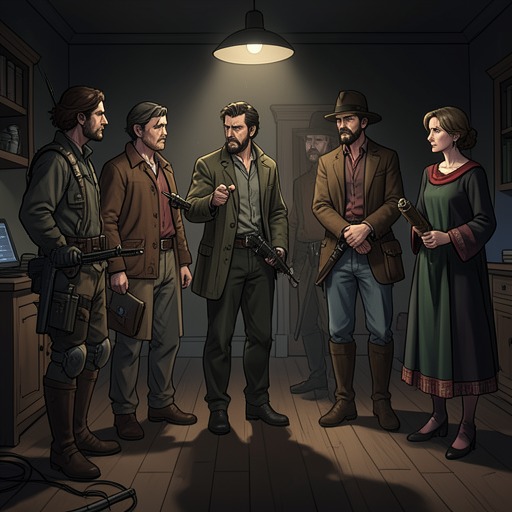
The True Knot's survival rule to never attract attention
Doctor SleepThe True Knot's survival rule to never attract attention shapes how the group moves across the country and prepares an abduction. In practice, the rule means avoiding conspicuous travel, accounting for surveillance, and relying on the RVs that let the True Knot cross long distances without drawing the notice it fears.
Purpose and Constraints
The rule is explicitly described as the True Knot’s first rule of survival: never attract attention. Its immediate context is a plan to move against a girl and arrange supplies in advance. Crow explains that the group must secure what it needs and send it to one of its mail drops before the operation can proceed cleanly. The rule thus reaches beyond concealment at the scene of a crime; it governs the logistical preparations that make such an operation possible.
The group’s caution is tied to the risk of official scrutiny. Homeland Security had been monitoring even private flights closely since the September 11 attacks, making air travel an unacceptable way to move a raiding party without notice. Private flights were also physically difficult for the True Knot: its members suffered extreme altitude sickness. Walnut speculates that this reaction may stem from nervous systems that differ radically from those of ordinary people, but presents that explanation as his belief rather than established fact.
Methods of Concealment
The True Knot maintains hundreds of mail drops across America, mostly at Mail Boxes Etc. locations and UPS stores. These allow the group to receive supplies without depending on a single fixed address, but using them requires planning days ahead. That delay follows from the group’s commitment to travel in its RVs: members would no more take public transport than slit their own throats.
The RVs make the rule workable over long distances. Thanks to the interstate highway system, they have served the group’s purposes before and can carry a small raiding party from Sidewinder, Colorado, to northern New England in less than thirty hours. The party can keep moving by putting new drivers behind the wheel every six hours, combining speed with the group’s preferred private transport rather than risking exposure on a public route.
Operational Consequences
The rule creates a practical tension between urgency and preparation. Crow wants to move quickly against the girl, yet supplies must first be arranged through the mail-drop network, and the group’s chosen mode of transport requires coordinated road travel. Concealment therefore depends not on disappearing without effort but on anticipating needs, distributing logistics, and making the RV system serve as both transportation and protection from attention.
The same principle limits the True Knot’s options. Commercial transport is rejected outright, while private aviation is constrained by both government monitoring and the members’ physical response to altitude. The RVs offer a workable alternative, but only through advance planning and disciplined travel. In this account, the rule is not merely a warning against being noticed; it is the operational logic that organizes how the True Knot prepares and moves.