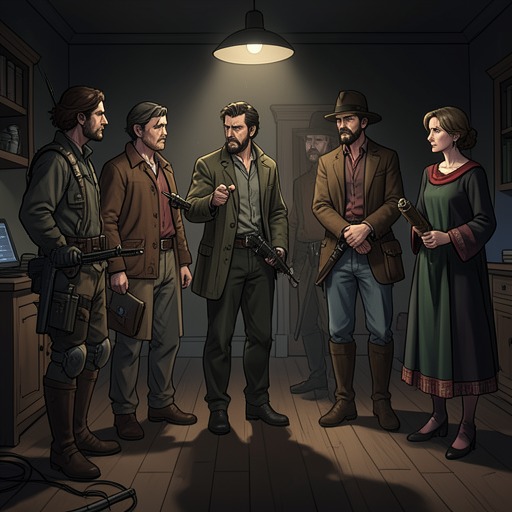
The True Knot's vows and creed
Doctor SleepThe True Knot's vows and creed define the group as a family bound beyond separation and as a people who endure by virtue of being chosen and fortunate. Spoken during Andi Steiner’s initiation, the declarations do more than describe the group: their repetition makes them a ritual of belonging even as Andi undergoes a transformation whose outcome is uncertain and whose pain the ceremony does not dispel.
Belonging and the unbroken knot
When Andi asks what Rose O’Hara and her companions call themselves, Rose rejects the ordinary language of friendship: “They’re not my friends, they’re my family. We’re the True Knot.” She laces her fingers together and holds them before Andi, giving the group’s name a visible counterpart in interlocked hands. The gesture presents membership as a bond between lives, not merely an association of individuals.
Rose gives that bond its rule in the same conversation: “And what’s tied can never be untied. You need to understand that.” The maxim makes permanence the price and promise of joining. For Andi, its meaning is not abstract: she understands it through the knowledge that a person who has been raped cannot be made untouched again. Her response places the group’s claim of familial unity beside an irreversible injury, and she asks whether she has any other choice. The creed offers belonging, but the scene does not present Andi’s acceptance as uncomplicated or freely chosen.
The initiation as a spoken bond
At the ceremony, Grampa Flick leads the group, raising his hands as the others raise theirs. In the headlights of the recreational vehicles, their linked figures resemble a chain of paper dolls. Grampa Flick’s voice, formerly associated with a frail body, sounds deep and strong as he declares, “We are the True Knot,” and the group answers, “We are the True Knot. What is tied may never be untied.” The repeated exchange joins the name to the binding maxim: the group announces what it is and immediately recites what membership means.
Grampa Flick then asks whether Andi will join them and tie her life to theirs. Rose instructs her to say yes, and Andi manages to do so. The ceremony thus gives the maxim a personal consequence: the promise of an unbreakable collective bond is made to include someone who has just voiced uncertainty about having a choice. The exchange is performative as well as descriptive. Andi’s answer marks her entry into the rite, while the gathered group’s response supplies the communal form in which that entry is recognized.
Endurance, selection, and the mist
The ceremony’s affirmations arrive in a sequence. Grampa Flick proclaims, “We are the True Knot, and we endure,” after Rose opens her canister and releases a small puff of silver mist. The mist hangs above it until Rose blows it toward Andi’s upturned face. The group then declares, “We are the chosen ones,” and “We are the fortunate ones,” answering each claim with the phrases “Lodsam hanti” and “Cahanna risone hanti.” The vows make endurance and special status sound like shared certainties, spoken together while the mist descends toward the new member.
Rose tells Andi to breathe deeply and kisses her cheek, saying, “I’ll see you on the other side.” The assurance has a tender surface, but the uncertainty surrounding the Turning gives it a more precarious force. Rose has not lied, yet she has withheld that steam can be scarce and that not everyone survives the transformation. Rose judges that Andi may survive, and Walnut cautiously agrees, but neither is sure. The group’s language of fortune and endurance therefore accompanies a real risk rather than resolving it.
Repetition under pressure
As the mist settles over Andi’s face, she inhales. It comes alive inside her, and she experiences a childlike figure of mist struggling while Rose cuts; the gathered members shine their flashlights on the slow-motion murder. The scene’s violence sharply tests the creed’s assurances. The words promise that the True Knot endures, but they do not make Andi’s ordeal gentle, nor do they guarantee that she will endure it.
Walnut thinks Andi is not strong enough and may cycle out, leaving nothing but her clothes. Her face returns into view, her body reappears, and she screams in agony. The True Knot continues its chant: “We are the True Knot and we endure,” followed by its repeated declarations of being chosen and fortunate. Andi begins to disappear again as her flesh turns cloudy and her screaming grows distant. The refrain persists through both her reappearance and renewed fading; it is the group’s response to uncertainty, not evidence that uncertainty has passed.
What the creed holds together
The vows bind identity to kinship, permanence, and survival. The joined hands, the question about tying Andi’s life to the group’s, and the answering chorus make the idea of a knot tangible through gesture and collective speech. At the same time, the ceremony exposes a divide between its confident language and the fragile body at its center: Andi has been told that the bond cannot be undone, while the Turning may not be survivable.
That tension gives the repeated words their force. The group speaks of being fortunate while a new member suffers, and insists that it endures while her presence flickers in and out. The creed supplies a shared identity and a script for the initiation, but the scene leaves its promise unresolved: the chant continues, and Andi’s fate remains uncertain.