The Turning
Doctor SleepThe Turning is the True Knot’s passage into membership: a perilous transformation in which a recruit must endure pain, draw in Steam, and emerge as one of the group. Rose O’Hara presents it as a route to long life and renewed youth, but the rite can kill or fail, and she conceals those risks from Snakebite Andi until the process is underway. Andi’s survival makes the Turning a decisive change in her life; it also exposes the cost behind the True Knot’s promise of endurance.
The Offer and Its Hidden Terms
Rose recruits Andi by promising that she will age far more slowly than ordinary people and regain youth when she takes Steam. In Rose’s account, the True Knot offers long life, renewed vitality, and a family to join. Andi recognizes that the promise sounds too good to be true, but Rose does not initially correct that impression. She withholds two essential facts: Steam can be scarce, and not everyone survives the Turning. The group’s doctor has only cautiously judged that Andi might make it through; no outcome is assured.
The invitation is therefore not an informed, uncomplicated choice. When Andi asks whether she has another option, Rose acknowledges that the alternatives are bad, while insisting that willingness will make the process easier. Andi asks whether the Turning hurts. Rose answers that it does not, although the narrative identifies this as her first outright lie. Her reassurance serves the group’s need for a recruit, while the concealed possibility of death makes the offer more coercive than its language of family and longevity suggests.
Andi’s decision also takes place against the knowledge that she has already been psychically restrained by the True Knot. As she sits in a recliner, she considers trying to run, then recalls the unseen force that held her in place at a movie theater. Rose’s account of choice and consent thus exists alongside Andi’s recognition that escape may not be possible. The Turning is presented as a threshold she is urged to cross, but not one she approaches from a position of safety or equal power.
The Rite and Andi’s Survival
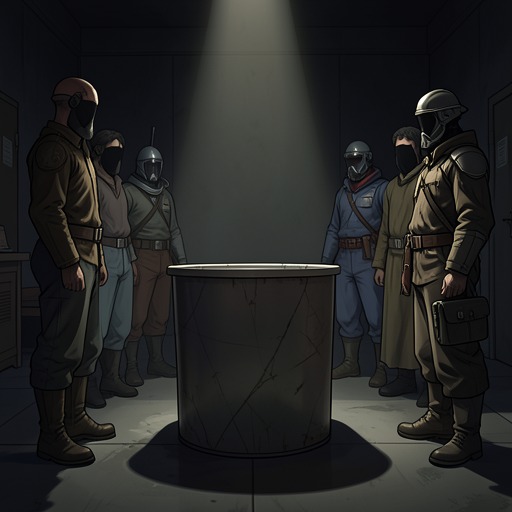
The ceremony takes place beneath the headlights of the group’s recreational vehicles. A member brings Rose a steel canister resembling a thermos, with a red cap, nozzle, and valve. To Andi it looks like an unlabeled can of bug spray. Rose opens it and releases a small cloud of silver mist, then blows it toward Andi. Grampa Flick leads the rite, while the True Knot raises its hands and joins in its familiar words. The linked figures, silhouetted in crossing beams of light, make the group’s name—an enduring knot—visible as an image as well as a creed.
When Andi inhales the mist, her experience becomes one of overwhelming distress. She perceives a childlike figure made of mist struggling, and Rose appears in that vision as the one causing its suffering while the others look on. Andi tries to rise, but feels she has no body with which to do so; pain and terror replace her ordinary sense of self. The scene makes the rite more than a change in age or status: the recruit experiences a rupture in bodily identity, and the True Knot’s ceremonial language accompanies rather than softens that ordeal.
The group watches as Andi’s visible form seems to disappear. The process does not proceed steadily toward recovery: she returns to view, only to cry out in pain, while Walnut privately fears that she is too weak to survive and may eventually cycle out. His recollection of his own Turning offers a contrast. He remembers fragments—the full moon, a bonfire, horses, and pain—but cannot recover the pain itself as a present sensation. The memory suggests that survival can leave the ordeal difficult to recall clearly, without making its danger any less real for the person undergoing it.
Rose then kisses Andi and breathes her own essence into her. Andi begins to fade again, but resists the process and takes in the life-force rather than trying to push it away. The narrative identifies this as her first taking of Steam. Her survival is not presented as guaranteed by the ceremony: she fights through a crisis that Rose had earlier hidden from her, and Rose’s intervention becomes part of what helps her endure it. The Turning concludes not because pain was absent, as Rose claimed, but because Andi persists through it and begins to participate in the process that sustains the True Knot.
Membership and Lasting Effects
After surviving, Andi becomes a member of the True Knot, whose members describe themselves as family rather than friends. The change brings her into the group’s shared identity and its promise of continued life, but it also binds her to a community whose survival depends on taking Steam. Rose’s earlier declaration that what is tied cannot be untied takes on a practical meaning: Andi’s new status is not merely ceremonial, but part of a lasting allegiance to the group.
The narrative also marks a change in Andi’s experience of intimacy after the rite, without erasing the painful history that preceded it. Her first night as a new member is described as an experience of pleasure that contrasts with the fear and pain associated with her past. This is a personal consequence of her transformation, distinct from the True Knot’s more instrumental interest in longevity and nourishment. Her endurance of the Turning is both a physical passage into the group and the beginning of a changed life within it.
One lasting practical benefit is Andi’s sleeper talent, a capacity shared to some degree by several members but strongest in her. After her transformation, she sometimes uses it to take cash from older men attracted to her. Rose considers this behavior risky and childish, yet expects Andi’s personal issues to fade with time. The contrast reveals the group’s priorities: Rose may have individual affection for Andi, but the True Knot measures the value of its members chiefly by what helps it survive. Andi’s ability makes her useful to the group, while her impulsive use of it remains a source of concern.
The Turning as a Survival Practice
The True Knot’s later circumstances place Andi’s Turning within a broader system of scarcity and adaptation. By 2011, the group is the only Knot left in America, and its members must keep moving because they do not age like other people. Their apparent returns to youth are associated with taking Steam, while members who go too long without it may show dramatic changes in age and health. The Turning is one way the group extends its numbers, but its risks ensure that it cannot be treated as a reliable or harmless initiation.
The group’s assumptions about the rite are not fixed. When Rose considers whether to keep a particularly powerful steamhead alive rather than kill or turn her, another member says the True Knot usually kills its prey after obtaining Steam, or turns someone only if that person is strong enough to survive. He cannot recall the group ever simply keeping a steamhead for later nourishment, and warns that such a person could be dangerous. Rose asks him to consult Grampa Flick, Heavy Mary, Andi, and anyone else with useful knowledge. Her request makes Andi’s survival relevant beyond her own history: as someone who lived through the Turning, she is among those whose judgment Rose seeks as the group considers alternatives to its established practice.
The rite consequently joins two meanings that the True Knot prefers to hold together: endurance as a shared identity and survival as a material problem. Rose’s promise of lasting youth conceals the shortages and mortal risks on which the group’s way of life depends. Andi’s transformation brings her into that family and gives her a useful ability, but it does not make the process safe or voluntary in any simple sense. Later, when Rose remembers Andi, she recalls the woman’s determination to fight through the Turning and her loyalty to the group. That memory affirms Andi’s personal courage while also showing how the True Knot turns a recruit’s ordeal into evidence of its own endurance.