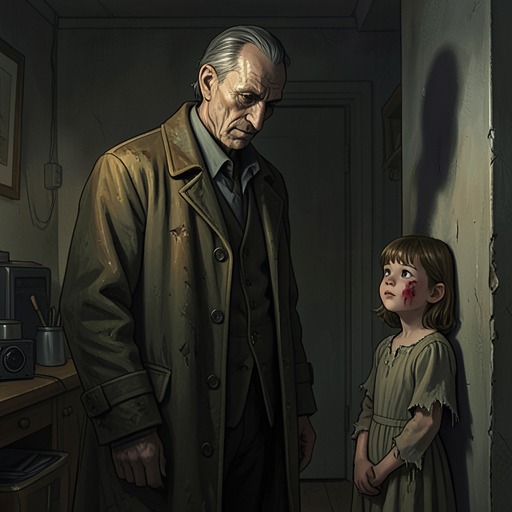
Tommy
Doctor SleepTommy is a toddler whom Dan Torrance encounters in Wilmington while Dan is drinking heavily and using drugs. His appearance transforms a moment of private desperation into an encounter with a vulnerable child: Dan notices signs of harm, intervenes when Tommy reaches toward cocaine, and later sees him again in visions that make the child impossible to dismiss. Tommy’s brief role exposes the distance between Dan’s self-protective drift and the responsibility he is not yet able to accept.
Identity and First Appearance
Tommy appears to be about eighteen months old. When Dan turns from his mother’s purse, where he has taken money, the child is standing nearby in an Atlanta Braves shirt that hangs nearly to his knees. Tommy identifies his mother as the person he has come from, and Dan recognizes the word as an answer even though it does not explain how the child arrived. The scene places Tommy’s dependence in immediate view: he is too young to care for himself, and he seeks the person he recognizes as his mother.
The encounter unfolds against Dan’s acute need for alcohol and his recent drug use. Tommy reaches toward the white powder on the table, using a child’s pronunciation for candy. Dan understands the danger and lifts him away. The interruption is decisive because it makes Dan respond to someone else’s need at the very moment his own addiction is organizing his attention around the drug. His action does not undo what has already happened to Tommy, but it is a brief, concrete act of protection.
Signs of Harm and Dan’s Response
As Tommy reaches toward the powder, Dan sees bruises on his upper arm. Lifting the child, he has a sudden mental image of the woman whose photograph he has seen in a wallet picking Tommy up and shaking him; later, when Tommy returns to his mother, Dan notices additional bruises on his legs. The evidence supports Dan’s suspicion of abuse, though the scene does not establish every circumstance behind the injuries. Tommy’s smallness and the marks on his body make his vulnerability tangible without giving Dan a clear way to solve the danger.
Dan carries Tommy into the bedroom, where the child immediately calls for his mother and crawls beside her. Deenie is asleep, but she puts an arm around him and holds him. This moment complicates the scene rather than reassuring Dan: Tommy seeks comfort from the person he knows, while the bruises and Dan’s disturbing image have already raised the possibility that he is not safe. Dan has acted to keep Tommy from the drugs, but he leaves the encounter without resolving the larger threat.
Recurrence and the Haunting
Tommy returns in Dan’s thoughts after Dan has gone outside to sleep, intoxicated and temporarily pleased with the course of his night. The remembered child appears reaching toward the drug, with his bruised arm and blue eyes fixed in Dan’s mind. That recurrence breaks into Dan’s chosen account of himself: he has told himself that the evening is fine, but Tommy’s presence gives the night an unresolved moral weight. The child is no longer simply someone Dan happened to see; he is the detail that Dan’s intoxication cannot keep erased.
Later, Dan wakes to find Tommy’s apparition beside him in bed. The child bears a severe head wound and reaches toward Dan, again asking for candy. Dan’s terror and the apparition’s injured appearance make this vision markedly different from the earlier encounter. The text presents Tommy’s return as a supernatural experience, but it does not give Dan a complete explanation of what happened to the child. What is clear is the effect: Tommy’s repeated appearance turns Dan’s suspicion and unease into a haunting, and the same request that once drew Dan’s attention to the drugs now becomes inseparable from the image of a child in danger.
Narrative Significance
Tommy’s role is brief, but his scenes expose the costs hidden by Dan’s attempt to treat his life as a temporary descent from which he can simply move on. The sequence connects Dan’s taking of money, his drug use, his recognition of a child’s immediate danger, and the visions that follow. Tommy does not cause Dan’s addiction, and the text does not present him as a solution to it. Instead, his vulnerability interrupts Dan’s self-absorption and leaves behind a responsibility that Dan cannot silence merely by getting high.
Later, Dan tells Abra Stone about violence in his own family: Don Torrance attacked his wife, and Jack Torrance later assaulted Dan’s mother. That history belongs to a separate family line from Tommy’s story, and the book does not identify Tommy as part of it. Read alongside Dan’s account, however, Tommy’s appearance belongs to the novel’s wider attention to violence and the fear that it may recur. Dan’s response to Abra is not to treat inherited urges as destiny; he acknowledges their force while urging her to face them. Tommy’s scenes earlier make the need for such attention painfully specific: a child’s danger can be glimpsed, but recognizing it does not by itself guarantee that the harm will end.