True Knot steam canisters
Doctor SleepTrue Knot steam canisters are portable stores of the steam the True Knot consumes to sustain itself. They turn the group’s predatory dependence into something that can be kept, carried, rationed, and spent. Their practical value is inseparable from their scarcity: the True Knot stores what it does not immediately use, yet still never has enough. In Rose the Hat’s hands, a canister can be both a dwindling reserve and the means to make a psychic attack.
Function and Scarcity
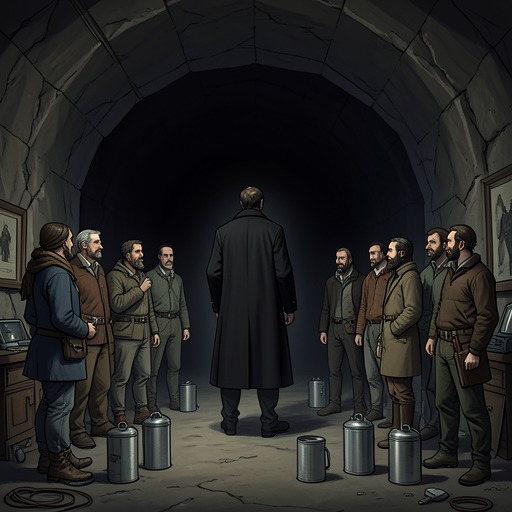
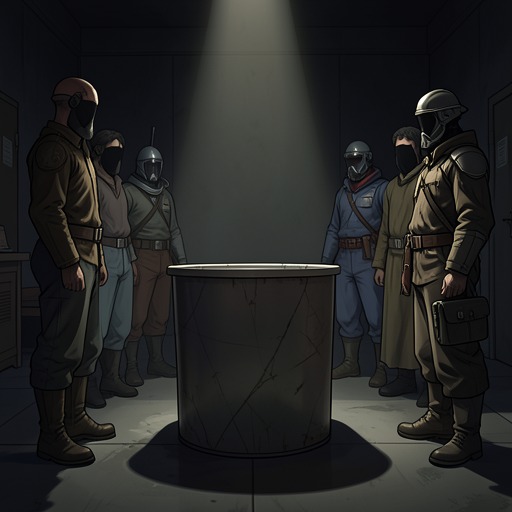
Abra learns that the True Knot breathes in the steam released when children with the shining die, and that the group stores unused steam in containers she compares to thermoses. She also recognizes that storage does not solve the underlying shortage: like sharks that must keep moving in search of food, the True Knot remains hungry. The canisters preserve a resource, not security. Their existence makes the group’s dependence visible as logistics—something that must be gathered and conserved—while their limited contents keep that dependence urgent.
That urgency is tied to the True Knot’s pursuit of Abra. Rose wants to capture her and obtain her steam, treating the child as a prospective source for a group whose reserves are inadequate. The canisters thus connect the True Knot’s method of survival to its continuing hunt: stored supply can be carried forward, but it cannot replace the search for more.
A Measure of Care for Grampa Flick
At Bluebell Campground, where the True Knot conceals itself behind the appearance of a campground business, Rose keeps a canister in a compartment beneath the floor. When she worries that Grampa Flick may be cycling, she orders Crow Daddy to have Walnut examine him thoroughly and to give him the steam remaining in the canister. Crow questions the decision, arguing that the reserve would be pointless if Flick is already cycling.
Rose insists that he receive it anyway. The True Knot has had a good year, she reasons, and can afford the expense; more personally, the group has only one Grampa, a survivor from a far older world, and she does not want to lose him if there is a chance of helping. Her decision makes the canister more than a ration to be allocated by immediate utility. By spending its contents on Flick despite uncertainty about the outcome, Rose asserts a limit to the group’s calculations of usefulness and survival.
Rose’s Psychic Use of a Nearly Empty Canister
Later, Rose prepares to reach Abra in Anniston. At one thirty on Monday morning, while most of the True Knot sleeps, she holds a printed picture of Anniston’s modest downtown in one hand and a canister in the other. The container has almost no steam left—only a faint trace—but Rose believes that trace will suffice. She loosens the valve, inhales the brief release, and lets the canister fall onto the carpet as she turns her attention to the picture.
The printed image helps orient her search, but it does not supply the psychic connection. Rose uses what she already knows from seeing Sam’s Supermarket: Abra has encountered her presence there and carries a sense of what Rose feels like. Following that marker, Rose finds the supermarket in her mind and moves through its remembered sounds and spaces toward the girl. The nearly empty canister has therefore served as a means of access, not as a lasting reserve: a small remainder is enough for Rose to begin the intrusion she intends.
Significance
The canisters give the True Knot’s otherwise uncanny hunger a material form. Steam can be stored, hidden beneath a floor, handed over to care for a vulnerable elder, or released to support Rose’s attempt to reach a child. Each use exposes a different pressure within the group: chronic shortage, loyalty to its oldest member, and the pursuit of new victims. Their contents are precious precisely because they are finite, and every decision about them makes the True Knot’s dependence—and the cost imposed on others to sustain it—more concrete.