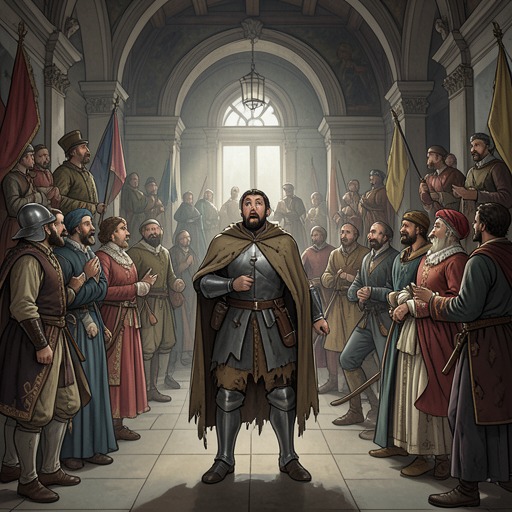
Altisidora
Don QuixoteAltisidora is a damsel in the Duchess’s household whose bold performance of unrequited love becomes one of the court’s staged jokes at Don Quixote’s expense. She sings and laments as he prepares to leave, later appears to die from his supposed cruelty, and finally admits that the spectacle was make-believe. The prank depends on a sharp contrast: Altisidora knows she is acting, while Don Quixote reads her gestures as evidence of genuine devotion and answers them through the rules of chivalric love.
Position in the Duchess’s Household
Altisidora belongs to the Duchess’s household and has enough freedom within it to address Don Quixote publicly and provocatively. Her performance takes place before the household as he departs the castle in full armour, with Sancho Panza mounted on Dapple. The Duchess knows Altisidora as bold, lively, and impudent, but is surprised by how far she goes in this scene. That surprise helps make the episode feel like an improvised breach of decorum, although the later account reveals that Altisidora’s apparent love and death are part of the Duke and Duchess’s organized entertainment.
The role gives Altisidora a conspicuous voice. Rather than leave her supposed passion to private hints, she turns it into a public lament, addressing Don Quixote as he rides away and presenting herself as a tender, abandoned victim. The poem invokes classical and romantic comparisons, and its exaggerated pathos makes the complaint theatrical. Her display places her at the center of the departure, but its intended comic effect depends on Don Quixote treating the performance not as playacting but as a genuine declaration.
The Departure Performance
As Don Quixote prepares to leave, Altisidora sings that he is fleeing from a tender lamb rather than a dragon and accuses him of having jilted a maiden of exceptional beauty. The song’s mock-heroic register turns an ordinary farewell into a scene of courtly accusation. Don Quixote does not answer her directly. Instead, he turns to Sancho and asks whether he has taken the three kerchiefs and the garters Altisidora has mentioned. Sancho admits to having the kerchiefs but denies taking the garters.
The Duke joins the performance by accusing Don Quixote of violating the hospitality he has received and challenging him to mortal combat unless the garters are restored. Don Quixote refuses to draw his sword against a host from whom he has received favours. He agrees to return the kerchiefs, but denies possessing the garters and insists that Altisidora should search her own hiding places. He also treats her complaint as evidence of love, arguing that her affections are not his fault and that he has no need to ask pardon for them. The Duchess tells him to continue his journey and promises to chastise her damsel for transgressing with her eyes and words.
Altisidora then reverses the accusation: she asks Don Quixote’s pardon for accusing him of stealing the garters, which, she says, she has been wearing all along. She compares her mistake to searching for an ass while already mounted on it. Sancho turns the admission into a defense of his own honesty, and Don Quixote leaves the castle with Sancho following. The exchange resolves the immediate dispute while preserving the larger joke: a supposed theft, a threatened duel, and a confession all serve as parts of a flirtation that Don Quixote continues to interpret in earnest.
A Lover in Don Quixote’s Imagination
After the departure, Don Quixote keeps returning to Altisidora’s apparent feelings. He asks Sancho whether she wept when he left or had already forgotten her love. Sancho says that he had other matters to think about and treats the question as foolish, but Don Quixote distinguishes love from gratitude. In his account, a knight may resist love, but cannot properly be ungrateful; Altisidora’s tears, curses, public lament, and the kerchiefs are, to him, signs that she adored him.
Don Quixote does not understand this supposed affection as a reason to abandon Dulcinea del Toboso. He says that his treasures are already devoted to her and that he cannot offer Altisidora a lover’s return. At most, he can give her a place in his memory without displacing Dulcinea. His reasoning converts the staged episode into a moral problem about constancy and gratitude. The distinction is sincere even though its premise is false: he treats Altisidora’s performance as a real attachment and answers it with the seriousness of a knight defending his fidelity.
The Catafalque and the Confession
The court later stages Altisidora’s death and revival. The Duke’s servants bring Don Quixote back to the castle, where Altisidora is laid out on a catafalque amid a carefully arranged spectacle. In the scene, Sancho is dressed in a black robe painted with flames and given a mitre; attendants pinch and prick him as part of the supposed ceremony. A singer performs verses about Altisidora’s death and anticipated return to life, while the assembled company declares that Sancho must undergo penance to restore her. When Altisidora turns onto her side, the bystanders announce that she is alive, and Don Quixote urges Sancho to perform the lashes he believes are required to disenchant Dulcinea.
The farce continues the pattern of making Sancho bear the physical cost of other people’s supposed enchantments. Sancho objects to being pinched, slapped, and pricked, and resists Don Quixote’s attempt to turn Altisidora’s revival into an occasion for whipping. By the next morning, Altisidora appears in Don Quixote’s chamber wearing the garland from the catafalque and a white robe embroidered with gold flowers. Don Quixote is so disconcerted that he huddles under the bedclothes and cannot offer her a civil greeting. She tells him that she had been dead for two days, overcome by grief at his cruelty.
Don Quixote again explains that his heart belongs to Dulcinea del Toboso and that no other woman can take her place. Altisidora’s answer breaks the fiction: with anger, she declares that the events of the night were make-believe and that she did not die for him. Her sudden change from professed, death-defying passion to open insult exposes the performance’s constructed nature. Altisidora’s role in the prank is therefore both comic and revealing: she helps the court manufacture an apparent miracle, while Don Quixote’s unshaken interpretation shows how completely he converts staged gestures into evidence for the chivalric world he inhabits.