Andres
Don QuixoteAndres is a fifteen-year-old servant whose treatment reveals the gap between Don Quixote’s confidence in knightly justice and the vulnerable person left to bear the consequences. First found tied to an oak and being flogged over a dispute about unpaid wages, Andres is freed by the newly dubbed knight—but his employer beats him again as soon as Don Quixote rides away. Their later meeting gives Andres the chance to tell what the supposed rescue actually cost him.
Identity and First Encounter
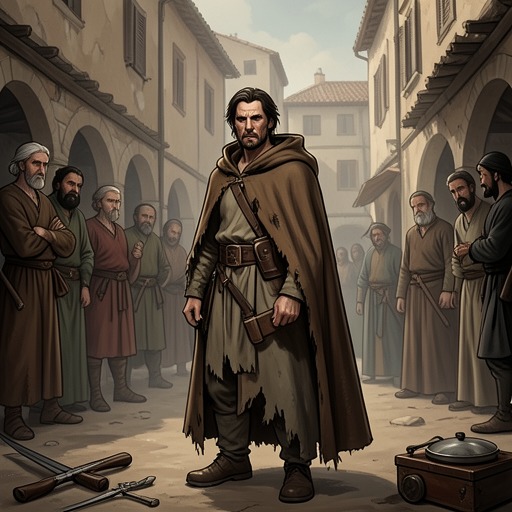
Andres watches a flock of sheep for Juan Haldudo the Rich, a farmer from Quintanar. When Don Quixote hears cries from a thicket, he finds Andres tied to an oak, stripped from the waist up, while his master strikes him with a belt. The farmer says the boy is careless and loses a sheep every day; Andres’s account is that he is being punished for asking for the wages owed to him. The immediate scene therefore turns on two competing explanations for the beating, and on the young servant’s inability to defend himself by force.
Don Quixote treats Andres’s plight as an opportunity to fulfill the duty he believes his new knighthood imposes. He challenges the farmer to take up his lance and face him, then demands that Andres be released and paid. Asked to calculate the debt, Andres states that he has served nine months at seven reals a month: sixty-three reals. Juan Haldudo tries to reduce that amount by claiming credit for three pairs of shoes and two bloodlettings. Don Quixote rejects the deductions, arguing that the blows inflicted on Andres outweigh the value of the shoes and medical treatment. His reasoning recasts the farmer’s alleged counterclaims as no excuse for the bodily harm.
The farmer says that he has no money with him and proposes taking Andres home to pay him there. Andres immediately objects that, once alone with his master, he will be beaten again. Don Quixote nevertheless trusts his own authority: he orders the farmer to keep his word and leaves Andres in his hands, believing that a promise sworn under the authority of knighthood will secure payment. Andres points out the decisive problem: his master is no knight, but Juan Haldudo the Rich. The mismatch between the knight’s imagined guarantee and the actual power relationship is present before Don Quixote departs.
The Failed Rescue
Juan Haldudo swears to pay the debt, real by real, and Don Quixote insists that the payment be made in money rather than in the promised perfumery. Before riding away, the knight threatens to return and punish the farmer if he breaks his oath, identifying himself as Don Quixote of La Mancha and the undoer of wrongs and injustices. The declaration gives the departure the shape of a successful judgment: Andres has been untied, the debt named, and the offender warned.
Once Don Quixote is out of sight, however, the farmer ties Andres to the oak again and gives him a worse flogging. He mocks the knight for having been made a fool of and says that, because he cannot take revenge on Don Quixote, his anger falls on Andres. Afterward, he releases the boy and tells him to find the judge who pronounced the sentence. Andres leaves weeping; he vows to seek Don Quixote and says the debt will have to be repaid sevenfold, while the farmer laughs. The promised payment has not been made, and the intervention has brought Andres a harsher beating rather than protection.
Don Quixote rides away satisfied, convinced that he has righted a great wrong. That confidence makes the outcome more than a failed attempt at collecting wages: the knight mistakes the appearance of obedience for an effective change in Andres’s circumstances. The separation is crucial. His warning carries no force once he is absent, and Andres, not the powerful farmer, suffers the immediate consequences of the confrontation.
Andres Corrects the Story
Some days later, Andres encounters Don Quixote again while the knight and his companions have stopped beside a spring. He recognizes Don Quixote, runs to him, clasps his legs, and weeps. Don Quixote presents Andres to the company as proof that knight-errants are necessary to redress the wrongs committed by tyrannical men. He recounts the oak, the beating, and the promise to pay, and asks Andres to confirm that the farmer submitted to his commands.
Andres confirms the events but immediately corrects their supposed ending. Juan Haldudo did not pay him; once Don Quixote had left, he tied Andres to the same oak and beat him again, joking as he struck him about having fooled the knight. Andres explains that his injuries kept him in a hospital until this meeting. He also disputes the assumption that Don Quixote’s intervention had helped: without it, he says, his master would have given him only a dozen or two lashes, then released him and paid what he owed. In his account, the knight’s insults inflamed the farmer, who, unable to retaliate against Don Quixote, took his anger out on his servant.
Don Quixote accepts one part of this correction, saying that the fault lay in his leaving before he had seen Andres paid. He renews his promise to find the farmer and secure both vengeance and payment. Andres, now armed with experience of what the earlier oath achieved, says he has no faith in such promises. Rather than more revenge, he asks for food to help him get to Seville. Sancho Panza gives him bread and cheese, describing the company as sharing in his misfortune. The modest gift answers an immediate need without pretending to settle the unpaid debt or undo the beating.
Character and Narrative Role
Andres appears in two encounters that frame the difference between rescue as Don Quixote imagines it and help as the victim experiences it. In the first, he identifies the danger of returning alone with his master, but the knight’s confidence overrides that warning. In the second, Andres supplies the missing consequence himself: he describes the renewed flogging, the hospital stay, and the reason the farmer’s anger intensified. His testimony forces the earlier episode to be reconsidered from the position of the person who remained behind.
His speech is practical and pointed. Andres does not merely repeat that the farmer broke his word; he explains how the intervention altered the punishment and why Don Quixote’s promise has lost credibility. His request for food rather than another vow makes the distance between grand declarations and immediate need especially clear. The account does not report whether he receives his wages or whether Don Quixote later finds Juan Haldudo. Andres’s story instead leaves the injustice unresolved, while making the cost of the knight’s premature departure unmistakable.