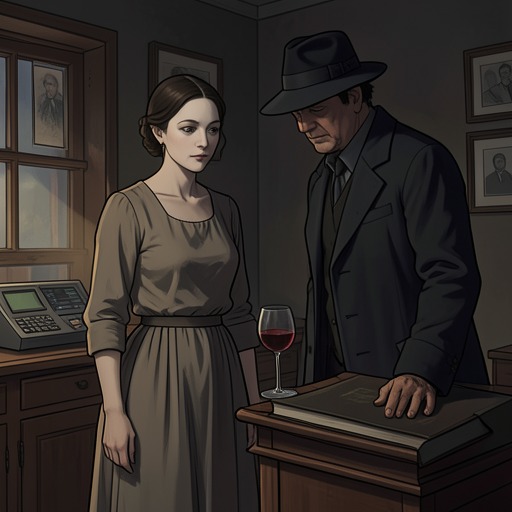
Anselmo and Camilla’s marriage undone by the chastity test and elopement
Don QuixoteAnselmo and Camilla’s marriage undone by the chastity test and elopement is a tragic relationship in which a husband’s demand for certainty turns trust into an experiment. Anselmo asks his friend Lothario to test Camilla’s fidelity, then mistakes a carefully staged appearance of virtue for proof. The resulting deception does not preserve the marriage: it conceals the breach of trust until discovery drives Camilla from the household, and Anselmo’s belated recognition ends with his death. The story presents the marriage’s collapse as the consequence of Anselmo’s own ill-advised curiosity, not simply as a failure of Camilla’s fidelity.
Marriage and the Demand for Proof
Anselmo’s confidence in Camilla is bound up with his desire to verify her virtue. By the time Lothario reports that Camilla may agree to meet him, Anselmo already believes she has defeated the advances he had arranged. Lothario counsels him to pretend to leave home for two or three days and hide in a closet, where he can observe what happens. He also urges Anselmo to wait rather than act precipitately, presenting concealment as a way to judge the matter with his own eyes. Anselmo is astonished by this advice, but accepts it and entrusts Lothario with keeping the plan secret.
That decision changes the terms of the marriage. Instead of relying on Camilla’s conduct within their relationship, Anselmo makes her fidelity an object of surveillance and turns Lothario into both the tester and the keeper of the test. The arrangement gives the husband the appearance of control while placing the marriage’s confidence in the hands of the very friend who reports the danger. The episode’s irony is structural: Anselmo seeks a demonstration that will secure his peace of mind, but the method depends on secrecy and performance, making honest trust harder rather than stronger.
The Staged Proof
Anselmo watches a scene in which Camilla and her attendant Leonela act out a crisis. The performance is convincing enough that he believes Camilla’s reputation has been defended and that her apparent injury is a minor matter to be concealed. He leaves the house eager to share his happiness with Lothario and embraces him as the friend whose skill has helped establish Camilla’s purity. Lothario, however, cannot share that satisfaction: he knows Anselmo has been deceived and that he himself has wronged his friend.
The deception continues for a time. Anselmo brings Lothario home by the hand, believing that he is welcoming the agent of his good fortune; Camilla receives Lothario with averted countenance, while inwardly smiling. Anselmo interprets the apparent proof as confirmation of the very certainty he sought, and even imagines that Camilla’s name can be preserved in verses. The contrast between his confidence and Lothario’s knowledge makes the scene a portrait of trust already broken but not yet publicly exposed. The marriage appears intact because its central fact remains hidden from the husband.
Discovery and Flight
The concealment fails when Leonela’s private circumstances threaten to reveal what she knows. Anselmo discovers a young man escaping through a window and confines Leonela, insisting that she tell him what she knows. She asks for time, promising an explanation the next day. Camilla understands the danger differently: fearing Leonela will disclose her own faithlessness, she does not wait to learn whether her suspicion is correct. That night she gathers her most valuable jewels and some money, leaves the house unseen, and goes to Lothario, asking him either to take her somewhere safe or to flee with her.
Lothario is initially unable to answer. He eventually takes Camilla to a convent where his sister is prioress, then leaves the city without telling anyone where he has gone. In the morning, Anselmo finds Leonela gone as well: knotted sheets at the window show that she escaped. He then notices the open boxes and missing jewels, and understands that Leonela was not the cause of his misfortune. The evidence he had once demanded has arrived, but only after Camilla and Lothario have left and the household has broken apart. His experiment has not given him timely knowledge or a means to repair the marriage; it has brought him to recognition after the possibility of reconciliation has receded.
Anselmo’s Last Recognition
After hearing news that confirms his disgrace, Anselmo goes to a friend’s house, appears pale and worn, and asks to be left alone with writing materials. He senses that he is dying and tries to write an account of the cause. His unfinished declaration identifies a foolish, ill-advised desire as what has robbed him of life. He asks that Camilla be told he forgives her, reasoning that she was not bound to perform miracles and that he ought not to have required them. He also recognizes himself as the author of his own dishonor, but dies before completing the statement.
That unfinished writing gives the marriage a final, altered interpretation. Anselmo does not present Camilla as responsible for meeting an impossible standard; he acknowledges that the demand itself was his mistake. His forgiveness arrives only when he can no longer speak to her directly or restore their shared life. The attempt to make virtue certain has instead made confidence impossible, and his final understanding cannot undo the choices that led to the separation.
Aftermath and Significance
Camilla remains in the convent after Anselmo’s death. She does not take the veil immediately, and news of Lothario’s departure affects her more directly than the news that she is a widow. Lothario has gone to the kingdom of Naples, where he is later killed in battle. After learning of his death, Camilla takes the veil and dies not long afterward, worn down by grief and melancholy. The account closes by connecting the deaths of all three to a thoughtless beginning: the original test set in motion the deception and separations that neither Anselmo’s forgiveness nor the eventual deaths can reverse.
The relationship is therefore defined by a distinction between apparent proof and trust. Anselmo’s plan treats fidelity as something that can be tested without cost, yet the test changes the relationships it is meant only to measure: it makes Lothario a participant in the marriage’s deception and leaves Camilla’s conduct concealed behind a scene Anselmo misreads. When the truth emerges, the marriage has no surviving basis on which to resume. Its tragic force lies in the distance between Anselmo’s early certainty, his delayed recognition, and the irreversible consequences of trying to turn another person’s virtue into an experiment.