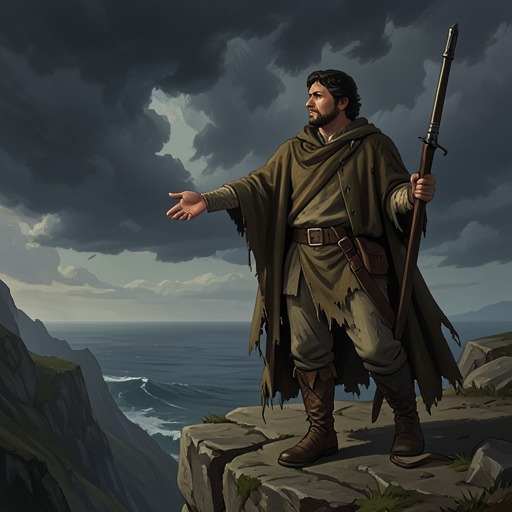
Basilio
Don QuixoteBasilio is the poor, exceptionally capable young man whose long-standing love for Quiteria is placed against her father’s preference for a wealthy match. At the wedding planned for Quiteria and Camacho, Basilio turns apparent despair into a calculated intervention: he seems to wound himself fatally, asks Quiteria to marry him, and reveals the trick only after she agrees. His success reverses the expected wedding, exposes the couple’s apparent understanding, and brings the disappointed Camacho’s supporters into conflict with Basilio’s defenders.
Identity and Circumstances
Basilio is a young man from Quiteria’s village, where he grew up next door to her parents’ home. He and Quiteria loved one another from childhood, and their attachment became a familiar subject of local talk. The student who recounts their story presents Basilio as a person of unusual natural gifts but limited fortune: he is poor in comparison with Camacho, whom the narrator describes as the richest man in the region. His abilities make the mismatch between talent and wealth conspicuous. Basilio is agile, excels at throwing the bar and wrestling, runs quickly, leaps with ease, and is accomplished at bowling. He sings well and plays the guitar with skill; the student also singles out his swordsmanship as outstanding. These accomplishments do not secure him social or economic standing sufficient to satisfy Quiteria’s father. The contrast between what Basilio can do and what he possesses shapes the obstacle to his marriage.
Love and the Obstacle to Marriage
Basilio’s relationship with Quiteria begins before either is grown. Their mutual affection is described as having been expressed through modest signs, and the village knew of it. Their proximity made the attachment easy to sustain, but it did not give Basilio lasting access to Quiteria: as they grew older, her father decided to keep him away from the house. Seeking to put an end to his suspicions, he arranged for Quiteria to marry Camacho instead. The father’s decision turns an existing childhood bond into a contest between love and a match grounded in wealth. He does not consider Basilio suitable because Basilio lacks Camacho’s fortune, despite his natural abilities. Quiteria is eighteen and Camacho twenty-two, and the student says that some people consider Quiteria’s family lineage superior; nevertheless, Camacho’s wealth weighs heavily in the marriage arrangement. Basilio is therefore not simply a rejected admirer: he is the partner in a mutual attachment displaced by a decision made on economic and parental grounds. When Basilio learns of the coming wedding, his outward state appears to confirm that he has been overcome by grief. He no longer smiles or speaks rationally, eats little, and sleeps little, if at all. He lives on fruit and sleeps outdoors on the hard ground. At times he stares upward; at others he fixes his gaze on the earth so abstractedly that observers compare him to a clothed statue. The villagers take these signs as evidence that Quiteria’s expected assent to Camacho will kill him. That reputation for despair supplies the circumstances in which Basilio makes his intervention believable.
The Wedding Intervention
At the gathering for Quiteria and Camacho’s wedding, Basilio speaks as though he intends to remove himself from the couple’s path and accepts his own death as the consequence of being poor. He takes up a staff planted in the ground; it conceals a rapier, and he leaves part of the staff fixed in place. He then appears to fall upon the weapon. Don Quixote dismounts from Rocinante and supports him, while those around Basilio try to help. The curate objects to drawing out the blade before Basilio has confessed, fearing that its removal will cause his death. Basilio revives enough to make his request directly to Quiteria: he will not confess unless she first gives him her hand in marriage. The curate urges him to attend to his soul, but Basilio insists that marriage would calm and strengthen him. Quiteria agrees to be his wife whether he lives for years or is carried from her arms to the grave. The curate then blesses the couple and prays for Basilio’s soul, treating the apparent wound as life-threatening.
Revelation and Consequences
Once the blessing is given, Basilio rises and pulls out the rapier. Those present are astonished, and some call the apparent escape a miracle. Basilio identifies it instead as a trick. Examination shows that the blade passed through a hollow iron tube, not his flesh and ribs; the tube held blood prepared so it would not congeal. The apparent crisis was staged to make Quiteria’s consent possible before the wedding could proceed as planned. The curate, Camacho, and many guests recognize that they have been deceived. Quiteria, however, does not show displeasure; when the validity of the marriage is questioned, she confirms it again. Those present consequently conclude that the plan was arranged between Basilio and Quiteria. The revelation changes the scene from a threatened death and an appeal to pity into a successful, mutually intended marriage, though it does not settle the public conflict peacefully. Camacho and his supporters, mortified by the outcome, turn to violence. Several draw their swords against Basilio, and an equal number unsheathe theirs to defend him. Don Quixote takes the lead on horseback, lance and shield ready, and forces the combatants to give way. Sancho Panza avoids the fighting and retreats to the wine-jars. Basilio’s maneuver thus succeeds in winning Quiteria’s hand, but its exposure immediately makes the wedding a confrontation between opposing groups. His role joins romantic determination to theatrical deception: he uses the very expectation of his death to secure the choice that wealth and parental arrangement had denied him.