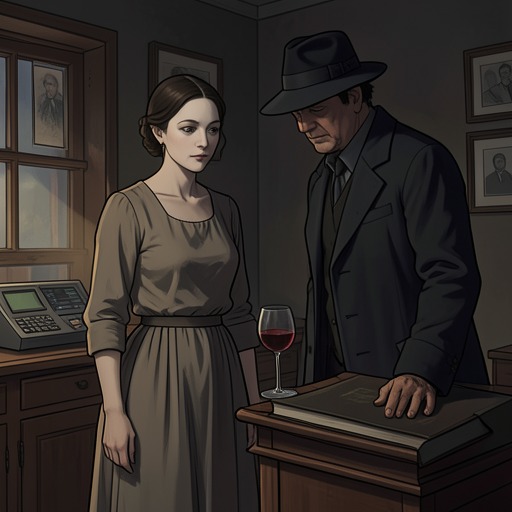
Camilla's Feigned Attack on Lothario and Self-Wounding
Don QuixoteCamilla's Feigned Attack on Lothario and Self-Wounding is a staged test within Anselmo's test of his wife's fidelity: Camilla performs the part of a woman defending her honor, while Anselmo secretly watches and mistakes the performance for proof. The scene's decisive irony is that her apparent resolve to punish Lothario and protect her husband depends on an arrangement with the very people whose conduct she claims to condemn.
Causes and Arrangement
Anselmo has left under the pretence of visiting Lothario's country house, then secretly returned and hidden himself to watch Camilla. His willingness to observe rather than openly address his suspicions makes the closet a private theatre: Camilla knows she is being watched, and Anselmo believes he is witnessing an unprepared revelation. Leonela assists the plan, giving Camilla the opportunity to enact it while Anselmo remains concealed.
Before Lothario arrives, Camilla tells Leonela to summon him and presents the dagger as an instrument of vengeance. She insists that she will first confront the man whose advances, as she represents them, have insulted her loyalty to Anselmo. Leonela answers in the role of a worried attendant, warning against both self-harm and the danger of admitting a determined man into the house. Her apparent caution supports the impression that Camilla's threat is spontaneous and real, although she is helping to shape the deception.
Anselmo listens from his hiding place. Camilla's words begin to change his judgment: he is moved by what seems to be her defence of their marriage. When he hears that Lothario may be killed, he nearly emerges to stop the danger, but restrains himself because he wants to see how the scene ends. That hesitation keeps him inside the fiction Camilla and Leonela are constructing, and makes him a witness whose presence is essential to the performance.
The Staged Confrontation
Leonela brings Lothario into the room. Camilla draws a line on the floor with the dagger and warns him not to cross it, presenting the boundary as a condition of her safety. She asks whether he knows Anselmo and how he regards him, and whether he knows her. Lothario understands that Camilla wants Anselmo to hear a particular exchange; he follows her design, answering in a way that makes his apparent confession of disloyalty part of the act.
Camilla then delivers a sustained accusation. She represents herself as having rejected Lothario's professions, promises, and gifts, while admitting that she may have been insufficiently guarded and could have encouraged hope without intending to. The admission makes her performance more persuasive: rather than claiming perfect foresight, she appears to accept a share of blame and to impose a penalty on herself. She declares that her husband's honor has been injured by Lothario and that she must answer for any carelessness of her own.
The scene turns from words to action when Camilla rushes at Lothario with the dagger. Her attack appears serious enough that Lothario is briefly uncertain whether the threat is genuine. He restrains her, allowing her to redirect the dagger and make a slight wound high on her left side, near the shoulder. She then falls as if fainting. The controlled extent of the injury sustains the appearance of sacrifice without producing the fatal outcome her earlier threats suggested.
Witness, Wound, and Cover Story
Leonela and Lothario react with apparent alarm. Lothario removes the dagger, sees that the wound is slight, and resumes his assigned role by lamenting over Camilla as though she were dead. He speaks in a way calculated for Anselmo to hear, making his grief part of the evidence that he and Camilla are victims of a tragic misunderstanding. He then leaves, saying that he will go where he will not be seen again. Once alone, however, he marvels at Camilla's composure and Leonela's consistent acting, and anticipates meeting Anselmo to share in the success of their deception.
Leonela tends the wound and stops the limited bleeding. Her words and manner continue to reinforce the image Anselmo is meant to see: Camilla as a model of purity, distressed that she did not carry her resolve further. Camilla adds to this impression by calling herself weak for not having gone further in her supposed attempt to end her life. The contrast between the small, deliberately limited injury and the language of extreme self-sacrifice is central to the scene's method: Anselmo is invited to read a managed act as unpremeditated proof.
Camilla asks whether she should tell Anselmo what happened. Leonela advises against it, arguing that disclosure would oblige him to seek vengeance on Lothario and risk a quarrel. Camilla agrees to follow that advice, while recognizing that the visible wound will need an explanation. The exchange extends the conspiracy beyond the staged attack: concealment after the scene is part of the plan, and the two women must account for the physical trace left by their performance.
Dramatic Irony and Consequence
The episode separates what Anselmo sees from what the reader knows. To Anselmo, the dagger, the apparent assault, Camilla's wound, and Lothario's lamentations form a sequence that confirms his wife's virtue. The reader, by contrast, has seen Camilla and Leonela coordinate the scene and knows that Lothario understands his role. The same details therefore function in opposite ways: for Anselmo they are evidence of sincerity; for the reader they are evidence of how carefully sincerity has been imitated.
Camilla's performance also exploits the terms on which Anselmo has set his test. She turns his hidden observation into an audience for an invented crisis, while using his concern for her safety to make the acting persuasive. Her apparent readiness to sacrifice herself gives the performance its greatest force, but the scene shows that this readiness is itself staged and limited. The episode's immediate outcome is a convincing display of fidelity, not an open reconciliation or confession: Camilla's wound must be explained, and the decision to keep Anselmo uninformed preserves the deception rather than resolving the distrust that produced it.