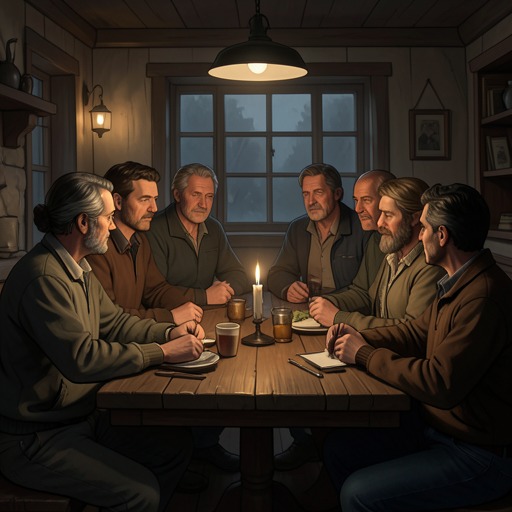
Cardenio and Luscinda’s love and reunion after separation
Don QuixoteCardenio and Luscinda’s love and reunion after separation is defined by a decisive recognition scene: each identifies the other by voice before they can meet face to face. Luscinda’s constancy becomes public when she names Cardenio as her true husband and refuses to let Don Fernando’s hold on her determine her allegiance. Their reunion, witnessed by Dorothea and Don Fernando, ends with Cardenio and Luscinda together again and Don Fernando accepting Dorothea.
A Love Interrupted
Cardenio and Luscinda’s relationship is disclosed at the inn through a chain of recognition and explanation rather than through a private meeting. A veiled woman, held back by Don Fernando, answers an accusation by insisting on her truthfulness. Cardenio hears her voice from a nearby room and immediately wonders who has spoken. The voice reaches him before the woman’s face is visible, making sound the first sign that their separation may be ending.
The woman is Luscinda. Her veil falls during the commotion, but Cardenio has already recognized her voice and tried to reach her. Don Fernando prevents her from moving, while her effort to enter the room makes the scene’s opposing claims visible: she is physically held by one man, yet her attention and remembered attachment turn toward another. The discovery is not simply that Cardenio and Luscinda are present in the same place. It is that their bond remains legible to each other despite the barriers between them.
Recognition and Declaration
A cry from Dorothea brings Cardenio out of the room. Thinking the cry may have come from Luscinda, he emerges in alarm and sees Don Fernando holding her. Don Fernando recognizes Cardenio as well. For a moment the three, with Luscinda, stand in silence, each looking toward the person whose presence has altered the situation. The sequence gives recognition a reciprocal force: Cardenio hears Luscinda, Luscinda responds to Cardenio’s voice, and Don Fernando sees the rival whose claim she has not abandoned.
Luscinda addresses Don Fernando directly and asks him to release her. She describes herself as bound to Cardenio as ivy to its support, and insists that neither pressure nor promises have detached her from him. She identifies Cardenio as her true husband and says that death alone could erase him from her memory. Her declaration makes the distinction between possession and relationship unmistakable: Don Fernando can hold her, but she does not accept that hold as a marriage or as a reason to cease loving Cardenio.
Her words also refer to a written declaration that had already established her commitment. Don Fernando later explains that he found a paper in Luscinda’s bosom declaring that she was Cardenio’s wife and could never be his. The document had revealed what she now says aloud: the relationship Don Fernando seeks to impose cannot displace her existing attachment. The reunion thus confirms, before the assembled witnesses, the truth that the writing had previously made known to him.
Reunion in Public
When Don Fernando releases Luscinda, she is too weak to remain standing. Cardenio, who has been close by, moves to support her and speaks to her as the beloved woman he had once been permitted to call his own. Luscinda recognizes him first by voice and then by sight. She embraces him without pausing over the decorum of the gathering, and calls herself his, even while acknowledging that adverse circumstances and further danger might still threaten them.
The embrace is the relationship’s central change of state: separation gives way to reunion in front of the people who had witnessed their uncertainty. Their private loyalty is no longer conveyed only through a letter, memory, or declaration. Cardenio supports Luscinda, and Luscinda returns his embrace; their actions confirm the words each has spoken. The onlookers are astonished, while Don Fernando appears to reach for his sword. Dorothea sees the danger and catches him by the knees, asking him to consider that she is there as his wife while Luscinda is in the arms of her husband. Her intervention prevents the recognition scene from turning into a renewed conflict.
Don Fernando’s Acceptance and the Outcome
Dorothea’s appeal places the two relationships side by side. She asks Don Fernando to let Cardenio and Luscinda live in peace rather than answer their reunion with anger. Her plea, joined by other arguments, moves him to accept what he cannot deny. He releases Luscinda and embraces Dorothea, acknowledging that he has wronged her and asking her not to reproach him. His acceptance makes the reunion possible without leaving the conflict unresolved: Cardenio and Luscinda can remain together, while Don Fernando turns toward the woman who has continued to claim him.
Cardenio and Luscinda then kneel before Don Fernando to thank him for releasing her. He raises and embraces them with courtesy, marking a shift from restraint and rivalry to public acknowledgment. The gathering’s response is emotional, but the ending is not only a general reconciliation. Each pair is distinguished: Cardenio and Luscinda are reunited through their declared fidelity, while Don Fernando accepts Dorothea after hearing her account and appeal. Their respective relationships are recognized together in the same room.
The scene gives Cardenio and Luscinda’s love its force through repeated proofs of constancy: a paper that identifies Luscinda as Cardenio’s wife, a voice recognized across a doorway, a declaration made under pressure, and an embrace that follows release. Their separation has made their bond difficult to enact, but it has not altered the allegiance each voices when they meet again. The public witnesses, and Don Fernando’s eventual acceptance, turn that allegiance into the basis for a peaceful outcome.