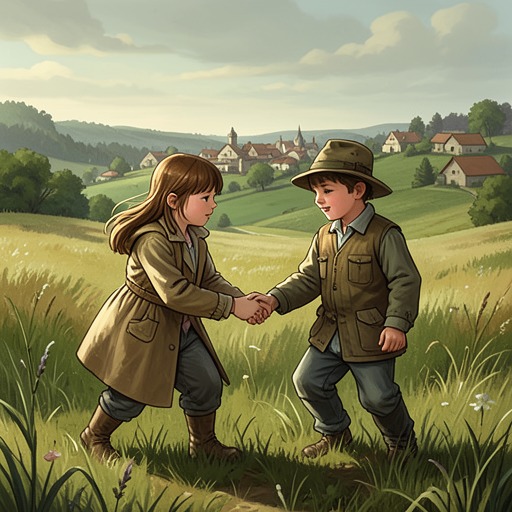
Cardenio's flight into the Sierra
Don QuixoteThe Knight of the Ragged Countenance’s flight into the Sierra Morena is the retreat that converts the collapse of his hopes for Luscinda into a life of prolonged isolation. After hearing her agree to marry Don Fernando, he leaves the city and seeks the most rugged part of the mountains, intending to end his life. Instead, he survives in a state of intermittent madness, sustained by goatherds who take pity on him. The episode is not a simple flight from danger: he turns away from immediate vengeance and directs the suffering inward, then discovers that neither solitude nor the landscape can erase the loss that drove him there.
The Wedding and the Decision to Leave
The flight begins at the wedding of Luscinda and Don Fernando, where the Knight of the Ragged Countenance is hidden from the household. He hears Luscinda answer affirmatively when asked whether she will marry Don Fernando. To him, that answer appears to destroy the hopes he had placed in their relationship. His account later makes clear that the scene is more complicated than he can understand at that moment: Luscinda had declared herself the Knight of the Ragged Countenance’s wife, although he does not yet know what the paper discovered on her person contains.
In the confusion that follows, he imagines that he could punish the people he regards as responsible for his ruin. But, as he tells Princess Micomicona Dorothea later, he chooses not to seek revenge against either Luscinda or Don Fernando. He instead leaves the house and rides away. The choice does not end his anger; it redirects it. He interprets the departure as a decision to make himself suffer rather than inflict a sudden punishment on others, and his later account treats that self-directed torment as a continuing, deliberate response to the perceived betrayal.
The Journey into the Mountains
The Knight of the Ragged Countenance rides through the night without turning back toward the city. Once alone in the open country, he gives voice to his grief and curses both Luscinda and Don Fernando. His blame of Luscinda shifts even as he speaks: he accuses her of choosing Don Fernando’s wealth and standing, but also considers how a young woman raised to obey her parents might have yielded when offered a husband of high birth and fortune. He can see reasons for her apparent choice, yet cannot reconcile those reasons with the promises he believes she made to him.
He travels through the remainder of the night and reaches a mountain pass by daybreak. He then wanders for three more days without taking a defined path. When he asks herdsmen where the roughest part of the range lies, he directs himself toward it, intending to die there. The journey therefore has a clear outward destination but no practical plan for return: the mountains are sought as a place of withdrawal and self-destruction, not as a refuge in which he expects to rebuild his life.
His mule dies from exhaustion and hunger as they make their way among the crags. Left without the animal, worn out and without assistance, the Knight of the Ragged Countenance collapses. He later understands that goatherds must have helped him during this period, because they tell him where they found him and report that he had been raving. The sequence reverses his purpose: he entered the mountains to end his life, but other people’s intervention preserves it, without restoring him to health or easing his grief.
An Intermittent Life in the Sierra
After the collapse, his reason does not return steadily. He says that he is conscious of periods in which he is not fully in possession of it, followed by episodes of uncontrolled distress in which he tears his clothes, cries out in the solitude, curses his fate, and calls on Luscinda. When his senses return, he finds himself exhausted. His condition is thus presented as a repeated cycle rather than a single breakdown: grief overwhelms him, the episode passes, and he becomes aware of its consequences without being able to prevent its recurrence.
His ordinary existence in the mountains is precarious. He takes shelter in the hollow of a large cork tree, while herdsmen and goatherds leave food along paths or on rocks where he may come across it. At times, even when he is not fully rational, the need for food draws him to what has been left. At other times, the goatherds say, he emerges onto the road and takes food from them by force, despite their willingness to give it. Their repeated assistance supplies the practical means of his survival, while his unpredictable behavior shows how little control he has over the life he has chosen.
The Flight Reconsidered
The account of the flight is told to Princess Micomicona Dorothea after she recounts her own misfortunes. Recognizing her as the daughter of Clenardo, the Knight of the Ragged Countenance identifies himself as the man whose wrongs, like hers, stem from Don Fernando’s actions. He recalls that he left before learning the outcome of Luscinda’s collapse or discovering the meaning of the paper found on her. That departure matters: he has been living in the mountains on the basis of a painful but incomplete understanding of the wedding scene.
Meeting Dorothea changes the direction of his attention. He reasons that Luscinda cannot marry Don Fernando if she has declared herself his wife, and that Don Fernando cannot rightly marry Luscinda while bound by his promise to Dorothea. On that basis, he asks Dorothea to hope for a better outcome and offers to help her secure Don Fernando’s recognition of his obligation. The offer contrasts with the earlier inward turn of the flight: in the mountains he chose to bear the harm alone, but in speaking with Dorothea he commits himself to helping another person seek redress. The episode ends its period of isolation not with an immediate reunion or resolution, but with the possibility of action grounded in newly shared knowledge.