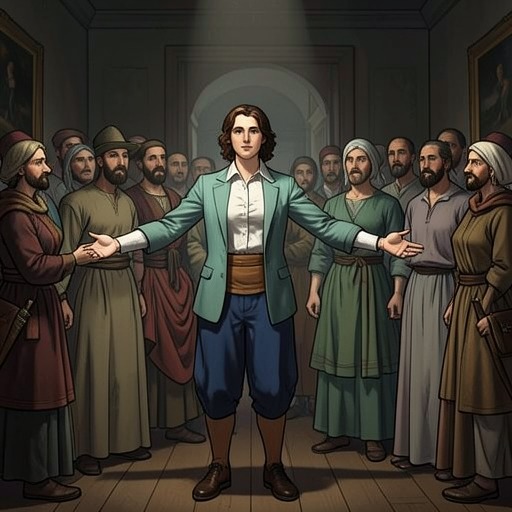
Chrysostom
Don QuixoteChrysostom is a student turned shepherd whose posthumous story brings together poetry, frustrated love, and a dispute over who bears responsibility for another person’s sorrow. After returning from Salamanca, he exchanges scholarly dress for a shepherd’s clothes and follows Marcela into the countryside. His death is reported as a consequence of love, but the funeral’s public judgment of Marcela is challenged by her own defense of free choice.
Identity and Background
Chrysostom is introduced through village report as a famous student-shepherd. He had studied at Salamanca and was remembered not only for his learning but also for his writing: he composed Christmas carols and plays for Corpus Christi, which the village young people performed and which were praised. The account presents him as a substantial literary talent before it presents him as a lover. His creative reputation survives him in the papers laid on his bier and in the poem later read aloud.
His circumstances changed when his father died and he inherited extensive property, including land, goods, cattle, sheep, and money. The goatherd who recounts his story describes him as generous, kind-hearted, and well liked. Chrysostom therefore enters the shepherd’s world not as someone forced into pastoral labor by poverty, but as a wealthy young man who chooses its clothing and setting. That distinction gives his change of life the character of a deliberate pursuit rather than a practical necessity.
The Shepherd’s Life and His Love for Marcela
Not long after his return from Salamanca, Chrysostom appeared in a shepherd’s outfit, carrying a crook and wearing a sheepskin. His friend Ambrosio, a fellow student, adopted the same dress. The villagers were astonished by the pair’s transformation; it later became known that Chrysostom had taken up this life in order to wander through the countryside after Marcela, a shepherdess whose beauty and independence had made her the subject of local attention.
The news of Chrysostom’s death reaches the travelers as a report, not as a witnessed account of how he died. A young villager says that Chrysostom died that morning and that it was rumored he had died of love for Marcela. The report also describes a conflict over his burial instructions. Chrysostom wanted to be buried in the open fields, like a Moor, beside the rock and the Cork-tree spring where he had first seen Marcela. The village clergy objected to carrying out directions they considered pagan, while Ambrosio insisted that his friend’s wishes should be followed. The dispute makes the funeral a public contest over how Chrysostom’s memory will be honored.
Funeral and the Fate of His Writings
The travelers reach the burial place as Chrysostom’s companions lay his flower-covered bier beside the rock and dig his grave. He is dressed as a shepherd, and the onlookers see a man of about thirty, still bearing the appearance of good looks and presence in death. His books and loose papers have been placed around him. The scene joins the two lives he had made: the scholar’s writings and the shepherd’s chosen identity.
Ambrosio describes his friend in terms of extraordinary intelligence, courtesy, generosity, and loyalty, while also presenting him as someone whose devotion was rejected. He says that Marcela’s rejection brought Chrysostom’s unhappy story to its close. The account makes the intensity of his grief central to the funeral, but this is Ambrosio speaking as a bereaved friend, not a neutral verdict on Marcela’s responsibility. The distinction matters because the funeral crowd is hearing Chrysostom’s life interpreted by people who loved him and mourn him.
Ambrosio means to burn the papers after the burial, following Chrysostom’s final direction. Vivaldo objects that the writings should not be destroyed merely because their author ordered it in bitterness. He asks to preserve some of them, arguing that they can keep the story from being forgotten. The choice turns the papers into more than private remains: their survival allows Chrysostom’s despair to speak, while also preserving the circumstances that others use to judge Marcela.
The Lay and the Public Story of His Death
The poem presented as The Lay of Chrysostom gives literary form to the reputation that precedes the funeral. Its speaker seeks an audience for an account of suffering and frames the poem as a lament born from despair. The song gathers images of animal cries, hostile winds, the sea, and infernal sorrow into a deliberately discordant expression of grief. Its scale and sound make private anguish into a public performance, consistent with the funeral’s effort to preserve Chrysostom’s story for others to hear.
Yet the poem and the mourners’ account do not settle the moral meaning of his death. Ambrosio’s tribute emphasizes unreturned devotion and rejection; Vivaldo sees the writings as a warning to readers about the dangers of reckless passion. Both interpretations preserve Chrysostom as the center of the tragedy, but they also risk making Marcela responsible for his suffering simply because she did not return his love. The narrative’s movement from lament to her appearance places that assumption under pressure.
Marcela’s Answer and Narrative Significance
Marcela arrives at the graveside and rejects the purposes Ambrosio attributes to her. She says she has come to defend herself against those who blame her for their sorrow and for Chrysostom’s death. Her argument distinguishes being loved from being obligated to love in return: beauty may attract admiration, she maintains, but affection cannot justly be compelled. She also points out that beauty was given to her rather than chosen, and should not itself be treated as a fault.
Her defense directly contests the story that the funeral has begun to establish. Where Ambrosio presents rejection as the final cause of Chrysostom’s ruin, Marcela asks the listeners to distinguish his feelings from her duties and choices. The episode does not erase the force of his grief or the tenderness with which his friend remembers him. Instead, it sets the language of mourning beside a woman’s claim that another person’s desire cannot determine her obligations. Chrysostom’s narrative significance lies in this unresolved passage from private love to public judgment: his death provokes the accusation, his papers preserve it, and Marcela’s speech challenges the terms on which his memory is being used.