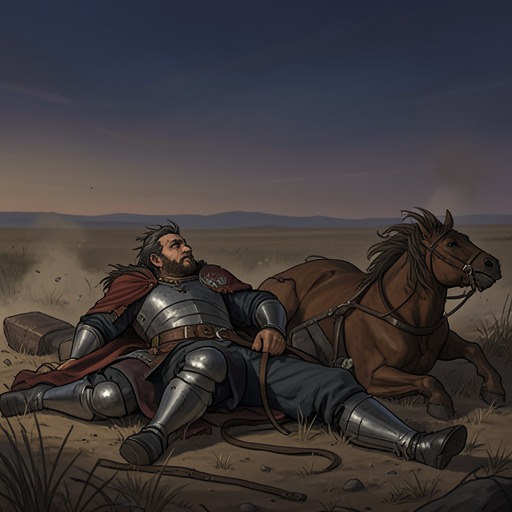
Combat with the Knight of the Mirrors
Don QuixoteThe Combat with the Knight of the Mirrors is both a physical victory for Don Quixote and a failed effort to bring his adventures to an end. Samson Carrasco’s plan depends on Don Quixote obeying the rules of knight-errantry after defeat; instead, Don Quixote wins the encounter, then explains away the evidence of his opponent’s identity as the work of enchanters. The reversal leaves the defeated pair injured and disappointed, while the victor continues toward Saragossa convinced that his own account of events is true.
The Terms of the Encounter
Before the charge, Don Quixote challenges the Knight of the Mirrors’ claim that he has already vanquished him. His opponent says that Don Quixote resembles the knight he defeated but will not confirm that they are the same person, allowing for the possibility that enchanters have altered appearances. Don Quixote takes this uncertainty as evidence of deception and proposes that they settle the matter by combat: he expects to reveal the other knight’s face and establish that he is not the man previously defeated.
The terms give the victor authority over the vanquished, but Don Quixote makes his acceptance conditional: any order must remain within the limits of chivalry. The Knight of the Mirrors reminds him of their agreement just before they fight. This stipulation gives the encounter a purpose beyond proving skill. Whoever loses will have to submit to the other’s demands, and Carrasco’s design relies on that submission to redirect Don Quixote’s conduct.
The Charge and the Fall
As the two prepare, Don Quixote pauses to help Sancho Panza mount into a cork tree. The Knight of the Mirrors sets out to charge, but his horse cannot sustain the approach and stops. Don Quixote, taking the movement for a direct attack, spurs Rocinante forward. The horse, usually limited to a trot, makes an exceptional rush; Don Quixote strikes his opponent while the latter is still struggling to manage his mount and lance, and brings him down.
The fall appears so severe that the Knight of the Mirrors does not move. Sancho comes down from the tree, and Don Quixote dismounts to unlace the fallen knight’s helmet and see whether he is alive. Instead of finding a stranger, he sees the face of Samson Carrasco. The sudden recognition changes what the encounter means for the reader: the masked challenger is not an unknown rival but a fellow townsman who had entered the road in disguise. Sancho also recognizes the squire once the false nose is removed: he is Tom Cecial, Sancho’s neighbor and friend.
Victory, Recognition, and Misrecognition
When Carrasco comes round, Don Quixote holds his sword over him and demands that he acknowledge the superiority of Dulcinea of Toboso over Casildea de Vandalia. He also requires him, if he survives, to go to El Toboso and present himself to Dulcinea, then return and report what happened. Carrasco, still at Don Quixote’s mercy, agrees to these conditions. Don Quixote further insists that the knight he defeated earlier could not have been the real Don Quixote, and that the man now resembling Carrasco must likewise be someone transformed by his enemies. Carrasco accepts the account Don Quixote imposes, and Don Quixote helps him rise with Tom Cecial’s assistance.
Sancho has direct evidence of Tom Cecial’s identity: he questions him, and the answers confirm that he is the man he claims to be. Yet Sancho cannot accept what he sees about Carrasco, because Don Quixote’s explanation of enchantment shapes his understanding. Master and squire therefore remain caught in the same delusion, even as the reader has learned who the masked men really are. The scene’s irony rests on that divide: a disguise has been removed, but recognition does not dispel Don Quixote’s belief in magical interference.
The Failed Plan and Its Aftermath
The account then reveals the purpose behind Carrasco’s challenge. After Don Quixote resumed his knight-errantry, Carrasco had consulted with the curate and the barber about how to persuade him to remain peacefully at home. They decided that Carrasco should meet him as a knight-errant, defeat him, and use the agreed terms to order him back to his village and house for two years, or until further instructions. They expected Don Quixote to obey such an order rather than violate the laws of chivalry, and hoped that confinement might help him abandon his folly or allow them to find another remedy.
Carrasco undertook the task, and Tom Cecial volunteered as his squire. To avoid being recognized, Tom wore a false masquerade nose; the pair followed Don Quixote’s route and eventually encountered him in the grove. The plan depended on Carrasco winning, but Don Quixote’s victory makes its intended command impossible. Carrasco leaves, downcast and in need of a place where he can tend to himself, while Don Quixote and Sancho resume their journey to Saragossa. Don Quixote expects the defeated knight eventually to report on Dulcinea; Carrasco, by contrast, has no immediate thought beyond finding a village where he can recover. The combat thus converts a carefully arranged attempt at restraint into another adventure that confirms Don Quixote’s confidence in his imagined chivalric world.