Discovery of Cide Hamete Benengeli's manuscript
Don QuixoteThe discovery of Cide Hamete Benengeli's manuscript is the novel’s decisive shift from an interrupted adventure into a story about how adventures become history. In the Alcana of Toledo, a first-person narrator finds Arabic papers that appear to record Don Quixote’s life. Their translation supplies the continuation of the tale while making its authority deliberately complicated: the history is presented as a recovered document, but the reader encounters it through an interpreter, a narrator, and a source whose truthfulness is open to question.
The find in the Alcana of Toledo
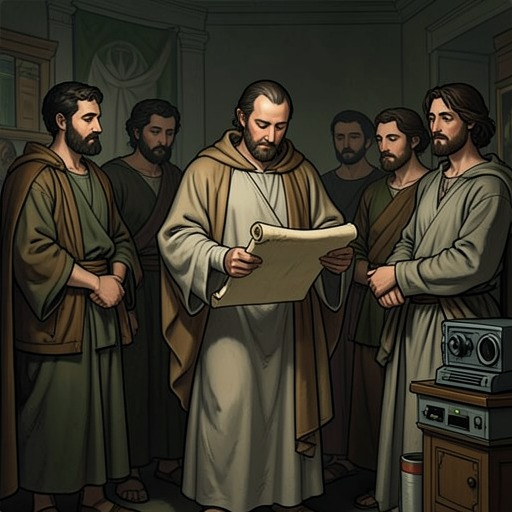
One day, while walking through the Alcana of Toledo, the narrator sees a boy offering pamphlets and old papers to a silk merchant. His stated fondness for reading even scraps in the street leads him to pick up one of the papers. He recognizes its characters as Arabic but cannot read it, so he looks for a Spanish-speaking Morisco who can interpret it. The encounter is made to depend on chance and ordinary commerce: a boy selling loose papers, a customer’s curiosity, and an interpreter found nearby.
The Morisco opens the document in the middle and laughs at a marginal note about Dulcinea del Toboso. The note associates the lady repeatedly mentioned in the history with an everyday village skill: salting pigs. That unexpected detail immediately alerts the narrator to a possible connection with Don Quixote. He asks the interpreter to read the beginning, which identifies the work as a history of Don Quixote of La Mancha by the Arab historian Cide Hamete Benengeli. The marginal joke thus does more than amuse: it provides the clue that turns an apparently miscellaneous paper into the missing source for the knight’s story.
Purchase, translation, and the interrupted adventure
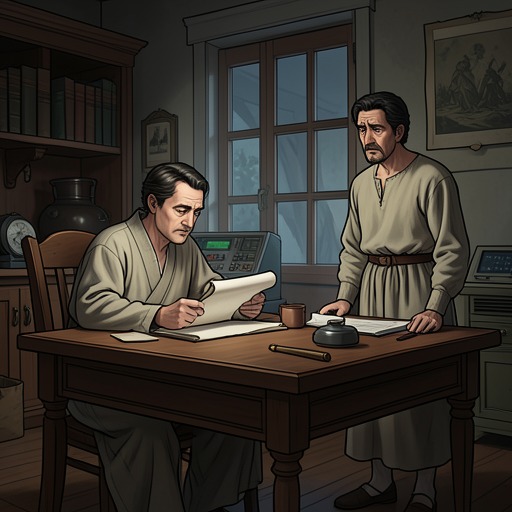
The narrator buys all the boy’s papers and pamphlets for half a real, then withdraws with the Morisco to the cloister of the cathedral. He asks for every paper concerning Don Quixote to be rendered into Castilian without additions or omissions and offers the interpreter whatever payment he chooses. The Morisco agrees to two arrobas of raisins and two bushels of wheat. To keep the find close and simplify the work, the narrator takes him home; in a little more than a month and a half, the whole text has been translated.
The recovered history resumes at a moment of suspended violence. Its first pamphlet contains a picture of Don Quixote and the Biscayan with their swords raised, as the preceding account had left them. Labels identify the Biscayan as Don Sancho de Azpeitia and the knight as Don Quixote; another identifies Sancho Panza as Sancho Zancas. The image also supplies a comic physical portrait: Rocinante appears long, thin, and gaunt, while Sancho is shown with a large belly, short body, and long legs. These details make the manuscript seem materially particular, as if its pictures and labels preserve evidence; at the same time, the joke about names and bodies keeps the supposed historical record in a comic register.
A historian whose authority is in question
The narrator treats the papers as both a fortunate recovery and a source requiring scrutiny. He recognizes that Cide Hamete is an Arab historian and raises the possibility that an Arab author might lie, while also suggesting that hostility toward the narrator’s people could lead to omissions rather than additions. This is not a stable guarantee of accuracy. It is a self-conscious argument about bias, in which claims to historical truth are immediately entangled with suspicions about the historian’s identity and loyalties.
The narrator nevertheless insists that the fault in any deficient account belongs to its author, not its subject, and invokes the historian’s duty to be exact and free from passion. The assertion sits beside the absurdity of the marginal note and the comic illustration: the recovered source is treated with the seriousness of evidence, but its presentation continually reminds the reader that evidence passes through interpreters and narrators. The translation’s promise of fidelity therefore sharpens, rather than resolves, uncertainty about who controls the story and how much confidence its history deserves.
The manuscript’s afterlife
The discovery establishes a layered narrative form that remains visible later in the novel. Characters discuss the history as a published book, notice its imperfections, and argue over what belongs in it. The Bachelor criticizes the inclusion of The Ill-Advised Curiosity as irrelevant to Don Quixote’s history, while Don Quixote himself attacks the historian’s judgment. The debate turns the work’s structure into part of its subject: the source is not simply a hidden record but a text that readers can evaluate, dispute, and remember.
The book’s fictional readership also gives the manuscript a public life beyond the narrator’s initial recovery. The Bachelor describes it as widely read across ages and social settings, with readers recognizing Rocinante when they see a lean hack. In the preface to Part II, Cervantes likewise refers to the unwanted rival continuation published under another name. Against that unauthorized claim to Don Quixote’s future, the Arabic manuscript device foregrounds the novel’s recurring concern with attribution: the story depends on a claimed source, a translator, and a narrator, while its later circulation produces further authors and competing versions. The discovery does not close the question of truth; it makes that question the framework through which the adventures continue.