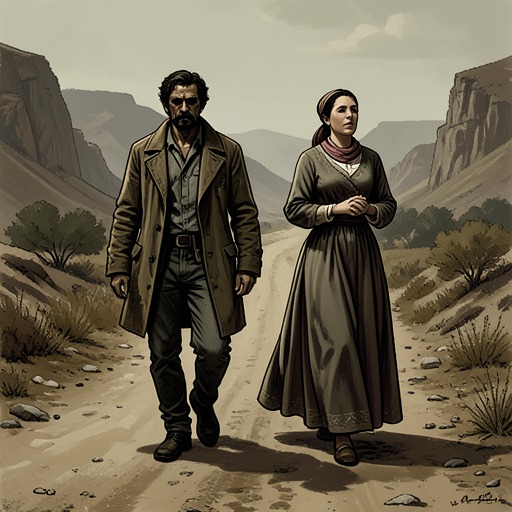
Don Gregorio
Don QuixoteDon Gregorio is a young Christian captive in Algiers whose rescue reunites him with Ana Felix, but does not secure their life together. His brief appearance brings the dangers of captivity into the plot of Don Quixote and Sancho Panza, then turns from adventure toward the intimate cost of separation: after reaching safety, Don Gregorio refuses to abandon Ana Felix, yet agrees to leave temporarily so he can visit his parents and seek a way to return for her.
Identity and Circumstances
The account introduces Don Gregorio chiefly through the efforts made to free him and through the reunion that follows. He is held in Algiers, and when he is taken away from there he is dressed as a woman. During the voyage to safety, he changes into the clothes of a captive who has escaped with him. The narrative does not dwell on the circumstances of his captivity; instead, his changing clothes establish the danger and concealment involved in getting him out.
His youth becomes clear at the reunion. Don Gregorio appears to be about seventeen or eighteen, and those present find him exceptionally handsome. The narrator also emphasizes that his intelligence seems to exceed what his age would suggest. These details make him more than the object of a rescue: he is presented as a young man capable of bearing the strain of danger and separation, and whose attachment to Ana Felix governs his choices after the escape.
The Rescue and Its Competing Plans
Don Quixote objects to the proposed means of recovering Don Gregorio, judging the plan too dangerous in relation to its advantages. He offers instead to go himself, armed and mounted, into Barbary and carry Don Gregorio off despite the opposing force. To justify this chivalric proposal, he compares the rescue to Don Gaiferos carrying Melisendra away. Sancho Panza immediately points out the practical difference: in the old romance the lovers could travel overland to France, whereas Don Gregorio would have to cross the sea to reach Spain. Don Quixote answers that a vessel could bring them close enough to board, but Sancho favors the renegade, whom he regards as trustworthy.
The proposed armed expedition remains a contingency rather than the means by which Don Gregorio is freed. Don Antonio Moreno says that Don Quixote’s plan could be attempted if the renegade’s undertaking fails. The renegade then sails in a light vessel with six oars a side and a strong crew. Two days later, the galleys depart eastward. Their general has asked the Viceroy of Barcelona to report what happens to Don Gregorio and Ana Felix, and the viceroy promises to keep him informed. This sequence places Don Quixote’s imagined intervention beside a more practical operation, while leaving the actual rescue to the renegade’s voyage.
The news arrives that Don Gregorio and the renegade have come ashore and are already at the viceroy’s residence. Don Quixote is initially cheered by the report, then laments that his defeat has barred him from taking up arms for a year. He imagines what he might have accomplished in Barbary, but must acknowledge that he cannot undertake the expedition. Don Gregorio’s safe return therefore coincides with Don Quixote’s enforced retirement from knightly action: the rescue succeeds without the intervention he had proposed.
Reunion with Ana Felix
After giving the viceroy an account of the outward and return voyages, Don Gregorio goes with the renegade to Don Antonio Moreno’s house, eager to see Ana Felix. Ricote and his daughter come out to meet him. The narrator describes her as bashful and her father as tearful; Don Gregorio and Ana Felix do not embrace, and their restraint makes the reunion a scene of quiet recognition rather than display. Their faces and silence convey what neither says aloud, while those gathered recognize the affection between them.
Their reunion also brings their different circumstances into view. Don Gregorio has escaped from Algiers, while Ana Felix and Ricote are in Spain and must confront the question of whether they can remain there. Don Gregorio’s return restores the lovers to one another, but it does not resolve the legal and practical uncertainty surrounding Ana Felix’s future. The scene’s happiness is therefore inseparable from the prospect of another parting.
Choice, Separation, and an Uncertain Future
The viceroy and Don Antonio discuss how Ana Felix and Ricote might be allowed to stay in Spain. Don Antonio offers to pursue the matter in the capital; meanwhile, he proposes that Ana Felix remain with his wife and Ricote stay at the viceroy’s house. Don Gregorio, when he learns of these arrangements, declares that he cannot leave Ana Felix. He nevertheless agrees to go and see his parents and to seek a way to return for her. His consent is not a renunciation of their relationship but a temporary accommodation to the journey and to the unresolved arrangements for her future.
At the departure, the separation is openly painful: Don Gregorio and Ana Felix part amid tears, sighs, fainting, and sobbing. Ricote offers Don Gregorio a thousand crowns, but he accepts only five, lent by Don Antonio, and promises to repay them in the capital. The contrast between the large offer and the small loan underscores the limited, immediate character of the practical help he accepts; the narrative gives no account of whether he later returns or whether the lovers are reunited.
Don Gregorio’s plot thus ends not with a settled marriage or a completed homecoming, but with a promise to seek a way back. His rescue is a success, yet freedom does not automatically remove the obstacles separating him and Ana Felix. The unresolved departure gives the episode its emotional shape: the escape brings the lovers together, while the conditions of their lives send them apart again.