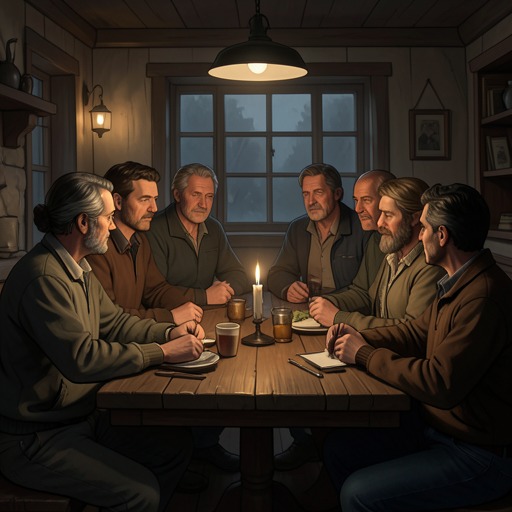
Don Luis and Clara’s marriage agreement
Don QuixoteDon Luis and Clara’s marriage agreement is a provisional settlement reached at the inn after Don Luis’s secret pursuit of Doña Clara de Viedma is discovered. Don Luis declares that he left his father’s household to follow her and asks The Judge, Clara’s father, to accept him as a son-in-law. The Judge does not conclude the marriage on the spot: he grants time for the parties to consider the match and arranges for Don Luis to remain in safe company rather than be compelled home. The episode turns a concealed romance into a matter of family consent, rank, and practical negotiation.
Discovery at the Inn
By broad daylight, the inn’s guests are awake after a noisy night. Among the newly arrived travellers are men searching for a youth dressed as a muleteer. The landlord has not identified their quarry, but one of the searchers recognizes the coach that brought The Judge and concludes that the young man they seek must be nearby. The searchers divide their efforts, with some entering the inn and others watching its approaches.
Don Quixote, still absorbed in his own imagined adventure, challenges the travellers to single combat, but they do not answer him. He restrains himself because he believes he must first complete the undertaking connected with the supposed Princess Micomicona. This pause leaves the search for Don Luis to unfold beside, rather than within, Don Quixote’s imagined contest.
One of the servants finds Don Luis asleep beside a muleteer. He addresses him by his title and reproaches him for travelling in humble clothes, then urges him to return because his father is deeply distressed by his absence. Don Luis is startled to recognize his father’s servant. The discovery makes clear that his disguise has not freed him from his family’s reach, and the servants’ insistence that they will take him home creates an immediate conflict over whether he can choose his own course.
Don Luis Explains His Choice
As the servants press him, Don Luis refuses to return before completing what he describes as a matter involving his life, honour, and heart. The dispute draws the inn’s company together. Cardenio, already familiar with part of the young man’s story, helps The Judge understand the situation; Dorothea has also told Cardenio about Clara and the musician who has followed her. Clara hears that her lover has been found and is so affected that Dorothea supports her.
In a private conversation with The Judge, Don Luis identifies Clara as the reason for his journey. He says he fell in love with her after seeing her and made her the focus of his devotion. To follow her, he left his father’s house and adopted the muleteer’s disguise; Clara, he says, has learned no more of his feelings than she could infer from seeing his eyes fill with tears. He asks The Judge to permit their marriage that very day, offering his own family’s wealth and noble birth as grounds for considering the match. He also makes plain that, if his father opposes his choice, he believes time may change that opposition.
The declaration changes the servants’ demand from a simple effort to recover a runaway son into a dispute about a marriage Don Luis regards as essential. His account also reveals why he has followed Clara in secret: he is not merely travelling after her, but seeking her hand despite the uncertainty of his father’s approval. The Judge is surprised by the sudden confession and must weigh Don Luis’s determination against the family arrangements that a marriage would involve.
A Provisional Arrangement
The Judge does not immediately accept Don Luis’s offer as a completed marriage agreement. He tells him to make his mind easy for the present and to persuade the servants not to take him away that day, allowing time to consider what would be best for everyone. Don Luis responds with gratitude and emotion. The Judge recognizes that the proposed match would benefit Clara, while also preferring, if possible, to secure the consent of Don Luis’s father, whom he understands to be seeking a title for his son.
The surrounding disorder briefly interrupts the negotiations. A dispute over the barber’s basin and pack-saddle develops into a wider quarrel, while Don Quixote interprets the uproar as the discord of Agramante’s camp. The curate and The Judge help restore calm; the guests settle the disputed property, and the innkeeper’s claims are also paid. Once the larger disturbance subsides, the question of Don Luis’s future can be addressed again. The episode’s comedy of mistaken identities and imagined enchantments thus gives way to a practical arrangement between families and supporters.
Don Fernando proposes that Don Luis accompany him to Andalusia, where the young man can receive a welcome appropriate to his rank from Don Fernando’s brother, the marquis. The company agrees that this is preferable to forcing Don Luis home against his will, since his determination makes an immediate return unlikely. Three of the four servants will go back to report the situation to Don Luis’s father; the fourth will remain with him until they return or receive further instructions. The servants accept this plan, and Clara’s happiness at the decision is apparent to those around her.
Meaning and Limits of the Agreement
The resolution is a negotiated reprieve, not a marriage ceremony or proof that the families have reached a final settlement. Don Luis remains committed to marrying Clara, and the Judge has shown that he sees the match as advantageous, but his preference for the father’s consent remains part of the question. The arrangement instead prevents an immediate separation: Don Luis will not be dragged home that day, and his servants will carry news to his family while he stays under Don Fernando’s protection.
The episode places private choice within the obligations of family standing. Don Luis’s noble birth and inheritance strengthen his proposal, yet neither wealth nor rank removes the need to reckon with his father’s wishes. The Judge’s response similarly balances Clara’s happiness against the social and familial consequences of the match. Its ending is deliberately provisional: the lovers’ intentions are disclosed, the threatened removal is averted, and a route toward further negotiation is established, while the actual marriage remains outside the events recounted here.