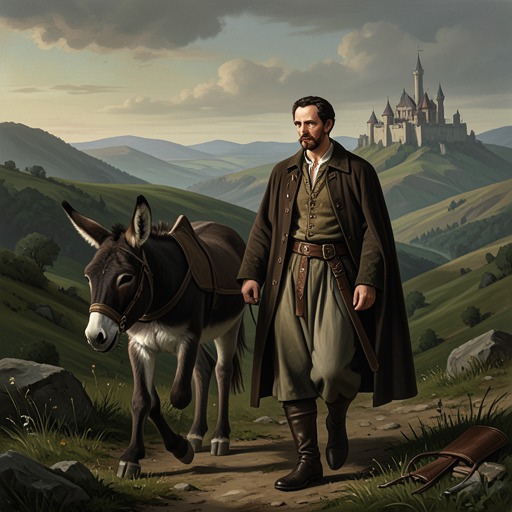
Don Quixote and Sancho Panza as master and squire
Don QuixoteThe relationship between Don Quixote and Sancho Panza as master and squire becomes the human center of a story that began without Sancho in its design. Their service is never simply a contract between a deluded knight and a comic attendant: Sancho challenges his master’s explanations, depends on his promises, and remains with him through disappointment, while Don Quixote scolds, forgives, and continues to treat the squire’s future as bound up with his own. Their different ways of reading the world create much of the comedy, but their continued return to one another gives that comedy its emotional weight.
An Accidental Partnership, Made Indispensable
The account of the book’s composition presents Sancho as a character who entered the story by chance. Don Quixote’s original equipment was meant to be complete, yet included no squire; a landlord’s remark that knights commonly travelled with squires supplied the opening for Sancho’s arrival. The relationship begins, then, as an addition to the knight’s imagined identity, rather than as part of a settled plan. Once Sancho joins him, however, the pairing becomes difficult to imagine apart: the commentary compares trying to conceive Don Quixote without Sancho to imagining a pair of scissors with only one blade.
Sancho’s plain, practical presence establishes a counterpoint to his master’s chivalric ambitions. His intention to take his ass along unsettles Don Quixote’s memory of knightly precedent, making their different assumptions visible from the outset. The discrepancy does not keep Sancho from following. Instead, the partnership proceeds through his service and his hopes that serving such a master will eventually bring him a position of his own.
The preface introduces Don Quixote as a celebrated knight and presents Sancho as an especially valuable part of the acquaintance offered to the reader. It describes him as gathering together the comic qualities assigned to squires in chivalric books. Later commentary emphasizes that Sancho was already a favorite of his creator and that, when he returned in the Second Part, his familiar traits were made more distinct without turning him into a caricature. His role also expanded: his deceptions about Dulcinea del Toboso help supply much of the later story’s action. Thus the partnership is not a static arrangement in which the squire merely accompanies the knight; Sancho’s conduct increasingly shapes the course of their adventures.
Practical Judgment and Chivalric Delusion
Their contrasting interpretations repeatedly bring them into conversation. When Don Quixote dreams that he is fighting a giant and slashes the innkeeper’s wineskins, Sancho rushes to summon help, sincerely reporting a battle and a severed head. The innkeeper identifies the supposed blood as wine, and the damage makes the practical consequences of the dream impossible to overlook. Don Quixote wakes only after water is thrown over him, and initially continues to understand the episode through the imagined adventure. Sancho, by contrast, names the wineskins and their spilled contents, even while the knight maintains that enchantment may explain what has happened.
The aftermath turns this difference into a compact portrait of their bond. Sancho tells his master that the business of the princess and giant is settled, while Don Quixote remembers his victory as real. Sancho makes the material cost plain: the wineskins have been cut, the room is flooded with wine, and the innkeeper will demand compensation. Yet he can also recognize that Don Quixote’s promised future has collapsed along with the fantasy. When the supposed princess is no longer part of the plan and his hopes of becoming a governor appear to vanish, Sancho approaches his sleeping master with disappointment rather than abandoning him.
The two also disagree about the cage in which Don Quixote is being carried. Sancho points out that his master eats, drinks, sleeps, and speaks, and therefore does not fit the signs of enchantment he has heard described. He recognizes the curate beneath a disguise and understands that the captivity is a human stratagem, not a magical transformation. Don Quixote answers that enchantments may take different forms and says he would feel guilty if he believed himself free to leave while people might need his help. Their exchange makes the contrast more than a simple opposition between sense and folly: Sancho reasons from observable circumstances, while Don Quixote’s chivalric duty supplies a framework that can absorb evidence against it.
Even so, Sancho does not merely expose the delusion and stand aside. He proposes that Don Quixote try to leave the cage, return to Rocinante, and resume the search for adventures; if the attempt fails, Sancho offers to go back into the cage with him. Don Quixote agrees to follow this plan when an opportunity arises. Sancho’s practical judgment therefore becomes a form of care: he seeks a way to restore his master’s freedom while promising not to leave him alone if the effort comes to nothing.
Loyalty Through Setbacks and Reconciliation
Sancho’s hopes of advancement make the partnership vulnerable to disappointment. At the inn, after the others have found a happy resolution to their own complicated affairs, he alone remains distressed by the disappearance of his expected reward. The landlady, in contrast, is pleased because the curate and Cardenio have promised to pay for the damage caused by Don Quixote. Sancho’s predicament is personal as well as financial: he has imagined that his master’s success will change his own standing and benefit his family. His hopes are repeatedly bound to the knight’s projects, even when those projects have produced immediate trouble.
The staged prophecy spoken when Don Quixote is confined in the cage renews those expectations. It promises that Sancho’s promised rewards will not fail and anticipates his future elevation. Don Quixote accepts the prophecy as meaningful and is comforted by it; Sancho, who can recognize the disguised participants, nevertheless remains caught between awareness of the trick and desire for the promised future. The episode shows how their hopes can be sustained by stories Don Quixote believes and Sancho partly understands as performances.
When Sancho later believes Don Quixote has died after an encounter with a penitents’ procession, his lament measures the importance of the master beyond the prospect of payment. He praises Don Quixote as a defender against wrongdoing and recalls that the knight had promised him an island after only eight months of service. When Don Quixote comes to himself, Sancho helps him back to the cart and proposes returning to their village before attempting another sally. The passage moves from apparent bereavement to renewed companionship: Sancho mourns the loss of his master, then immediately helps him continue toward home and the possibility of setting out again.
Their arguments can be sharp. After Sancho is beaten in the braying-town episode, he objects that knights-errant flee and leave their squires to suffer the consequences. Don Quixote insists that he withdrew prudently rather than fled, distinguishing rash courage from a retreat made in expectation of better circumstances. Later, Don Quixote threatens to send Sancho home for speaking too much in his own interest and abandoning the service. Sancho is moved to tears, admits his foolishness, asks forgiveness, and says he will remain in his master’s service. Don Quixote grants forgiveness and reassures him that a delayed promise is not an impossible one. The quarrel ends not by proving one man wholly right, but by restoring their shared commitment.
Affection, Service, and the Promise of Reward
Sancho explains his continued attachment directly when the Duchess questions why he follows a master he considers mad and trusts promises that may be empty. He acknowledges that wisdom might have led him to leave, but says that they come from the same village, that he has eaten Don Quixote’s bread, that he is fond of him and grateful for him, and that Don Quixote gave him ass-colts. Above all, he describes himself as faithful, saying that only death could separate them. His list combines shared origins, material benefit, affection, and loyalty; the relationship rests on several bonds at once, not solely on the expectation of an island.
Sancho’s ambition remains real. When an ecclesiastic asks whether he is the Sancho Panza promised an island, he affirms that he deserves it and argues that months spent with a good master have helped make him worthy. The Duke then grants him the government of an island in Don Quixote’s name, and Don Quixote tells him to kneel and thank the Duke. The episode gives the squire’s long-standing hope a concrete form, while preserving the relationship’s hierarchy: the appointment is bestowed through the Duke and framed as a favor associated with the master.
Their attachment does not erase the difference in their judgment. Sancho admits that he himself invented the deception that made Don Quixote believe a peasant girl was Dulcinea del Toboso, explaining that he sought to escape his master’s scolding and did not intend harm. When the Duchess supplies a new account in which Sancho may have been deceived by enchanters himself, he becomes willing to reconsider what happened, including Don Quixote’s account of the Cave of Montesinos. Their shifting explanations keep the relationship alive as an exchange of stories: Sancho can knowingly mislead Don Quixote, but he can also be drawn into his master’s imaginative account of events.
Narrative Significance
The partnership allows the book to hold practical observation and chivalric idealism in the same scene. Sancho supplies material facts—wineskins, a cage, a damaged room, an unpaid or anticipated reward—while Don Quixote turns circumstances into tests of duty, enchantment, and knightly reputation. Sancho’s resistance prevents the knight’s interpretations from becoming the only account available; his loyalty, meanwhile, prevents plain sense from simply ending the adventure. Their disagreements create reversals, but their reconciliations make it possible for the story to continue.
Sancho also changes the balance of the narrative. Commentary on the Second Part describes him as more prominent and identifies his lies about Dulcinea as a major source of action. His service is therefore not merely a response to Don Quixote’s adventures: his inventions and explanations help generate them. At the same time, the recurring promises of an island, Sancho’s concern for his family, and his insistence on the physical realities his master overlooks keep the relationship grounded in ordinary needs. The result is a partnership in which dependence runs both ways: Don Quixote has a companion who can challenge his account of the world, while Sancho’s hopes, choices, and loyalty give the knight’s imagined vocation a continuing human counterpart.