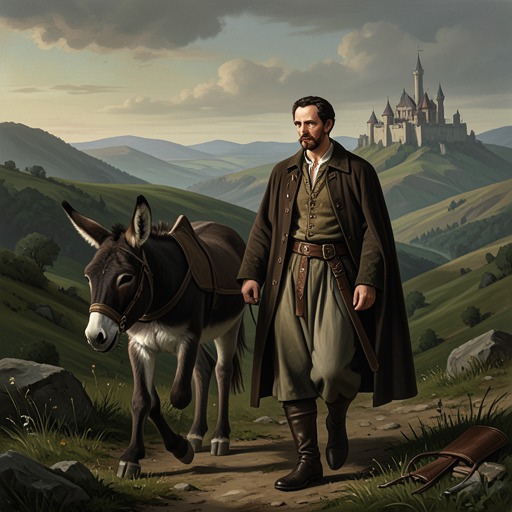
Don Quixote and Sancho Panza: adventures, quarrels, forgiveness, and hopes of reward
Don QuixoteDon Quixote and Sancho Panza’s relationship is a partnership sustained by unequal but reciprocal dependence: the knight supplies the adventures and promises of future reward that keep his squire on the road, while Sancho brings news, practical counsel, and a persistent attachment to the life they hope to share. Their quarrels can turn abruptly serious, particularly when Sancho’s material hopes seem to insult Don Quixote’s devotion to Dulcinea. Yet anger does not end the bond. Each can ask forgiveness, and their return to conversation shows how affection, obligation, and self-interest remain intertwined.
A Partnership of Service and Expectation
In the Sierra Morena episode, Sancho returns from seeking Don Quixote and reports finding him in a state of deliberate hardship: stripped to his shirt, weakened by hunger, and sighing for Dulcinea. Sancho says he delivered the message that she commanded Don Quixote to leave the place and go to El Toboso, where she awaited him. Don Quixote, however, has refused to present himself before her until he has performed deeds worthy of her favor. The gap between the message and the knight’s decision puts Sancho in the familiar position of messenger and adviser, trying to translate his master’s imagined obligations into a course of action.
Sancho’s service is bound up with his expectation of advancement. He fears that Don Quixote may choose an archbishopric rather than the worldly rewards Sancho anticipates, and he reasons that marriage to the distressed princess traveling with them would prevent that outcome while bringing a kingdom within reach. He explains that his own wife and children make a church office unsuitable for him and would complicate any attempt to obtain the necessary dispensations. His argument is comic in its calculation, but it also reveals how closely he connects his future to Don Quixote’s choices: the master’s status, in Sancho’s imagination, is the means by which the squire might become a lord or governor.
The curate’s account of the princess’s supposed identity and need gives Sancho an apparent route toward those hopes. He urges Don Quixote to accept the marriage and kingdom, while the curate and Dorothea pursue a plan to bring the knight home. In this scene, Sancho is not merely seeking personal advantage: he is trying to persuade Don Quixote to take the opportunity he believes will secure both their futures. But his practical counsel depends on treating the adventure as a real prospect, just as Don Quixote’s decisions depend on treating chivalric duties as binding.
Dulcinea and the Limits of Practical Counsel
The disagreement sharpens when Sancho compares the princess’s beauty favorably with Dulcinea’s. Don Quixote takes this not as a negotiation over marriage but as an offense against the lady on whom he believes his strength and achievements depend. He strikes Sancho with his pike and rebukes him for speaking against her. The episode makes visible a limit in their otherwise close exchange: Sancho may advise his master about kingdoms and rewards, but he misjudges how far Don Quixote’s identity is joined to Dulcinea’s honor.
Sancho retreats behind Dorothea’s palfrey and returns to the question of reward. If Don Quixote refuses the marriage, Sancho argues, he will lose the kingdom and therefore the power to bestow favors. He proposes that the knight marry the princess first and return to Dulcinea afterward; he also admits that he has not seen Dulcinea closely enough to compare the two women’s beauty. Don Quixote challenges this admission because Sancho has supposedly carried a message from her. Sancho clarifies that he did not have the opportunity to inspect her at leisure. His shifting explanations expose the comic strain between the messenger’s claims and the master’s demand for exact, emotionally satisfying news.
Don Quixote’s resistance to marriage is not simply indifference to Sancho’s prospects. He argues that he can obtain a portion of the kingdom for Sancho without marrying, provided he defeats the giant, and so can honor his promise by another route. Sancho accepts the proposal and adds his own practical preference: the territory should be on the coast, so that he could send his black vassals away if he disliked the life there. Their discussion repeatedly returns to material reward, but it also shows Don Quixote trying to reconcile his promises to Sancho with his devotion to Dulcinea and his pledged undertaking to the princess.
Quarrel, Forgiveness, and Renewed Confidence
The exchange over Dulcinea produces a swift reversal. After Sancho has argued for the princess’s marriage and questioned his master’s judgment, Don Quixote forgives him; he also asks Sancho to forgive the injury he has done. Sancho answers that he cannot always restrain his first impulse to speak. Don Quixote warns him that repeated provocation may bring consequences, and Sancho counters that both men will ultimately be judged for their respective failings. The conversation preserves their differences rather than resolving them: Sancho remains outspoken, and Don Quixote remains protective of Dulcinea’s honor.
Dorothea directs Sancho to ask his master’s pardon and to be more careful in praising one lady without disparaging the other. Sancho approaches with his head lowered, kisses Don Quixote’s hand, and receives his blessing. Don Quixote then asks him to go ahead so that they can speak privately. The formal gesture of reconciliation returns them to their familiar roles, but the subsequent confidence is not merely ceremonial: Don Quixote wants to hear the particulars of Sancho’s mission and the answer he has brought back.
He asks Sancho to recount where and when he found Dulcinea, what she was doing, what was said, and how she appeared while reading his letter. He specifically asks him not to add, falsify, or omit details. Sancho responds that nobody copied the letter because he carried no letter at all. Don Quixote acknowledges that the notebook containing it remained in his own possession after Sancho’s departure. The missing letter complicates the very report on which Don Quixote’s hopes depend, while the request for a full and accurate account shows how much he relies on Sancho as the bearer of news, even when the journey has not gone as expected.
Shared Aims, Different Measures of Success
Their later discussion returns to the competing claims that organize the relationship. Don Quixote says he is pulled between Dulcinea’s command and the promise he has made to the princess; he resolves to accompany the princess, defeat the giant, restore her to her realm, and then return to Dulcinea. Sancho urges him not to sacrifice a kingdom and marriage opportunity for a distant journey to El Toboso. He treats the reward as tangible and the romantic obligation as postponable; Don Quixote treats his pledged word and Dulcinea’s favor as obligations that define his honor.
Don Quixote nevertheless accepts Sancho’s advice about accompanying the princess before seeking Dulcinea. He asks Sancho not to repeat their private discussion, arguing that Dulcinea’s decorum requires discretion. Sancho points out the tension between secrecy and Don Quixote’s custom of sending defeated knights to present themselves to her. Don Quixote explains that such submission publicly magnifies her honor, since those knights serve her without expecting reward. Their exchange ends not in agreement about the meaning of service, but in a clear contrast: Sancho sees relationships through practical benefits and visible arrangements, while Don Quixote understands them through the ideals of chivalric devotion. Their partnership endures because neither measure entirely displaces the other. Sancho continues to counsel and accompany his master; Don Quixote continues to promise him a share in the victories he imagines.