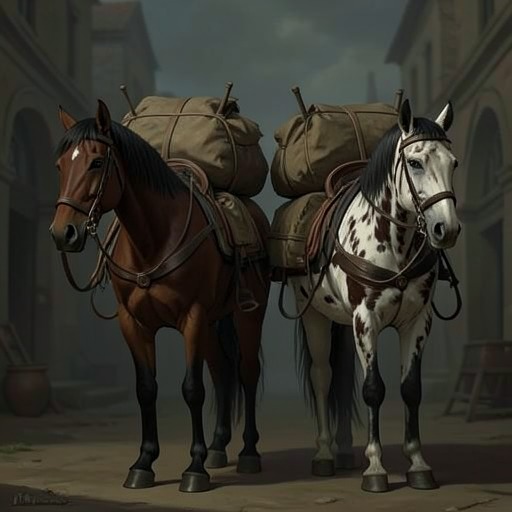
Don Quixote and his mount Rocinante
Don QuixoteDon Quixote and his mount Rocinante are bound together by a shared act of reinvention: the knight gives his neglected hack a grand name and a place in the heroic story he believes he is beginning. Rocinante remains visibly an ordinary, worn-out horse, but in Don Quixote’s imagination he becomes a celebrated steed and the companion who will accompany him through his wanderings.
The Hack and His New Name
Don Quixote’s horse is first described as a worn and blemished hack, far removed from the splendid mounts of chivalric legend. Don Quixote nevertheless sees him as surpassing even the celebrated horses Bucephalus and Babieca. The contrast establishes the imaginative gap at the heart of their partnership: the animal’s condition is plain, but his master’s vision gives him a heroic stature.
Don Quixote spends four days searching for a suitable name. It must express both what the horse had been before serving a knight-errant and what he is becoming now that his master has taken up a new identity. After turning over many possibilities, he settles on Rocinante, a name he considers distinguished and resonant, and interprets it as declaring the horse first among hacks. The naming makes the horse’s lowly past part of his new identity rather than something to conceal.
A Partnership in the First Sally
As Don Quixote sets out, he rides wherever Rocinante chooses, believing that the horse’s direction is where adventure lies. The first journey thus gives the mount a practical role in carrying his master into the world, even as Don Quixote supplies the journey with a more extravagant meaning. While they cross Campo de Montiel, he imagines how a future chronicler will describe their departure in the elevated style of the romances that have shaped his ideas of knighthood.
That imagined history does not treat Rocinante as mere equipment. Don Quixote specifically asks the imagined chronicler not to forget his horse, whom he regards as the constant companion of his travels and wanderings. The appeal makes their bond part of the record of his anticipated fame: the knight’s story, as he pictures it, includes the mount who carries him through it.
The Horse in Don Quixote’s Imagination
Don Quixote’s account of Rocinante repeatedly transforms ordinary circumstances through chivalric language. The horse is a shabby hack to an observer, but to his master he is a celebrated steed; his name converts a former state into a claim of precedence. The disparity is comic, yet it also shows how Don Quixote builds his new life by assigning significance to the people and things around him.
Rocinante’s place in that imagined world is both material and symbolic. He carries Don Quixote on the first sally, and his chosen course becomes a guide to the search for adventure. At the same time, Don Quixote’s insistence that the horse be remembered alongside his own deeds makes Rocinante an acknowledged companion in the knight’s self-created history, not merely a background possession.