Don Quixote of La Mancha
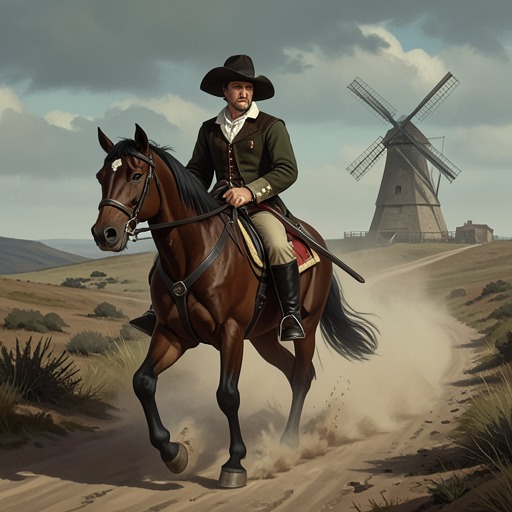
Don QuixoteDon Quixote of La Mancha begins as a nearly fifty-year-old country gentleman and becomes a self-appointed knight-errant after reading chivalric romances until their imagined world seems more real to him than ordinary life. His transformation gives him a code of public service—especially the duty to aid the oppressed—but also leads him to mistake personal conviction for authority, as his intervention to free royal galley slaves brings the Holy Brotherhood after him.
Identity and Household
The opening account places Don Quixote in an unnamed village in La Mancha. He is hardy, spare, gaunt-featured, an early riser, and a keen sportsman. His household consists of a housekeeper past forty, a niece under twenty, and a young servant who works in the fields and at the market. A lance, an old buckler, a lean horse, and a greyhound belong to his modest country life before he recasts those possessions as the equipment of an adventurer.
The account gives several possible forms of his surname: Quixada or Quesada, with Quexana offered as the likeliest. It treats the uncertainty as a minor problem of the histories that record him, while the name he chooses for himself is decisive. Following the example of Amadis of Gaul, he adds his region to Don Quixote and becomes Don Quixote of La Mancha, making his home country part of the identity he means to carry into the world.
His finances and habits make the scale of his reinvention visible. Food consumes three quarters of his income; the remainder goes toward better clothes for holidays, while he wears homespun on ordinary days. His chivalric reading eventually displaces both hunting and the management of his property. To buy books, he sells acres of farmland, converting the practical resources of his household into the imagined world that will govern his life.
Reading and Reinvention
Don Quixote reads with an intensity that becomes obsession. He especially admires Feliciano de Silva, whose intricate, convoluted prose he struggles to understand, sometimes lying awake trying to untangle it. He also takes the injuries of fictional knights seriously: considering the wounds Don Belianis of Greece receives and inflicts, he doubts that even skilled surgeons could have healed him without leaving extensive scars. The books are not merely entertainment for him; he examines their episodes as though they described a coherent and consequential reality.
His response to the romances is both consuming and creative. He admires the heroes and marvels of their adventures, and the unfinished promise at the end of one story tempts him to take up a pen and complete it himself. In time, the distinction between invented adventure and history collapses for him: he accepts the romances as more real than any other histories. From that conviction comes his plan to become a knight-errant, travel in armor, right wrongs, face danger, and win enduring fame. His imagined destination is not modest: he pictures the might of his arm raising him to at least the emperorship of Trebizond.
The change is enacted through objects and names. He cleans and polishes armor inherited from his great-grandfather, long neglected and corroded. Finding that its morion does not make a closed helmet, he fashions an addition from pasteboard; after his first test destroys it, he reinforces it with iron bars and accepts it as fit without testing it again. The improvised helmet turns household salvage into a sign of the chivalric identity he has chosen.
He similarly renames his horse. The animal is a worn-out hack, but Don Quixote spends four days finding a name that will mark both its former condition and its new status as a knight’s mount. He settles on Rocinante, a name he considers grand and expressive of the horse’s supposed promotion. After another eight days of reflection, he chooses Don Quixote and appends La Mancha. Each naming ceremony gives ordinary things a place in the romance he is constructing around himself.
That construction also requires a lady. Don Quixote holds that a knight-errant without love is incomplete, like a tree without leaves or fruit. He imagines a defeated giant being sent to kneel before his chosen lady, then gives that role to a farm girl from a nearby village, Aldonza Lorenzo, whom he had once loved without her knowledge. He renames her Dulcinea del Toboso, elevating a local woman into the princess-like figure required by his ideal of knightly devotion. The transformation reveals his characteristic method: the world supplies its people and objects, while his imagination assigns them roles of romance and grandeur.
Chivalric Purpose and the Law
Don Quixote’s self-appointed mission is not only a private fantasy of fame. He understands knight-errantry as a duty to redress wrongs and aid the distressed, and the encounter with a chain of galley slaves brings that ideal into direct conflict with royal justice. Sancho Panza identifies the prisoners as men being sent to the galleys by the king’s order. He warns that the law is punishing them for their crimes, not wrongfully forcing them.
Don Quixote nevertheless questions the guards about the prisoners’ individual cases. After hearing their accounts, he reasons that although they have been punished for faults, their unwillingness to undergo the punishment, and possible disadvantages such as lack of money or advocacy, may have contributed to their ruin or deprived them of justice. His conclusion is that his knightly office requires him to help people oppressed by the powerful. He first asks the guards and commissary to release the prisoners voluntarily, arguing that others can serve the king under better circumstances; when they refuse, he threatens to compel them by force.
The episode sets a genuine ethical impulse beside a serious failure of judgment. Don Quixote notices the prisoners’ lack of freedom and imagines procedural injustice, but he acts on his own reading of the situation against Sancho’s reminder that the chain represents lawful punishment. His claim to defend the weak thus becomes an assumption of authority over the king’s officers. A warrant later confirms that the Holy Brotherhood has ordered his arrest for freeing the galley slaves, turning his intervention into a continuing legal consequence rather than an isolated quarrel.
Rank, Honor, and Social Possibility
Don Quixote’s imagined future includes the power to distribute rank. When Sancho says that being an Old Christian would qualify him to become a count, Don Quixote replies that, if he becomes king, he can make Sancho a count and thereby make him a gentleman. The exchange shows how thoroughly he inhabits his projected role: he speaks of royal power and noble status as resources he will soon possess and bestow. Sancho’s ambition is treated as something his master can satisfy by granting a title, rather than as a change dependent on wealth, ancestry, or service.
The novel’s biographical framing also connects its treatment of chivalry with Cervantes’s family history, while keeping the author distinct from the fictional gentleman. It describes Cervantes’s ancestry as including genuine knights and suggests that this background gave particular force to his sense of the sham chivalry of romances. It also draws attention to families that had once been great and diminished over time. This context sharpens the contrast at the heart of Don Quixote: inherited symbols and noble language can survive as powerful ideals even when the material and social conditions behind them have changed.
At the Duke’s Castle
A later nighttime scene makes Don Quixote the object, as well as the interpreter, of romantic performance. Troubled by his damaged stockings and by Sancho’s absence, he goes to bed and then rises because the warm night keeps him awake. He opens a grated window slightly and hears Altisidora speaking with a companion in the garden. Altisidora says that the arrival of the stranger has left her unable to sing without weeping; her companion tells her that the Duchess is asleep and that Don Quixote is awake, and encourages her to sing softly to her harp.
The scene places Don Quixote within a courtly display whose language casts him as the object of a lady’s longing. Unlike his invention of Dulcinea, this performance reaches him from outside: he listens from his room, while the voices below arrange the circumstances for him to hear the song. The moment extends the novel’s recurring play between chivalric ideals and the social world that imitates, exploits, or stages them around him.