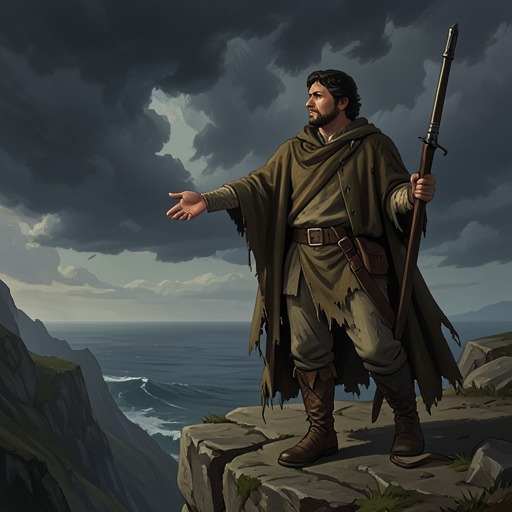
Don Quixote–Dulcinea del Toboso relationship
Don QuixoteDon Quixote’s relationship with Dulcinea del Toboso is less a mutual romance than a sustaining act of imagination: he elevates Aldonza Lorenzo, a woman he has scarcely seen, into the incomparable lady for whom he undertakes adventures and measures his worth. His devotion supplies a purpose for danger and hardship, while the gap between the woman Sancho knows and the noble figure Don Quixote imagines makes the relationship a compact expression of the book’s conflict between chivalric ideals and ordinary life.
The Lady and the Ideal
Don Quixote eventually tells Sancho that his love has lasted twelve years, yet he has seen Dulcinea fewer than four times, and he doubts that she has ever noticed him looking at her. He describes their love as entirely platonic: no correspondence has passed between them, and he says she cannot read or write. His account makes the distance between them more than physical. Dulcinea has not, on the evidence given here, accepted a role in their supposed romance; Don Quixote has constructed that role from afar.
Sancho identifies the woman behind the title as Aldonza Lorenzo. His knowledge is practical and local: he remembers her strength, her carrying voice when calling workers from a distance, and her easy manner with other people. Don Quixote does not deny that she is the same woman. Instead, he insists that she is worthy to be lady of the whole universe. The disagreement is not over identity but over how identity should be understood: Sancho describes a recognizable villager, while his master confers on her the dignity and reach of a chivalric ideal.
Imagination as a Principle of Love
When Sancho questions whether Dulcinea has ever rejected him or been unfaithful, Don Quixote makes the absence of any such cause central to his plan. He intends to enact a knight’s despair without having suffered the betrayal that, in the stories he cites, provokes it. He points to Amadis of Gaul and to Roland as models, but says he will imitate them selectively. His chosen performance is to endure sorrow and tears in the wilderness, rather than reproduce every act attributed to Roland. The penance is therefore not evidence of a change in Dulcinea’s conduct; it is an action Don Quixote chooses to make his constancy visible.
He explains this idealizing method through the conventions of poetry. The celebrated ladies praised by poets, he argues, need not have been actual mistresses: they can be inventions that give a subject to verse and allow their admirers to appear worthy of love. In the same way, Don Quixote persuades himself that Aldonza is as good as the highest princess. He pictures her as he wishes her to be, claiming beauty and a good name for her regardless of her birth. The ideal is not simply a false report about a woman; it is the standard by which he organizes his own conduct and interprets the world.
Devotion in Danger and Separation
During a frightening night beside a stream, Don Quixote declares that he was born in the Iron Age to revive the Golden Age. He casts the peril before him as an opportunity for the mighty deeds reserved for him, then tells Sancho to wait three days. If he does not return, Sancho is to go to El Toboso and tell Dulcinea that her captive knight died attempting deeds that might make him worthy of being called hers. The imagined lady gives the possible death a destination and meaning: even in his absence, Don Quixote wants his final act conveyed to her.
At daybreak he repeats the commission and makes practical arrangements alongside the chivalric farewell. He says he has made a will providing Sancho with wages proportionate to his service, and renews the promise of an island if he survives. Sancho weeps and resolves to remain beside him until the outcome is known. Don Quixote’s devotion to Dulcinea thus unfolds within his bond with his squire: Sancho is asked to serve as messenger, witness, and companion, while the promise of reward acknowledges the material demands of that service. The episode presents ideal aspiration and practical obligation together rather than treating them as separate worlds.
The Letter and the Distance Between Them
Don Quixote composes a letter to Dulcinea in a book, entrusting its delivery to Sancho. Its formal language presents him as wounded by absence and uncertainty, and makes her response decisive: a favorable answer would end his staged madness and penance, while an unfavorable one would leave him in what he calls genuine madness. Whatever the result, he imagines her reply as having power over the course of his experience, although the evidence here establishes neither that she receives the letter nor that she answers it.
The letter’s signature, The Knight of the Rueful Countenance, binds the message to Don Quixote’s chosen identity. He also tells Sancho that no earlier letter has passed between them and that even their rare encounters may have gone unnoticed by her. The document is therefore intimate in its language but one-sided in its circumstances: Don Quixote writes into a relationship whose significance is certain to him, while Dulcinea’s own response remains outside the account. Sancho admires the composition, but his praise does not close that distance.
Chivalric Meaning
The relationship makes private devotion serve a public, performative purpose. Don Quixote’s attachment gives him a lady to invoke before danger, a recipient for the report of his imagined death, and a reason to undertake a deliberately unprovoked penance. Yet his version of love does not depend on shared conversation or demonstrated consent; it depends on constancy and on his own power to imagine Dulcinea in exalted terms. That tension is clearest when Sancho’s concrete knowledge of Aldonza meets his master’s insistence on her universal rank.
The book’s account of Cervantes’s ancestry adds a broader chivalric context: his family could look back to a lineage of genuine knights, even as its fortunes later declined. That contrast between historical chivalry and its literary or social afterlife gives added resonance to Don Quixote’s self-invention. His love for Dulcinea is at once sincere within his chosen code and comic in the distance it opens between an imagined princess and a woman he barely knows. The relationship sustains the knight’s idealism without resolving the discrepancy that makes it legible.