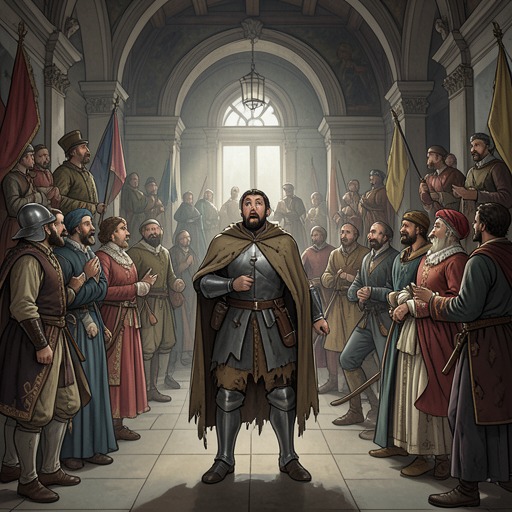
Don Quixote’s Arrival at the Duke and Duchess’s Castle
Don QuixoteDon Quixote’s Arrival at the Duke and Duchess’s Castle turns a chance meeting at a hunt into a carefully staged welcome. Don Quixote and Sancho Panza are received by The Duchess and The Duke, who know their story from its printed First Part and choose to treat the knight as though his chivalric world were real. The reception gives Don Quixote the recognition he has long imagined, while its theatrical design establishes the difference between his belief and the hosts’ knowledge.
The Meeting at the Hunt
The encounter takes place the day after Don Quixote and Sancho leave the river, as evening approaches. Emerging from a wood, they see a hawking party across a green meadow. Among its members is The Duchess, dressed in green and riding a white palfrey with green trappings and a silver-mounted side-saddle. She carries a hawk on her left hand. Don Quixote reads these signs of rank as confirmation that she is a great lady and the mistress of the company, and sends Sancho to request permission to approach and offer his service.
Sancho goes to The Duchess, dismounts, and delivers the message with formal courtesy. She answers by inviting Don Quixote to her and her husband’s country house. Her response immediately makes the encounter more than a polite exchange: she has heard of the Knight of the Rueful Countenance and asks Sancho whether his master is the Don Quixote whose history has been printed, and whether Dulcinea is the lady of his heart. Sancho confirms that the history concerns them and identifies himself as the squire described in it. The two travelers have entered a world in which their adventures are not merely remembered by those who witnessed them; they have become a published story that strangers can recognize.
The Hosts’ Design
The Duchess sends for The Duke and tells him about Sancho’s message as Don Quixote approaches. Both hosts have read the First Part and know of Don Quixote’s delusion. They nevertheless intend to welcome him as a knight-errant and to observe the ceremonies they have encountered in the books of chivalry, a genre they themselves enjoy. Their welcome therefore rests on a deliberate double understanding: to Don Quixote, the ceremony confirms his identity; to his hosts, it is an opportunity to play along with what they already know about him.
The approach does not unfold with the composure Don Quixote expects. As he dismounts, Sancho becomes caught by a rope of his pack-saddle and cannot get free. Don Quixote, accustomed to having Sancho hold the stirrup, throws himself down from Rocinante before his squire can assist him. The poorly secured saddle comes off with him, and both knight and squire end up on the ground. The Duke’s huntsmen help them up. The mishap briefly punctures the formal dignity of their arrival, while the hosts’ preparations allow the reception to resume without abandoning its chivalric script.
The Duke invites the Knight of the Lions to his nearby castle and promises the welcome due to an exalted knight. Sancho corrects him: his master’s current title is the Knight of the Lions, not the Knight of the Rueful Countenance. The Duke accepts the correction. Once Sancho has secured Rocinante’s saddle, the party rides on, with The Duchess asking Sancho to travel beside her because she enjoys his shrewd remarks. Sancho is pleased by her favor and anticipates the good living he hopes to find at the castle.
A Chivalric Welcome
The Duke has gone ahead to instruct the household in how to receive the guests. At the gates, two attendants in long crimson satin garments hurry out and tell Don Quixote that he should help The Duchess down from her horse. She refuses to dismount except into The Duke’s arms, insisting that she should not impose that task on so great a knight. The exchange assigns Don Quixote an honored place in the ceremony, even as its arrangements are visibly controlled by his hosts.
Inside the spacious court, two young women place a fine scarlet mantle over Don Quixote’s shoulders. The household’s servants line the galleries and welcome him with cries of praise, while most of them throw pellets filled with scented water at Don Quixote and the ducal couple. The elaborate reception astonishes him. Its effect is decisive: for the first time, he thoroughly believes himself a knight-errant in reality, because he is being treated as he has read that knights of old were treated. The ceremony does not merely flatter his fantasy; it gives that fantasy a public setting and the gestures of social recognition.
Sancho, Dapple, and the Arrival’s Irony
Sancho enters the castle with The Duchess, but remembers that he has left Dapple at the gate. Concerned that his donkey is easily frightened and dislikes being alone, he quietly asks a duenna, Dona Rodriguez, to have the animal put in the stable. The request brings Sancho’s practical care for his familiar companion into the same courtly scene that has elevated him, for a moment, into the favored attendant of a great lady.
The arrival thus works through contrast rather than a change in Don Quixote’s convictions. A stumble, an unsecured saddle, and Sancho’s worry about Dapple remain alongside mantles, formal honors, and the reception of a knight from romance. Don Quixote takes the performance as proof; The Duke and The Duchess know it is a performance and have arranged it in advance. That difference in knowledge shapes the event’s significance: his imagined chivalric world receives an apparent confirmation precisely because people who understand its fiction have chosen to stage it for him.