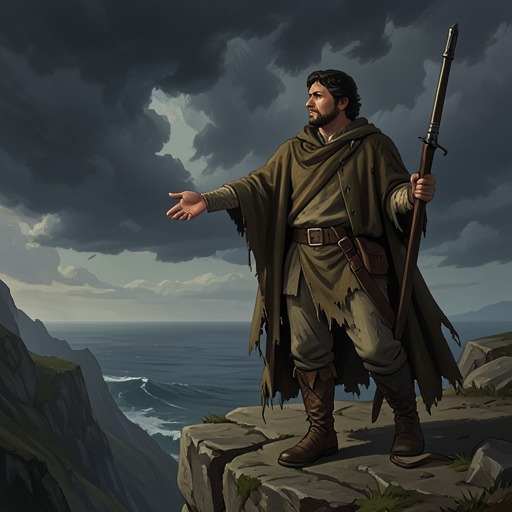
Don Quixote’s madness and recovery
Don QuixoteDon Quixote’s madness and recovery form the final reversal of his story: after years of interpreting the world through chivalric romances, he regains his reason only when fever and melancholy have brought him to the edge of death. He names himself Alonso Quixano the Good, repudiates the books that had shaped his imagined identity, and faces his end not as a knight-errant but as a Christian who wants to set his affairs in order. The recovery is lucid and decisive, but comes too late to restore him to ordinary life.
Illness and the return of reason
After the defeat that ended his travels, Don Quixote falls ill and remains in bed for six days. Those around him suppose that grief is worsening his condition: he has been vanquished, and the liberation of Dulcinea of Toboso, which he had hoped to achieve, remains unfinished. His friends try to cheer him by proposing a pastoral life instead. Samson Carrasco of the village says he has already composed an eclogue and bought two dogs to guard their prospective flock. Sancho Panza stays at his master’s bedside, while the curate and Master Nicholas also visit.
A doctor, dissatisfied with Don Quixote’s pulse, warns that his bodily health is poor and urges attention to the health of his soul. Don Quixote receives the warning calmly; his housekeeper, niece, and Sancho, by contrast, weep as though he were already dead. He asks to be left alone and sleeps continuously for more than six hours. His niece and housekeeper fear that he will not wake, but when he does, he speaks of God’s mercy and of human sin in a manner that strikes his niece as unusually coherent. His recovery of reason begins not with another adventure but with this quiet awakening from a sleep mistaken for death.
Recognition and rejection of chivalric romance
Don Quixote explains that his reason is clear again and that the constant study of books of chivalry had cast shadows of ignorance over it. He now recognizes those books’ absurdities and deceptions, and regrets that this understanding has come so late that he has little time to read other works that might benefit his soul. He says he is near death and wants to avoid leaving behind only the reputation of a madman. When his friends arrive, he makes the change still more explicit: he is no longer Don Quixote of La Mancha, he says, but Alonso Quixano the Good.
His repudiation reaches beyond his own assumed name. He declares himself an enemy of Amadis of Gaul and of the whole company of that hero’s descendants, and says that the stories of knight-errantry now seem hateful to him. For his companions, this declaration initially sounds like another abrupt delusion. Samson Carrasco points out that they have heard Dulcinea is disenchanted and reminds Don Quixote of their plan to become shepherds. Don Quixote refuses the proposed escape into a new role. He insists that his former fantasies, though once real to him and harmful, may now turn to his good through death and repentance. The people who spent the story trying to correct or contain his imagined world cannot immediately recognize that he has truly left it.
Sancho, friends, and the abandoned future
Sancho urges his master not to die without cause and tries to revive their pastoral plan. He suggests that they might find Dulcinea in the fields, and offers to accept blame for the defeat, proposing that Don Quixote was overthrown because he had badly girth-hitched Rocinante. He also invokes the reversals of the chivalric books: a defeated knight might be victorious the next day. Samson agrees with Sancho’s reasoning, but Don Quixote answers that last year’s nests contain no birds this year. He repeats that he was mad and is now in his senses, asking that repentance restore him to the esteem his friends once had for him.
The exchange makes the recovery’s cost visible. Sancho still imagines another chance to travel together, and the friends still offer a future in pastoral disguise; Don Quixote, however, understands that neither a new adventure nor a new identity is possible. His affectionate household and companions respond with grief, but his lucidity is not presented as a return to the life they hope to resume. It is the condition in which he can acknowledge its end.
The will and final repudiation
Once the curate has heard his confession, his friends accept that Don Quixote is dying and in his right mind. The curate tells them that Alonso Quixano the Good is indeed near death, and they return to him as he makes his will. He leaves his property to his niece, after providing for his housekeeper’s unpaid wages and an additional twenty ducats for a gown; the curate and Samson Carrasco are appointed executors. These specific provisions turn his final clarity into action: he recognizes his obligations to the people who have served and cared for him.
His will also makes his condemnation of chivalric books part of his family’s future. If his niece marries, he directs that her prospective husband first be found not to know what books of chivalry are. If she marries a man who does know them, she is to lose her inheritance, which the executors should give to charity. He further asks the executors to seek the supposed author of a circulating Second Part of the Achievements of Don Quixote of La Mancha and ask forgiveness for having unintentionally prompted its absurdities. Even at the point of death, the fictional record of his adventures remains part of his concern; his request frames his own story as something that can be distorted or continued by another writer.
Death and the closing of the story
After making his will, Don Quixote suffers repeated fainting spells during the three days he lives. He receives the sacraments and expresses his detestation of books of chivalry in emphatic terms. He then dies calmly in bed, amid the tears of those present. The notary remarks that he has never read of a knight-errant dying in bed so peacefully and like a Christian. The contrast completes the change: the man who had tried to live according to romances meets death outside their conventions, as Alonso Quixano the Good.
The curate asks the notary to attest that Alonso Quixano, commonly called Don Quixote of La Mancha, has died naturally. He wants to prevent any author other than Cide Hamete Benengeli from bringing him back to life and extending his adventures. The requested testimony gives the ending a second kind of finality: Don Quixote’s recovery closes not only his imagined career as a knight, but also the possibility of another unauthorized continuation. His epitaph preserves both halves of the paradox, recalling a life spent as a madman and a death in his senses.