Dulcinea of Toboso
Don QuixoteDulcinea of Toboso is the imagined lady at the center of Don Quixote of La Mancha’s knightly self-fashioning: a local farm girl is transformed in his mind into the distant, exalted beloved before whom his future deeds will be displayed. The distinction between the woman he once knew as Aldonza Lorenzo and the princess-like figure he invents defines the relationship. In the supplied account, Dulcinea’s significance lies not in actions of her own, but in the ideals and obligations Don Quixote builds around her.
Identity and Invention
After naming his horse Rocinante and choosing his own knightly name, Don Quixote decides that his new identity also requires a lady. He regards love as essential to knight-errantry: a knight without a beloved would be like a tree without leaves or fruit, or a body without a soul. The lady is therefore not an incidental addition to his fantasy; she completes the role he has chosen to inhabit.
The woman behind the invention is Aldonza Lorenzo, a good-looking farm girl from a village near his own, with whom Don Quixote had once been in love. The account stresses the one-sidedness of that attachment: as far as is known, Aldonza never knew of it or gave it any thought. Don Quixote nevertheless makes her his Lady of his Thoughts, replacing her everyday name with Dulcinea of Toboso, a name he considers musical, uncommon, and suited to a princess or great lady. Its reference to El Toboso gives his invention a local anchor even as its sound raises her into romance.
The Beloved in Don Quixote’s Knightly Imagination
Dulcinea supplies Don Quixote with an audience for the victories he expects to win. He imagines that if he defeats a giant, he can send the vanquished enemy to her as a present. The giant, in his imagined speech, would kneel before her, identify himself as defeated by Don Quixote of La Mancha, and submit to her pleasure. The fantasy assigns Dulcinea authority over the fruits of his combat, while allowing Don Quixote to picture his own exploits as already entering the formal world of chivalric fame.
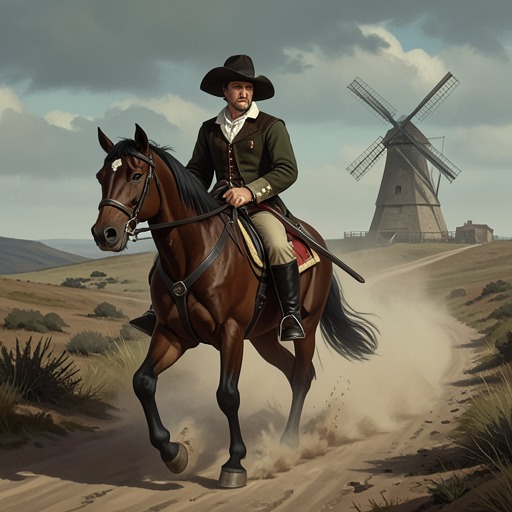
On his first sally, as he rides across Campo de Montiel, Don Quixote addresses Dulcinea as a princess and the lady of his captive heart. He imagines that she has driven him away with scorn and banished him from her beauty, and pleads for her to remember him. These grievances and appeals belong to his self-dramatizing speech: the evidence does not show that Dulcinea has rejected him, heard his declaration, or even knows that he is traveling in her name.
Relationship and Narrative Significance
The relationship is sustained by distance and projection. Don Quixote’s devotion is expressed through titles, imagined audiences, and the language of service, rather than through an exchange between the two. His chosen name for Aldonza and his imagined scene of a defeated giant presenting himself before her turn a local woman into the indispensable recipient of a knight’s victories. The gap between the evidence about Aldonza and the elevated role assigned to Dulcinea makes visible how thoroughly Don Quixote’s chivalric identity reshapes ordinary experience.
The result is a deliberately incomplete portrait. Aldonza’s existence and the fact that she apparently never knew of Don Quixote’s former attachment are stated; her own view of him, any later encounter, and any response to the title Dulcinea are not supplied here. Within the available episodes, she functions as the ideal that gives his adventures a beloved, a destination for imagined homage, and a reason to frame his solitary journey as a story of devotion.