Dulcinea’s enchantment
Don QuixoteDulcinea’s enchantment is the fiction that makes Don Quixote’s ideal lady and the rough peasant girl he sees coexist in his mind, while turning Sancho Panza’s lie into a burden neither man can easily set down. Sancho originally invents the enchantment to explain why Don Quixote fails to recognize the country girl he has presented as Dulcinea del Toboso. Don Quixote accepts the explanation as proof of hostile magic; later, The Duchess deliberately reinforces it by insisting that Sancho, rather than his master, has been deceived. The resulting state is at once a joke, a sustaining romance, and an obligation whose fulfillment is continually deferred.
Origin and Competing Explanations
Sancho’s story begins as a practical evasion. Having fabricated a message from Dulcinea del Toboso and an account of finding her sifting wheat, he later tells The Duchess that he also made Don Quixote believe she was enchanted. He admits that he had devised the deception to escape his master’s scolding, not to injure him. The disguise therefore has no reliable supernatural beginning: its first clear cause is Sancho’s quick invention, and its first purpose is to manage the consequences of his earlier lie. Don Quixote, however, treats the explanation as confirmation of a larger pattern of persecution. He argues that enchanters have changed Dulcinea from fair to foul and have similarly altered the appearances of people around him. When Sancho asks why a knight resembling Samson Carrasco and a squire resembling Tom Cecial should have appeared, Don Quixote claims that malign magicians gave his defeated opponent the bachelor’s face so that affection would restrain his sword. In his account, the same power that changed Dulcinea has repeatedly interfered with what he sees; he counts victory over the supposed enemy as real even while treating the enemy’s identity as magically obscured. Sancho privately knows that his own account of Dulcinea’s transformation was an imposture, and this knowledge makes Don Quixote’s confidence difficult for him to accept. He does not immediately expose himself, because he fears that a reply might reveal his trickery. Later, when Don Quixote describes seeing Dulcinea in the Cave of Montesinos, Sancho’s concealed knowledge gives way to open alarm: he concludes that his master has lost his wits. The enchantment thus divides the two men not simply over what they see, but over the origin of the story they are using to explain it.
The Cave Vision and the Unreachable Lady
Don Quixote’s cave account gives the supposed enchantment a new scene and a wider company of captives. He says that Montesinos showed him three country girls skipping across the meadows like goats, and that he recognized one as Dulcinea del Toboso and the other two as the girls who had accompanied her on the road from El Toboso. Montesinos, according to Don Quixote, did not know them but supposed they were enchanted ladies of distinction. Don Quixote folds their appearance into a landscape already populated by enchanted women from different periods, including Queen Guinevere and her attendant Quintanona. His recognition rests on the clothing Sancho had described, not on a conversation that confirms the woman’s identity. Don Quixote says that Dulcinea did not answer him; she turned away and ran so quickly that he could not follow. Montesinos advised against pursuing her, and Don Quixote says he was also approaching the time when he had to leave the cave. The encounter offers neither reunion nor proof that she recognizes her knight. Her flight preserves the distance on which his idealized devotion depends. The scene also converts longing into a small, material embarrassment. One of the other girls approaches Don Quixote and reports that Dulcinea sends greetings and asks to borrow six reals, offering a new dimity petticoat as security. Don Quixote has only four reals, the coins Sancho had given him to distribute as alms, and he gives those to the messenger. He sends back a declaration of distress at Dulcinea’s need and a vow to roam the world until she is disenchanted, invoking the vow of the Marquis of Mantua. The girl responds with a leap rather than a formal curtsey. Romance, poverty, and physical comedy meet in the same exchange, without bringing Don Quixote any closer to Dulcinea.
The Duchess Turns a Lie into a Shared Belief
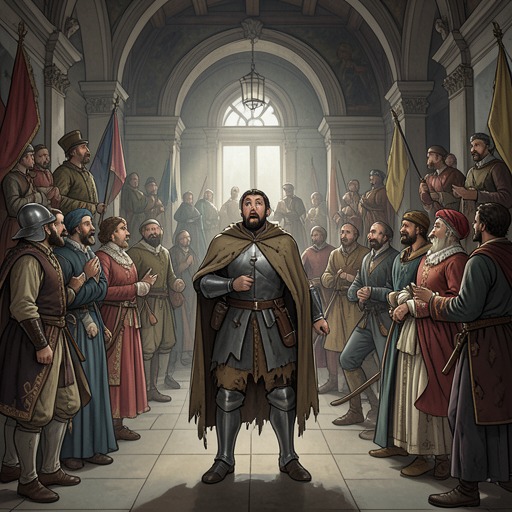
At the castle, The Duchess uses Sancho’s own deception to make the enchantment harder for him to dismiss. She first raises the history’s account of his invented delivery and the wheat-sifting girl, asking how a faithful squire could have falsified both. Sancho checks the room by silently lifting the hangings before he answers, then acknowledges that he considers Don Quixote mad despite the wisdom he sometimes speaks. He explains that he could persuade his master of things without sense because he had already judged him susceptible to them. The Duchess reverses the explanation. She declares that the country girl was and is Dulcinea del Toboso, and that Sancho merely imagines himself the deceiver while being deceived by enchanters. She claims that informants have told her plainly what is happening and predicts that Dulcinea will eventually return to her proper form. This is not an independent demonstration of magic; it is The Duchess’s assertion, used to sustain the account and unsettle Sancho’s confidence in his own knowledge. Sancho adapts to her version, allowing that matters may be the other way around, but explains that he invented his story to avoid a reprimand and meant no harm. The exchange makes the enchantment a contest over who has authority to name what Sancho saw. Don Quixote explains difference as magical transformation; Sancho initially knows the difference was produced by his own fabrication; The Duchess claims superior knowledge and recasts the fabricator as another victim. Her account also protects Don Quixote’s ideal: when she questions Dulcinea’s rank because the history says she was sifting wheat, he answers that the wheat may itself have been altered and that Sancho’s report is no sound measure of her true station.
Love, Obligation, and Deferred Release
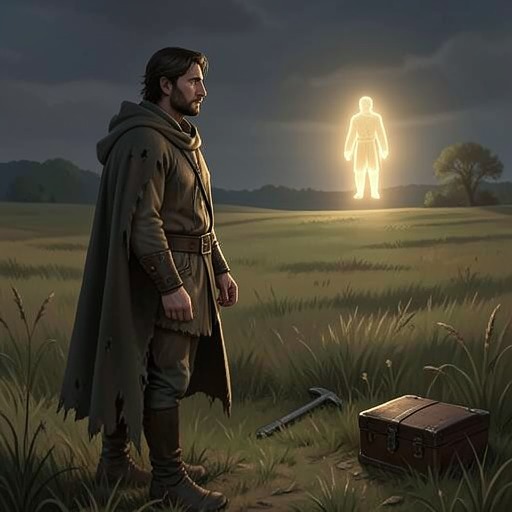
For Don Quixote, the danger of the enchantment is not limited to Dulcinea’s changed appearance. He tells The Duke and The Duchess that, on returning to seek her blessing before his third sally, he found a peasant where he expected a princess. He attributes the change to enchanters who cannot wound him directly and therefore attack what he loves most. His description moves through oppositions—princess and peasant, fair and foul, angel and devil—until he presents Dulcinea’s condition as an injury to his own life and identity. A knight without his lady, he says, is like a tree without leaves, a building without a foundation, or a shadow without a body. The metaphors make her absence the condition that both sustains his knightly role and keeps it incomplete. The story attaches a further condition to her release: Sancho must undergo flagellation. After the staged flight on Clavileño, a parchment announces that the adventure of Countess Trifaldi has been completed and the bearded duennas restored, but that Dulcinea will be delivered only when the squire’s flagellation is completed. Don Quixote reads the notice as confirmation of a genuine future disenchantment. The device converts the false story into a demand on Sancho’s body, placing the cost of Don Quixote’s hope on the person who first invented the explanation. That demand remains active in the surrounding episodes. Altisidora, while bandaging Don Quixote after the cat attack, wishes that Sancho will forget to whip himself so Dulcinea will never be released and Don Quixote will never attain his desire. Her remark makes the supposed cure an instrument in another character’s teasing and courtship, even as it underscores how little control Don Quixote has over the outcome. The enchantment persists not because the narrative supplies an unambiguous magical confirmation, but because each person can use it to interpret, manipulate, or endure the gap between Don Quixote’s ideal and the world that resists it.