Enchantment
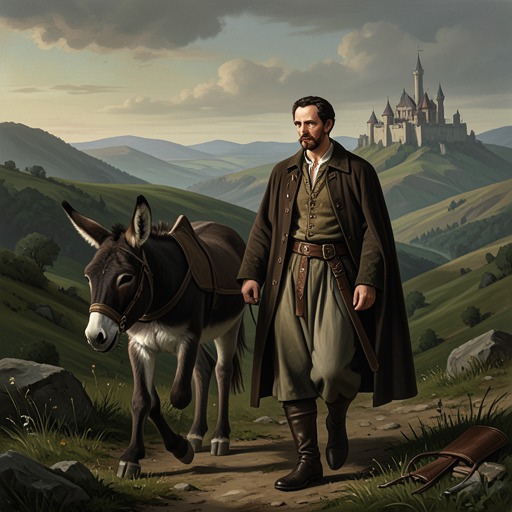
Don QuixoteEnchantment is the explanatory system Don Quixote uses to preserve the world of chivalric romance when ordinary experience refuses to match it. It makes defeat evidence of hostile magic rather than mistaken judgment, and allows objects and people to seem radically different to different observers. Its importance lies in this double function: it keeps Don Quixote’s imagined adventures alive, even as the recurring gap between his account and the material facts makes that account increasingly visible as an interpretation rather than shared reality.
A Flexible Explanation for Contradiction
The idea first takes shape as an explanation for the disappearance of Don Quixote’s library. The curate and the barber have the room walled up to prevent him from finding his books, hoping that removing what they consider the cause of his disorder may help end it. The housekeeper and niece support the concealment with a story: a magician arrived on a cloud, rode away on a serpent, and carried off both books and room. The niece gives the supposed magician the name Sage Munaton; Don Quixote corrects it to Sage Friston, whom he already regards as an enemy. The cover story therefore does more than conceal a household intervention. It supplies a supposed supernatural agent who can be fitted into Don Quixote’s existing account of the world.
That pattern recurs on the road. When Don Quixote attacks windmills, the sails shatter his lance and bring horse and rider down. Sancho Panza has identified them as windmills, but Don Quixote says Sage Friston has changed giants into mills to deprive him of victory. Later, after Don Quixote charges a flock of sheep and is knocked down by the shepherds, he again attributes the mismatch to a hostile sage: the armies he believed he saw have, he insists, been turned into sheep. In both cases, the physical outcome is plain to Sancho, while Don Quixote treats the contradiction as proof that an enchanter has interfered.
Objects and Appearances
Enchantment also explains why a single object can sustain incompatible identities. Don Quixote calls a barber’s basin Mambrino’s Helmet; Sancho recognizes the basin, has kept it in his sack, and plans to have it mended for shaving. Don Quixote answers that the things of knights-errant are subject to illusion and contradiction: what appears to Sancho as a basin appears to him as the helmet. He further reasons that a sympathetic sage has made the helmet look commonplace to other people so that they will not try to take it from him. The object’s actual use and damaged condition do not dislodge its imagined chivalric identity; instead, enchantment accounts for why others fail to see what he believes he possesses.
The same interpretive habit reaches the inn. Don Quixote imagines the building as a castle and its innkeeper’s daughter as a lord’s daughter who has fallen in love with him. When an encounter there ends in confusion and he is left hurt, he attributes the outcome to a giant or an enchanted Moor guarding the imagined lady. On another night, Maritornes and another woman tie his wrist to a bolt while he stands on Rocinante. Unable to move without risking a fall, he believes himself enchanted, invokes the help of the sages and the sorceress Urganda the Unknown, and imagines that he and his horse may remain suspended until another enchanter releases them. His mistaken account turns a practical trick into a prolonged supernatural ordeal.
Sancho’s Counter-Interpretations
Sancho repeatedly supplies explanations grounded in what he can see. He calls the windmills windmills, the sheep sheep, and the helmet a barber’s basin; he also suspects that the curate and the barber, traveling with Don Quixote while he is shut in a cage, are responsible for his confinement. Don Quixote refuses that conclusion. The men may resemble his neighbors, he says, but enchanters can assume any appearance, and their likeness is itself part of the deception. His reasoning makes contrary evidence difficult to use: familiar faces, visible objects, and bodily needs can all be absorbed into a theory of magic.
When Sancho points out that Don Quixote eats, drinks, and answers questions despite claiming to be enchanted, Don Quixote grants that the observation is true but argues that enchantments may have changed over time. He also insists that accepting ordinary imprisonment as the explanation would mean admitting that he has been held through weakness or cowardice, while believing himself enchanted allows him to maintain that he remains ready to help those in distress. Sancho’s practical tests do not simply settle the disagreement; they show how Don Quixote’s account adjusts to preserve its authority. Yet Sancho does not always confront him directly. After inventing the story that Dulcinea del Toboso has been transformed, he later recognizes that Don Quixote’s appeal to enchantment rests on the deception Sancho himself devised, but avoids exposing his own role.
Adventures and Uncertain Knowledge
The concept also shapes how Don Quixote approaches events before they have happened. Seeing clouds of dust on the road, he predicts that armies are advancing and promises that the encounter will establish his fame; Sancho observes that another cloud is rising opposite them. Don Quixote’s expectation of enchantment and adventure is already active before any evidence has been assessed. At the inn, the sight of a cart carrying small flags likewise becomes, in his mind, a possible adventure requiring him to arm himself, although his companion identifies no such threat. The expectation does not merely reinterpret events after failure: it helps determine what Don Quixote believes he is seeing in the first place.
The same uncertainty attends his descent into the Cave of Montesinos. Don Quixote enters after clearing the brambles at its mouth and is lowered by rope. When he returns, he says that he saw Montesinos and other enchanted figures, including Dulcinea in the company of two country girls. Sancho suggests that Merlin or the enchanters have filled Don Quixote’s imagination with the account. Don Quixote insists that he saw and touched what he describes. The exchange leaves the report divided between a claimed encounter and Sancho’s suspicion, without giving Sancho’s explanation the force of direct proof.
At the inn, Don Quixote also interprets Master Pedro’s ape as evidence of a compact with the devil. Because the animal answers questions about past and present but not the future, Don Quixote reasons that its knowledge has the limits he associates with diabolical power. He contrasts that apparent gift with the future knowledge reserved to God and questions why the Holy Office has not investigated the ape. This episode shows enchantment broadening from an explanation for his personal misfortunes into a framework for judging claims of supernatural knowledge.
Narrative Function
Across these episodes, enchantment makes contrary appearances and setbacks narratively usable: a defeat can become a thwarted victory, confinement can become a spell, and a familiar object can retain the identity of a treasured relic. The recurring explanations also create a clear contrast between Don Quixote’s chivalric interpretation and Sancho Panza’s practical observations, while the characters’ changing explanations show how easily either confidence or doubt can be shaped by incomplete knowledge. Enchantment is therefore not a single event or a consistently verified force in these scenes. It is a recurring principle of interpretation, one that allows Don Quixote to continue his imagined vocation and allows the narrative to expose, through concrete objects and consequences, the cost of treating that vocation as literal fact.