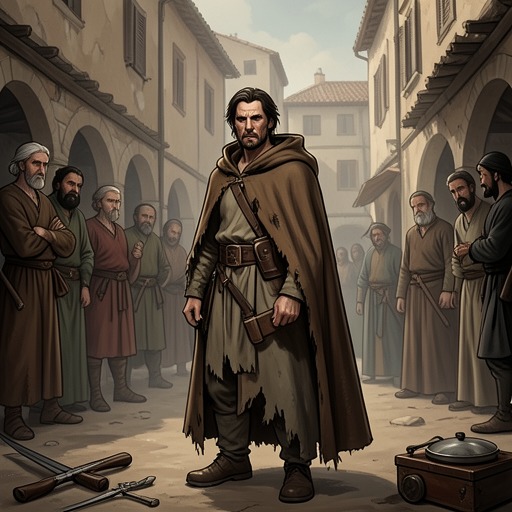
Funeral procession incident
Don QuixoteThe funeral-procession episode exposes the cost of Don Quixote’s habit of converting uncertain appearances into chivalric threats. Mistaking a torchlit party escorting a dead man for a sinister presence, he attacks its unarmed mourners; their flight and the injury to Bachelor Alonzo Lopez turn his professed work of righting wrongs into a fresh injury. The episode’s comic reversal is sharpened by the explanation that the dead man died of fever, not violence, and by Sancho Panza’s practical insistence that the living should leave the scene and eat.
The procession and the mistaken threat
At night, a group of mourners and clerics travels with a litter bearing a dead man. One of the encamisados explains that the party is in haste and cannot stop to answer Don Quixote’s questions. Don Quixote responds by seizing the mule’s bridle and demanding an account, turning a request for information into a challenge to combat. The mule rears and throws its rider; when an attendant curses Don Quixote, he charges with his lance and attacks the group.
The escorts are timid and unarmed, and the party is poorly equipped to resist him. The men flee across the plain with their torches, while the mourners’ enveloping garments make it difficult for them to move quickly. Don Quixote drives them away, and they take him for a devil come to carry off the body. Their fear echoes his own mistaken interpretation: each side sees the other through an imagined danger, but only Don Quixote has the power and willingness to turn that misunderstanding into an attack.
Sancho Panza watches in astonishment and privately recognizes his master’s boldness. His response registers the spectacle’s double character: Don Quixote appears courageous in the immediate action, yet the cause of the fight is his failure to establish what the procession is. The attack seems to confirm his prowess even as the circumstances expose the distance between heroic appearance and useful judgment.
The dead man’s identity and the reversal
After the confrontation, the bachelor identifies himself as Alonzo Lopez, a native of Alcobendas. He explains that he and eleven priests have come from Baeza and are accompanying the dead body to Segovia, where the gentleman was born and where his remains are to be buried. The man died in Baeza and had already been interred there; the party is transporting his bones to their intended burial place. The explanation replaces the nocturnal spectacle that Don Quixote took for an otherworldly threat with a specific, ordinary funeral duty.
Asked who killed the man, Alonzo Lopez answers that a malignant fever did. Don Quixote then reasons that, because no person slew him, there is no human killer for a knight to avenge. He identifies himself as a knight of La Mancha whose calling is to roam the world righting wrongs. The bachelor’s reply turns that declaration back on its speaker: Don Quixote has left him injured, with a broken leg that he says will never be straight again. The supposed defender of the harmed has become the immediate cause of harm, and his explanation—that the mourners’ night dress, lights, and prayers made them appear evil—does not undo the consequences.
Sancho’s practical intervention
Alonzo Lopez asks for help because one of his legs is caught between the mule’s stirrup and saddle. Don Quixote calls to Sancho, who is occupied with the loaded sumpter mule. Before answering, Sancho makes a bag of his coat and gathers as much of the group’s provisions as it can hold. The detail gives the aftermath a material counterpoint to the knight’s concern with combat and reputation: amid the disorder, Sancho attends to the food that can be carried away.
Sancho then helps free the bachelor and sets him on the mule, giving him the torch. Don Quixote tells him to follow his companions and ask their pardon for the wrong he could not help doing them. The apology acknowledges the damage without resolving the contradiction between Don Quixote’s claim that the attack was his duty and the bachelor’s account of its lasting cost. As the bachelor departs, Sancho offers Don Quixote’s name and the title Knight of the Rueful Countenance as the identity by which the party may remember the man who attacked it.
Retreat and the episode’s consequence
Don Quixote would like to inspect the body in the litter, but Sancho argues against lingering. He points to the risk that the beaten men may return, the nearby mountains, their hunger, and the need to make a safe retreat. Don Quixote accepts this counsel without replying, and they proceed between two hills into a wide, secluded valley. The movement away from the procession closes the immediate danger not through a further feat of arms but through Sancho’s assessment of what is prudent.
There, Sancho unloads the animal, and the pair eat the cold provisions carried by the clerics’ sumpter mule. The abundance of food is undercut by the absence of wine or even water; thirst remains after hunger has been satisfied. The episode ends with that practical discomfort, as Sancho notices the meadow’s green grass and prepares to speak further. The ending redirects the story from the supposed mystery of the dead body to the ordinary needs of the living, while leaving the central contrast intact: Don Quixote acts on what appearances seem to promise, and Sancho’s attention to danger, food, and thirst helps them get away.