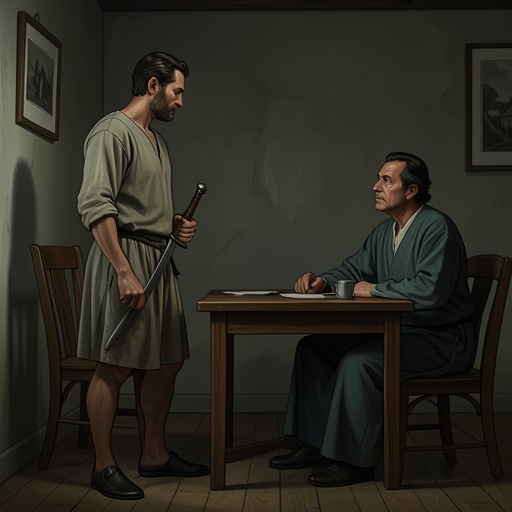
Good governance, Mercy in judgment
Don QuixoteGood governance, Mercy in judgment joins impartial justice to compassion: a ruler must establish the facts and apply the law without favoritism, yet avoid needless harshness toward people subject to human weakness. Don Quixote gives this ideal to Sancho Panza as practical counsel for governing, and Sancho’s judgments on the Island of Barataria show both its promise and its demands. The principle is not simply leniency. It asks a judge to distinguish mercy from bribery, compassion from partiality, and justice from the rigid use of rules without regard to their consequences.
The Ethical Standard
Don Quixote’s instructions begin with the need to resist arbitrary rule. A governor must not substitute personal will for law, nor let the wealth or social standing of a litigant determine whose case receives attention. The tears of a poor person may awaken compassion, he advises, but should not earn greater justice than the arguments of a rich one. The governing task is to discover the truth amid both the rich person’s promises and gifts and the poor person’s pleas. Mercy belongs in the judgment, but it cannot mean that one party’s distress automatically decides the case.
The distinction becomes clearest when Don Quixote considers punishment. Where equity permits a more humane response, a judge need not press the law’s maximum severity against someone who is guilty. He warns that the reputation of a compassionate judge can stand as high as that of a stern one, and that if justice inclines from its proper course, it should be moved by mercy rather than by a gift. The counsel therefore sets two limits at once: a judge must be lenient where possible, but must not confuse leniency with corruption or favoritism.
Don Quixote grounds this standard in a view of human nature. A person brought before a governor is still a fallible human being, vulnerable to the same weaknesses as others; the judge should therefore show forbearance as far as the office allows. He presents mercy not as a denial of justice but as a quality that should shape its exercise. The resulting ideal is both civic and moral: rule requires discernment, self-command, and attention to the person affected by a sentence.
A Principle Put to the Test
Sancho’s governorship turns this instruction into a series of concrete decisions. In one case, an old debtor swears that he has repaid ten crowns, while the creditor says he cannot remember receiving them and withdraws his demand. The debtor leaves carrying a stick, and Sancho notices both his departure and the creditor’s apparent resignation. After thinking, he calls the debtor back and asks for the stick. It contains the money: the debtor had returned the crowns by handing over the stick, then sworn truthfully that he had given them back, while the creditor had not known where the money was. Sancho returns the ten crowns to the creditor. His decision depends not on taking either man’s assertion at face value but on noticing a detail that resolves the dispute. The episode makes sound judgment a matter of careful attention as well as moral principle.
Another case shows a less straightforward judgment. A man and a woman have struggled over a purse, and the woman insists that she would sooner lose her life than surrender it. When the man admits he cannot take the purse from her, Sancho returns it to him. He reasons that she showed more strength defending the purse than she would have needed to defend herself, and orders her to leave the island, threatening punishment if she returns. The decision turns on conduct observed in the dispute, but it also reveals a limit in Sancho’s application of his authority: his conclusion about the woman’s claim is an inference from her resistance, not an independently established account of what happened. The scene thus complicates the praise his judgments receive. Decisiveness can make a governor appear perceptive, but a confident inference is not the same thing as certain knowledge.
The most explicit test of mercy comes in a dilemma about a traveler at a bridge. A law requires the traveler to swear whether he is going to die on the gallows beyond it: a truthful answer means he may cross, while a false one requires that he be hanged. The traveler says he will die there, so either outcome makes the oath both true and false. Sancho first articulates the contradiction as a proposal to divide the traveler’s fate between acquittal and punishment, then rejects that impossible resolution. Since the arguments for condemning and releasing him are equally balanced, he chooses to let him cross, recalling Don Quixote’s instruction to lean toward mercy when justice is uncertain. The decision does not claim to solve the law’s contradiction. Instead, where the rule cannot yield a coherent verdict, Sancho declines to make uncertainty a reason for harm.
Advice, Practice, and the Governor’s Character
Sancho’s memory of Don Quixote’s teaching is important to the decision. He says the principle did not originate with him, but was among the precepts his master gave him before he left to govern. The episode depicts counsel as something that must be recalled and applied amid pressure, rather than merely admired as abstract wisdom. The majordomo praises the ruling by comparing it to the work of Lycurgus, but the scene’s ethical force rests on Sancho’s stated reason: when the claims for punishment and release are evenly matched, doing good is preferable to doing harm.
Don Quixote’s advice also anticipates situations in which a judge’s personal feelings threaten impartiality. Sancho is told to put aside injury when judging an enemy, to keep passion from distorting another person’s case, and to avoid letting the tears of a handsome woman displace consideration of the merits. He should not add verbal abuse to punishment, since the sentence itself is already a burden. These instructions make restraint part of public office: justice is compromised not only by bribes but also by resentment, attraction, anger, or a ruler’s desire to humiliate someone under his authority.
The wider narrative connects this ethic with Don Quixote’s own declared duty to assist people under the oppression of the powerful. When he encounters a chain of galley slaves, he suspects that torture, poverty, inadequate advocacy, or a judge’s bad decision may have contributed to their punishment. He asks the guards and commissary to release them, invoking the freedom given by God and nature, and threatens to use force if they refuse. That intervention is not identical to Sancho’s work as a governor: Don Quixote acts as a self-appointed knight, not as a judge hearing a case. Yet both episodes place the vulnerable person against the authority of an established process and ask whether obedience to punishment is enough when justice may have failed. Don Quixote’s speech about arms supplies a related civic ideal: human letters aim to establish distributive justice and uphold good laws, while arms ultimately have peace as their purpose. Law and force are presented as means whose value depends on the human good they serve.
Administration and Its Limits
Sancho’s exercise of office extends beyond individual court cases. During his governorship, he drafts ordinances intended to regulate commerce, prices, labor, and public conduct. He bars provision sellers, permits wine to be brought in from wherever it is produced if its origin is declared, and prescribes severe consequences for watering wine or falsifying its name. He reduces the prices of shoes, boots, and stockings, and fixes servants’ wages because he considers them to have risen excessively. These measures show the governor trying to make the standards of everyday exchange visible and enforceable, not confining government to dramatic disputes in court.
Other ordinances address public morality and the verification of claims. Sancho penalizes lewd songs and forbids blind singers to present miracles in verse without authentic evidence, reasoning that fabricated accounts injure the reputation of genuine ones. He creates an alguacil of the poor, whose task is to examine whether people seeking help are genuinely poor rather than to harass them. The measure brings together concern for need and concern about deception: assistance should reach those who require it, but the office must distinguish genuine hardship from pretence. Across these decrees, Sancho’s government aims to protect the public while checking abuses, although the range and severity of the rules also show how easily reform can become expansive regulation.
The practical conditions of the governorship expose another limit. Sancho complains that he went hungry throughout his tenure, that Doctor Pedro Recio restricted his food, and that enemies attacked him; he also says he had no opportunity to take bribes or levy taxes. After leaving office, he insists that he entered naked and returns naked, without gain or loss. His account undercuts the idea that authority necessarily brings wealth, and his experience of hunger gives bodily force to Don Quixote’s earlier insistence that judgment should attend to the hardships of the poor. When Sancho is later rescued from a pit, Don Quixote warns him that governors are criticized whether they leave office rich or poor. The standard of good rule is therefore not public approval or personal profit, but the quality of decisions and the governor’s own conscience.
Significance
Good governance, Mercy in judgment is a practical ethic tested through contrasts: law against equity, evidence against assumption, public responsibility against private passion, and compassion against corruption. Sancho’s decisions are praised because he attends to particulars, remembers his teacher’s precepts, and favors mercy when a legal dilemma offers no fair way to condemn. Yet the purse case prevents his wisdom from becoming an uncomplicated guarantee of justice; judgment still depends on what a ruler chooses to infer from the evidence before him.
The concept also links distinct forms of authority in the novel. Don Quixote’s appeal for the galley slaves is driven by a knight’s duty to defend the oppressed, while Sancho’s island cases and ordinances examine the responsibilities of a governor. In both, justice must answer to human vulnerability, but good intentions alone cannot settle whether an intervention is fair. The governing ideal that emerges is neither bare enforcement nor indiscriminate mercy: it is the disciplined effort to discover the truth, judge without private bias, and temper punishment when the circumstances warrant compassion.