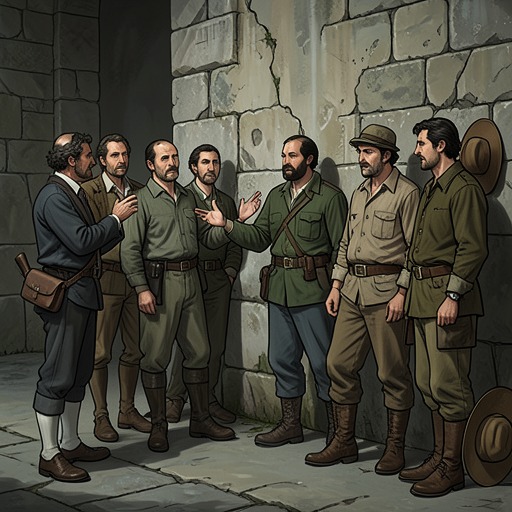
Hairdresser Copper Basin Incident
Don QuixoteThe Adventure of Mambrino's Helmet makes the collision between Don Quixote's chivalric imagination and ordinary material life almost comically tangible. A barber's brass basin, made conspicuous by the rain, becomes in Don Quixote's eyes the legendary helmet he has long desired; Sancho Panza recognizes the man, his grey donkey, and the shining household object for what they are. The encounter ends not with a shared recognition but with Don Quixote claiming the basin and inventing a history of enchantment and damage to preserve his interpretation. The episode compresses the book's larger satire into one object that can be seen, handled, and explained in incompatible ways.
The Promise of a New Adventure
The encounter follows the previous night's misadventure at the fulling mills. As rain begins, Sancho proposes entering the mills, but Don Quixote refuses, still repelled by what happened there, and they turn onto a different road. Soon Don Quixote sees a figure approaching with something shining on his head. He recasts the change in their fortunes through a proverb: the previous night's adventure may have been closed to them, but another, better one is now opening. This new opportunity, he declares, is the helmet of Mambrino, for which he says he has already taken an oath.
Sancho's warning gives the moment its immediate counterpoint. Remembering the mills, he urges his master to be cautious and does not want another encounter to end in blows. Don Quixote dismisses the comparison and insists that the approaching figure is a knight on a dapple-grey steed wearing a golden helmet. Sancho reports a less elevated sight: a man on a grey donkey with something bright on his head. Their disagreement is not over a hidden object but over what counts as evidence. Don Quixote treats the familiar landscape as the setting of a romance; Sancho's account stays close to the visible details.
The Barber and the Basin
The narrator supplies the plain explanation behind the competing descriptions. Two villages lie in the area: the smaller has neither a barber's shop nor an apothecary, so the barber of the neighboring larger village serves its residents. He is on his way to attend to a sick man who needs bleeding and another who needs shaving, carrying a brass basin for the latter errand. When rain threatens to spoil his hat, he puts the clean basin over his head. Its brightness catches the light at a great distance. He rides a grey donkey, just as Sancho says; to Don Quixote, however, the glint, the animal, and the rider together form a knight and a golden helmet.
Don Quixote does not stop to ask the supposed knight to explain himself. At Rocinante's top speed, he charges with his lance lowered and calls on the man to defend himself or surrender what Don Quixote considers rightfully his. The barber, taken by surprise, escapes the charge by falling from his donkey, then runs across the plain. The basin is left behind. Don Quixote takes the barber's flight as proof of a defeated pagan's prudence, comparing him to a beaver that parts with what its pursuers seek. The interpretation transforms an ordinary escape from an unexpected attack into a small episode of chivalric combat.
Claiming and Reinterpreting the Object
Don Quixote tells Sancho to pick up the basin. Sancho handles it as an everyday utensil, judging that it is worth a real of eight if it is worth even a maravedis, and hands it over. Don Quixote tries it on, turning it this way and that because it does not fit. Rather than let its size and shape undermine his certainty, he concludes that the original pagan owner must have had an exceptionally large head and that half of the helmet is missing.
Sancho can barely contain his laughter when his master calls the basin a headpiece, but checks himself for fear of provoking Don Quixote. When asked what amuses him, he points out that the supposed helmet looks exactly like a barber's basin. Don Quixote absorbs this objection without yielding the object or the legend. He proposes that someone who failed to recognize the helmet's value melted down half of the pure gold and fashioned the remainder into the basin-like form. Its transformation, he insists, makes no difference to him: at the first village with a blacksmith, he will have it restored so that it surpasses the helmet forged by the god of smithies. Until then, he will wear it as best he can, since even its present state should protect him from a stone.
That promise of protection carries its own comic qualification. Sancho recalls the earlier battle in which sling stones struck Don Quixote and broke the flask containing his balsam. The basin may be claimed as armor, but the recollection makes clear that Don Quixote's confidence in protective objects has already been tested by ordinary weapons and ordinary consequences. The scene does not resolve the dispute by changing what the object is; instead, Don Quixote makes its physical inadequacy part of a new account of its damage and future repair.
Chivalric Fiction and the Reader's Judgment
The incident enacts the purpose declared in the preface: the book presents itself as an attack on the books of chivalry and their influence. Here, the romance is not merely recalled in speech; it determines how Don Quixote sees a passerby, reads an object, and justifies an attack. The narrator's explanation places the mundane circumstances beside his knightly interpretation, allowing the discrepancy itself to expose how the fantasy works. Don Quixote's imagination does not erase the basin's material presence—he handles it, tests its fit, and proposes a blacksmith's repair—but it repeatedly incorporates those facts into the story that protects his belief.
The Canon of Toledo later criticizes chivalric books for their disproportion and improbability, arguing that fiction gives greater pleasure when it resembles what could happen. Don Quixote defends those romances by appealing to their appearance of truth and to their detailed accounts of knights and their deeds. The basin episode turns that debate into action. Don Quixote's belief in the legendary helmet survives the sharpest possible test: Sancho names the object correctly, and the narrator explains precisely how it came to be on the barber's head. Yet the ending leaves the basin in Don Quixote's possession as a helmet in need of repair. The comedy depends on that unresolved division between what the reader knows, what Sancho sees, and what Don Quixote insists the object can become.