It is a hard case to make slaves of those whom God and Nature made free
Don QuixoteThe expression “it is a hard case to make slaves of those whom God and Nature made free” gives moral force to the idea that liberty is a natural condition, not a favor granted by human authority. In Don Quixote, however, the sentence does not stand apart as a simple maxim. It is bound to an act of liberation and to its damaging aftermath, so that the novel tests the principle through the consequences of the speaker’s conduct.
The Claim and Its Context
Don Quixote’s words are recalled as a “beautiful sentiment” in a discussion of the novel’s moral direction. The phrase’s appeal rests on a broad contrast: human beings are made free by God and Nature, while slavery is an imposed condition. Its language therefore casts liberation as the restoration of something fundamental, rather than as an exceptional gift bestowed by a rescuer.
The novel also gives captivity a more extended and concrete place in Captain Viedma’s embedded narrative. He recounts being captured after a naval battle and describes a system in which Christian captives were held in a bano, with some designated for ransom and others compelled to labor for the city. This account supplies a distinct context for the book’s concern with freedom: captivity is not only an abstract moral wrong but a condition shaped by ownership, ransom, forced work, and the uncertain possibility of escape.
Liberation and Reversal
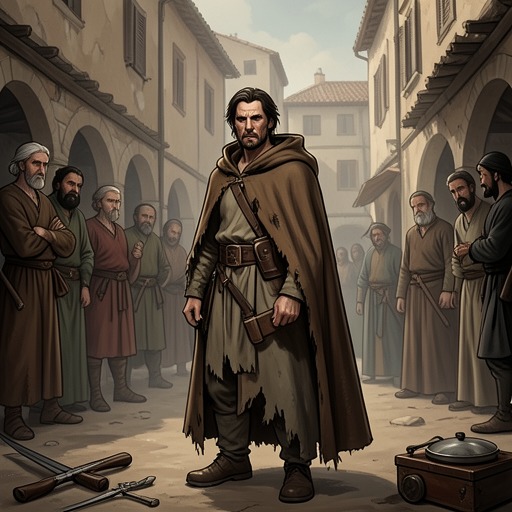
The expression is associated with Don Quixote’s intervention on behalf of the galley slaves. His defense of their freedom leads him to release men being transported under guard. Yet the act does not produce the gratitude or just outcome he expects: the freed men pelt him. That reversal gives the words their particular dramatic tension. The claim for liberty remains forceful, while the manner of its enactment exposes Don Quixote’s failure to reckon with circumstances and consequences.
The episode is central to the distinction drawn in the novel’s later interpretation between genuine enthusiasm and enthusiasm distorted by vanity, self-conceit, or impulse. The criticism is not that compassion for the enslaved is itself foolish. Rather, the intervention is presented as reckless because it releases people without a sound judgment of what will follow, leaving the rescuer injured by the very men he has freed and creating trouble for the surrounding community.
Cervantes’s Experience of Captivity
The phrase also carries resonance beside the account of Cervantes’s own military service and captivity, though the available evidence does not establish it as a direct statement of his personal experience. Cervantes left a chamberlain’s position and enlisted as a soldier in 1570. At the Battle of Lepanto he insisted on taking his post despite illness, was wounded, and permanently lost the use of his left hand. In 1575, while returning to Spain with his brother Rodrigo, he was captured by Algerine galleys.
Cervantes’s letters of recommendation led his captor to regard him as a person of consequence and therefore to demand a ransom his family could not initially meet. His parents and sisters made efforts to raise the money; after a further payment was assembled and supplemented by borrowing, he was freed on September 19, 1580, after nearly five years in captivity. These biographical circumstances make the novel’s concern with enslavement especially resonant, but they do not collapse the distinction between Cervantes’s life and Don Quixote’s conduct: the expression’s immediate dramatic meaning comes from the character’s liberation of the galley slaves and its reversal.
Meaning and Limits
The sentence endures in the novel because its moral clarity is placed beside practical failure. Don Quixote recognizes an injustice, but recognition alone does not make his response wise or effective. The ensuing attack prevents the episode from becoming a straightforward celebration of heroic rescue, just as the novel’s critique of his impulsiveness does not erase the force of his objection to slavery.
The expression thus holds two judgments in view at once: making free people slaves is a grave wrong, and acting on a worthy conviction without regard for consequences can itself cause harm. Its significance lies in that unresolved pressure between principle and judgment. The words defend liberty; the episode asks what responsibility accompanies the attempt to restore it.