Knight of the Ragged Countenance
Don QuixoteThe Knight of the Ragged Countenance is Cardenio, a noble Andalusian whose devastation over Luscinda’s apparent marriage to Don Fernando leaves him living among the ravines and brambles of the Sierra Morena. His story makes heartbreak visible as both a social injury and a physical condition: in lucid moments he asks for food courteously and weeps with gratitude, while in fits of madness he snatches it from shepherds, even when they offer it freely. The eventual reunion of Cardenio and Luscinda, and his alliance with Dorothea against Don Fernando, turn a tale of private ruin toward a fragile possibility of repair.
Identity and Background
Cardenio comes from a wealthy, noble family in one of the principal cities of Andalusia. He and Luscinda, who is also noble and wealthy, love each other from childhood. Their families know of the attachment and appear to accept that it may lead to marriage, since their standing and means are equal. As they grow older, Luscinda’s father refuses Cardenio admission to the house, but the separation does not end their intimacy: they exchange letters and modest replies, and Cardenio writes songs expressing his longing.
When Cardenio asks Luscinda’s father for her hand, the father does not reject the match outright. Instead, he says that Cardenio’s living father must formally make the request; Luscinda is not to be given or taken without that father’s consent. Cardenio accepts this reasoning and sets out to tell his father, expecting his family to agree. That anticipated route to marriage is interrupted by his friendship with Don Fernando, a young nobleman whose confidence makes Cardenio a participant in a second, concealed courtship.
Cardenio’s appearance in the mountains marks the distance between his origins and his present condition. Don Quixote of La Mancha first sees him bounding along the mountainside, nearly naked. When the youth approaches, his ragged clothes include a tattered, amber-tanned doublet, which Don Quixote takes as a sign that its wearer is not of low birth. The contrast is striking: a gentleman’s courteous greeting and formal bearing survive in a figure otherwise reduced to wilderness and rags.
Betrayal and Life in the Sierra Morena
Don Fernando confides that he desires a beautiful peasant woman, Dorothea, and promises to make her his wife in order to overcome her virtuous resistance. Cardenio first tries to dissuade his friend. He then considers informing Don Fernando’s father, Duke Ricardo, because he sees concealment as a failure of his duty to the family he serves. Don Fernando anticipates this and proposes that they travel together to Cardenio’s home under the pretext of buying fine horses. Cardenio welcomes the plan because it gives him a chance to see Luscinda again.
The proposed journey conceals a betrayal already in motion. Don Fernando has pledged himself to Dorothea and is waiting for a safe opportunity to disclose the affair; after possessing her, his desire cools, and he wants to leave partly to evade the promise. Once they reach Cardenio’s city, Cardenio renews his attachment to Luscinda. He tells Don Fernando about her beauty, wit, and liveliness, then shows her to him one night by a window, in the light of a taper. Don Fernando becomes enamored of her. Cardenio’s openness to a trusted friend thus helps bring about the rival claim that will destroy his expected marriage.
Cardenio’s account of the crisis is not delivered in one uninterrupted sitting. During an earlier telling, an episode involving Don Quixote’s insistence on the obligations of chivalry leaves the story unfinished. When Cardenio later recounts his misfortunes to the curate and barber, the fit of madness keeps away long enough for him to complete it, including the note Luscinda had written to him. The narrative interruption mirrors the break in Cardenio’s own life: crucial evidence of Luscinda’s intentions exists, but it cannot at first be brought fully into view.
In the Sierra Morena, Cardenio describes himself as unable to recover health without Luscinda and unwilling to accept consolation while she seems to belong to another. He says he has chosen his isolation himself and cannot find the strength to leave it. Recollections of the wrong done by Don Fernando and the beauty and apparent treachery of Luscinda repeatedly overwhelm his reason. Shepherds report the practical rhythm of his disorder: in one state he begs for food in God’s name, politely receives it, and offers thanks; in another he takes it by force. He sometimes roams the road to intercept food being carried from the village. Hoping either to help him recover or to learn his identity and notify his family, a goatherd and four companions resolve to take him to Almodovar, eight leagues away. Before they can carry out that plan, Cardenio appears before Don Quixote and the goatherd.
Dorothea and a New Purpose
Cardenio’s meeting with Dorothea transforms his relation to his own story. After she explains her misfortune, he recognizes her as Don Fernando’s abandoned wife. He identifies himself as the man Luscinda had declared to be her husband and explains that he had witnessed the wrong done to Dorothea’s hopes as well as his own. He left the city after hearing Luscinda apparently accept Don Fernando, unable to endure the scene, and sent her a letter through his host before withdrawing into the mountains.
At first, Cardenio had believed that Luscinda’s fainting and the paper found on her would leave his loss unresolved. Dorothea’s account supplies a reason to hope: if Luscinda remains faithful to him and Don Fernando has already made Dorothea his wife, neither rival claim need be treated as settled by the apparent wedding. Cardenio therefore asks Dorothea to prepare for better fortunes, as he intends to do himself. The change is not a sudden cure for his madness, but a redirection of his strength: he promises not to leave Dorothea until Don Fernando acknowledges his obligation, and, if persuasion fails, to challenge him on her behalf. He sets aside his own grievance temporarily in order to defend hers.
The curate and the barber offer to take Cardenio and Dorothea to the curate’s village, where they can obtain what they need and consider how to find Don Fernando or restore Dorothea to her parents. Cardenio accepts their help. His willingness to travel with them contrasts with his earlier resolve to remain in the mountains until death, and gives his story a purpose beyond replaying his loss.
Recognition and Reunion
At the inn, Cardenio hears a woman insist that her truthfulness, not deceit, has brought her to misery. Recognizing the voice, he cries out and moves toward the speaker. The veiled woman attempts to enter his room, but the gentleman holding her back restrains her. Her veil falls, revealing Luscinda. The gentleman’s own veil slips away in the struggle, and Dorothea recognizes her husband, Don Fernando. Dorothea faints; Cardenio, hearing her cry and mistaking it for Luscinda’s, rushes out. He sees Don Fernando holding Luscinda, while she and Cardenio recognize one another by their voices and then by sight.
Luscinda tells Don Fernando that neither his threats nor his promises have detached her from Cardenio, whom she calls her true husband. When Don Fernando releases her, Cardenio catches her as she is about to fall. Luscinda embraces him and renews her declaration of fidelity. Their reunion is bodily as well as verbal: after separation and uncertainty, Cardenio’s arms again become the place where Luscinda can rest.
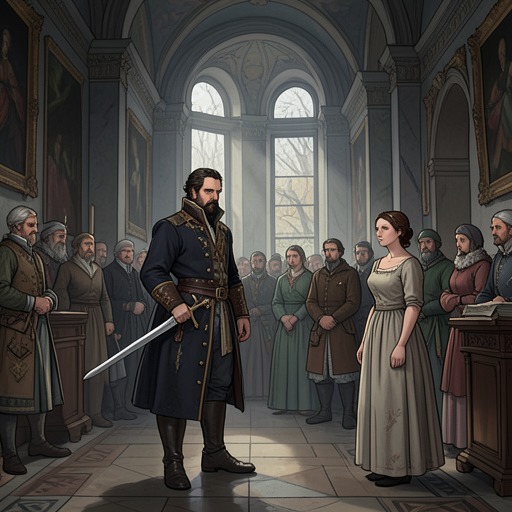
The recognition does not immediately settle the conflict. Dorothea sees Don Fernando put his hand to his sword and throws herself around his knees, asking him to consider that his wife is there before him and that Luscinda is already in her husband’s arms. Others add their arguments. Don Fernando finally accepts the force of what has been revealed, embraces Dorothea, and asks her not to reproach him for his wrong. He also recounts the events that followed his discovery of Luscinda’s written declaration: he had intended to kill her, was prevented by her parents, and later learned that she had withdrawn to a convent rather than live apart from Cardenio. He and his companions entered the convent and carried her away.
Cardenio and Luscinda kneel before Don Fernando in gratitude when he accepts their reunion, and he raises and embraces them. Their restored relationship is not presented as a resolution achieved by Cardenio’s solitary endurance; it comes through disclosure, recognition, Dorothea’s appeal, and Don Fernando’s decision to relent. At the inn, Sancho Panza weeps too, though he explains that his disappointment comes from learning Dorothea is not the imagined Queen Micomicona from whom he expected favors.
Narrative Role and Significance
Cardenio’s plot is built around misrecognition and delayed knowledge. He reads Luscinda’s apparent acceptance of Don Fernando as proof of betrayal, leaves before seeing what happens to her, and retreats with only his own grief for company. Later, Dorothea’s story reveals the connection between their injuries, while Luscinda’s voice at the inn makes recognition possible before the assembled company knows who she is. The written note, the interrupted tale, the voice through a door, and the falling veil each hold back or release knowledge in turn.
His changing conduct also complicates the image of madness as simple incapacity. The goatherds distinguish between Cardenio’s violent fits and his lucid courtesy, and Cardenio himself recognizes that recollection can overwhelm him. Yet when Dorothea’s story gives him a concrete obligation, he can reason about their circumstances, offer assistance, and formulate a plan. His recovery is not described as complete; rather, the narrative shows a moment in which sympathy and a shared cause draw him out of self-destructive isolation. In the reunion, he is no longer merely the wounded man waiting for consolation to fail. He acts for Dorothea, recognizes Luscinda, and receives her renewed fidelity, while the story’s ending allows the injuries caused by Don Fernando’s choices to be acknowledged by those who suffered them.