Knight of the White Moon’s one-year retirement condition
Don QuixoteThe Knight of the White Moon’s one-year retirement condition is the wager Don Quixote accepts in a duel on the beach at Barcelona: defeat means returning to his village and giving up arms and adventures for a year. Its force comes not from magic or a public decree but from the terms of a challenge he freely accepts and, after losing, chooses to honor. The condition redirects his journey home, while his refusal to withdraw his devotion to Dulcinea del Toboso preserves a distinction between surrendering his travels and surrendering his conviction.
Terms of the Challenge
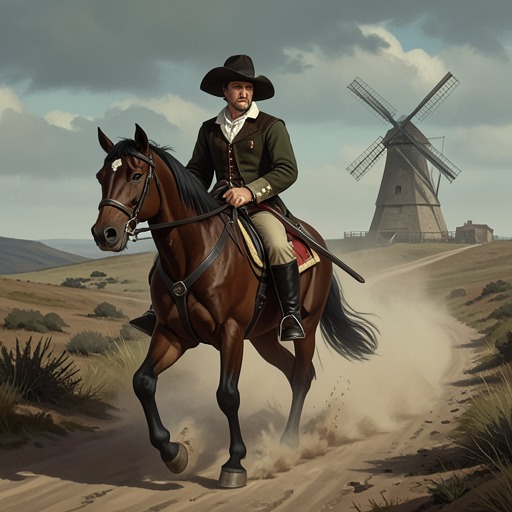
The Knight of the White Moon approaches Don Quixote in full armor, his shield marked with a shining moon. He frames the contest as a test of whose lady is more beautiful: Don Quixote must acknowledge that the Knight’s lady, whoever she may be, surpasses Dulcinea del Toboso. The challenger offers to spare Don Quixote if he admits this; if Don Quixote fights and loses, the required satisfaction is not money or the surrender of his beloved’s honor, but withdrawal to his village and abstention from arms and adventures for a year.
The terms also set out the reverse outcome. If Don Quixote wins, the Knight’s head, arms, horse, and renown are to become his. Don Quixote accepts the challenge and its conditions, but expressly rejects any transfer of the opponent’s renown: he does not know what those achievements amount to and is content with his own. His answer narrows the prize without weakening the wager that will govern his conduct if he is defeated.
The challenger describes the retirement as a period of peace, quiet, and useful repose, adding that it would benefit Don Quixote’s substance and the salvation of his soul. These are the Knight’s stated grounds for the condition, not reasons Don Quixote offers for accepting it. Don Quixote answers instead from his certainty about Dulcinea’s beauty and agrees to fight before the day set for the contest expires.
Defeat and the Binding Promise
The contest ends with Don Quixote bruised and stunned. Even in defeat, he will not say that Dulcinea is surpassed. He maintains that she is the fairest woman in the world and treats his physical weakness, rather than her beauty, as the cause of his loss. He invites the Knight to kill him, but the victor refuses: Dulcinea’s fame is to remain undiminished, and the retirement condition is the only satisfaction demanded.
Don Quixote then draws the boundary that makes the agreement bearable to him. So long as nothing is required to Dulcinea’s prejudice, he will observe the rest as a true and loyal knight. He has lost the duel, but he does not treat that defeat as permission to abandon either his belief in her or his pledged word. The condition therefore separates two kinds of concession: he accepts the restriction on his conduct, while resisting any demand that would make him deny his lady.
The viceroy, Don Antonio, and others present hear the agreement and Don Quixote’s response. Once his promise is given, the Knight of the White Moon rides back into the city. The witnesses make the pledge a visible turning point rather than a private intention. Don Quixote is carried into Barcelona in a hand-chair; Rocinante cannot move for the moment, and Sancho Panza fears that his master is badly injured and that their hopes of reward have vanished. Sancho also understands that the loss binds Don Quixote not to take up arms for a year.
Observance and the Road Home
After leaving Barcelona, Don Quixote looks back at the place where he fell and mourns the loss of his glory and happiness. Sancho Panza counsels patience in adversity, drawing on the contrast between his former happiness as governor and his present life as a squire on foot. Don Quixote answers by rejecting chance as the explanation for events: he says that he has made his own fortune, but without sufficient prudence, and that his confidence has cost him dearly. In particular, he recognizes that Rocinante’s feeble strength could not withstand the great bulk of the Knight of the White Moon’s horse.
That assessment does not lead him to contest the result or evade the agreed consequence. Don Quixote says that although he has lost his honor, he has not lost—and cannot lose—the virtue of keeping his word. When he was a knight-errant, he supported his achievements through action; now, as a humble squire, he will support his words by fulfilling his promise. He sets out with Sancho Panza to spend the year of his novitiate in their own country, expecting that seclusion will restore strength before he returns to the calling of arms he has not forgotten.
Sancho Panza objects to the practical burden of a long journey on foot. He proposes hanging Don Quixote’s armor on a tree as a trophy and traveling on Dapple, with the stages arranged to avoid long marches. Don Quixote accepts the suggestion that the armor be hung up for a trophy. The detail gives the withdrawal a physical sign: the arms associated with his public identity are to be set aside, while the pair continue their journey under the restriction.
Function and Significance
The condition changes the direction of Don Quixote’s story through a rule he has accepted for himself. The Knight of the White Moon’s victory does not persuade him that Dulcinea is less beautiful, nor does the victor demand that he confess it. Instead, the agreed penalty suspends Don Quixote’s active pursuit of adventures. His loyalty to the pact makes the loss consequential even though it does not undo the belief that prompted the duel.
The episode also places action and speech in deliberate contrast. Don Quixote acknowledges that he misjudged the contest, including the disparity between the horses, and he can no longer maintain his former course by force of arms. Yet his promise remains something he can perform. For the year ahead, fidelity takes the form of restraint: he must keep away from adventures and weapons, and he accepts that obligation without treating it as a renunciation of his future identity. The retirement condition thus turns a defeat into a test of whether Don Quixote will honor his word when doing so costs him the very activity through which he has defined himself.