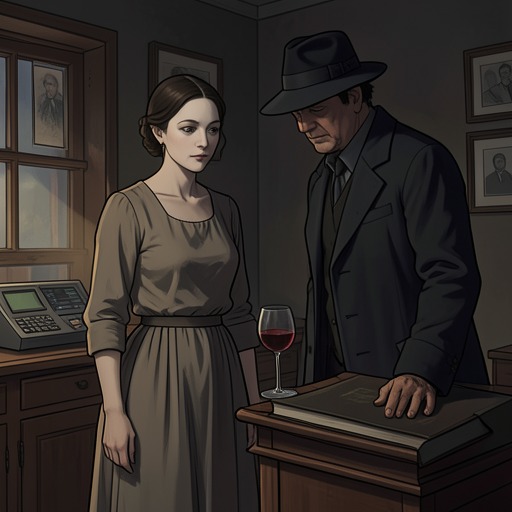
Lotario and Camilla’s concealed love affair
Don QuixoteLothario and Camilla’s concealed love affair grows out of a test that Anselmo, Camilla’s husband and Lothario’s close friend, insists on conducting. What begins as a performance meant to reassure Anselmo instead becomes a real attachment, hidden behind a false account of Camilla’s resistance. The arrangement makes Anselmo both the instigator of the danger and the person most thoroughly deceived by it.
The Test and Its Unequal Terms
Anselmo asks Lothario to court Camilla so that her fidelity can be tested. He presents the request as a limited trial: a beginning, even a lukewarm or feigned one, would satisfy his curiosity and spare him from abandoning his confidence in her virtue. Lothario tries to dissuade him, but Anselmo’s resolve and his threat to confide the scheme to someone else leave Lothario fearing a greater harm. He agrees, intending to satisfy his friend without actually corrupting Camilla’s mind.
The agreement gives Anselmo control over the conditions of the experiment. He plans to leave Lothario alone with Camilla, supplies money and jewels for gifts, and suggests music and verses as further instruments of courtship. Lothario accepts these proposals while concealing that his purpose is different from Anselmo’s expectation. When Anselmo arranges an opportunity for him to remain with Camilla, Camilla herself objects to her husband’s departure and to the impropriety of another man taking his place at the table. Anselmo insists that she obey.
From Watchfulness to Courtship
During Anselmo’s absence, Camilla tries to prevent any private encounter. She keeps servants present, particularly Leonela, a maid who had grown up with her in her father’s household and whom she retained after marriage. Camilla orders Leonela to remain beside her and arranges for the servants to dine separately and earlier, so that she and Lothario will not be left alone. Leonela does not consistently follow these instructions, however, leaving them together when Camilla has meant to ensure company.
For the first three days, Lothario says nothing to Camilla, though he has opportunities to speak when the servants withdraw. He watches her instead. Her composure, goodness, and beauty gradually become objects of sustained attention, and the role he has accepted begins to undermine his loyalty to Anselmo. He considers leaving the city to escape the situation, but does not do so; he also reproaches himself, then argues that Anselmo’s reckless experiment is worse than his own disloyalty. The conflict has shifted: Lothario is no longer merely acting the part of a suitor, but trying to justify the desire that the arrangement has given room to develop.
After Anselmo has been away for three days, Lothario finally makes his advances. Camilla is astonished and withdraws to her room without replying. She sends a servant to Anselmo with a letter describing what has happened. Anselmo misreads the report as evidence that Lothario has begun the test and that Camilla must have answered him favorably. Instead of returning at once to protect her, he tells her not to leave the house and says that he will soon come back. Camilla is left between the danger of remaining and the disobedience of going to her parents’ home. She stays, partly to avoid giving the servants grounds for gossip, and resolves to resist Lothario without involving her husband in a quarrel.
The Affair and the Cover Story
Lothario presses his suit while Anselmo is absent, using praise, promises, appeals, and apparent sincerity. Camilla’s resistance weakens, and she yields to him. Leonela alone knows of the affair. Lothario does not tell Camilla that Anselmo had deliberately created the opportunity, fearing that knowledge of the original scheme would make her think his courtship accidental or diminish the sincerity of his attachment. Their relationship is therefore concealed not only from Anselmo but, at first, from Camilla in one crucial respect: she does not know that her husband had set the test in motion.
When Anselmo returns, Lothario supplies the false account the experiment was meant to produce. He tells his friend that Camilla rejected his words and presents her as a model of purity, claiming that he has not needed the money Anselmo provided. Anselmo believes him completely. Lothario even advises him to stop testing his wife, but Anselmo, satisfied by the supposed proof, asks him to continue for curiosity and amusement, this time by writing verses under the name Chloris.
The name gives the lovers a screen within the household. Anselmo tells Camilla that Lothario is supposedly in love with a woman called Chloris, and reassures her that his friend’s fidelity and their friendship leave no cause for concern. Camilla already knows that this is a fiction: Lothario has told her that the verses are intended to praise her. When Lothario recites them at table, she takes pleasure in the writing because she understands herself to be its real subject, while Anselmo praises it as evidence of a harmless, invented romance. The performance lets the affair continue in his presence, with the husband applauding the poetry that conceals his own dishonor.
Private Knowledge and the Affair’s Significance
The arrangement produces different versions of the same events. Anselmo sees a successful test and an exemplary wife; Lothario knows that he has betrayed his friend and lied about Camilla’s response; Camilla knows both that the verses are directed at her and that their public explanation is false. Leonela’s knowledge makes her the only other person explicitly admitted to the secret. The characters’ access to the truth is thus sharply divided, and Anselmo’s confidence turns the cover story into an instrument that protects the relationship from his scrutiny.
In private, Camilla tells Leonela that she is ashamed of having yielded so quickly and fears Lothario may think her too easily won. Leonela reassures her that the speed of giving does not reduce the value of what is given. Camilla answers by recalling the opposing maxim that what costs little may be valued less. The exchange shows that secrecy has not erased Camilla’s concern about how her choice will be judged; even within the affair, she measures herself against standards of value and reputation. At this point in the account, the relationship remains hidden and ongoing, while Anselmo’s renewed experiment supplies the lovers with a false public story rather than exposing what has happened.