Madness and sanity
Don QuixoteMadness and sanity in Don Quixote are not stable opposites: Cardenio’s uncontrolled fits, Don Quixote’s chosen performance of lovesick madness, and his lucid reasoning on other subjects repeatedly unsettle the distinction. The contrast makes madness both a force that can erupt into violence and a role deliberately assumed under the authority of chivalric books. It also leaves recovery difficult to certify: observers see good sense return, yet fear that a conversation about knight-errantry can reopen the disorder.
Different Forms of Madness
Cardenio’s madness arrives as an interruption. While recounting his story, he falls silent, then returns to an accusation about Queen Madasima and Master Elisabad. Don Quixote takes the accusation as an attack on an illustrious lady and answers as if defending a real beloved. When Cardenio is called a liar and a scoundrel, his fit takes physical form: he seizes a nearby stone and knocks Don Quixote down, strikes Sancho Panza, and beats the goatherd who tries to intervene. He then withdraws to his mountain hiding place. The episode shows an abrupt movement from silence to violence, with no negotiated resolution between the men.
Don Quixote’s response to the episode is itself revealing. He insists that Cardenio spoke out of his wits, but that explanation does not prevent him from continuing to defend Madasima’s honor. In his account, Master Elisabad was the queen’s prudent governor and physician, and the claim that she was his mistress is an ignorant slander. Don Quixote treats the defense as a knight’s obligation, whether the alleged offender is sane or mad. His judgment is therefore divided: he recognizes Cardenio’s impaired state, yet remains wholly committed to the fictional chivalric world that makes the dispute feel urgent and personal.
Chosen Penance in the Sierra Morena
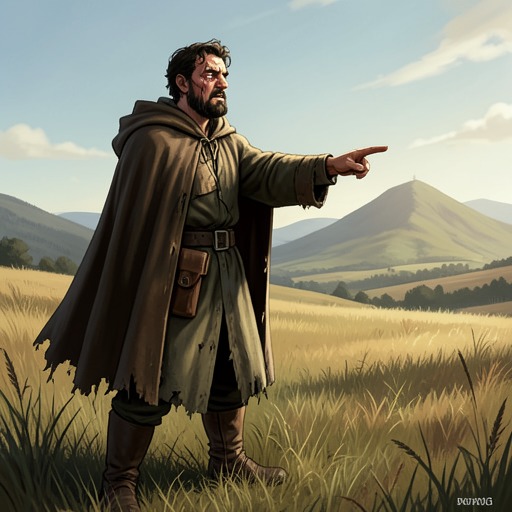
Unlike Cardenio’s fit, Don Quixote’s madness in the Sierra Morena is planned. He announces that he has come into the mountains not chiefly to find Cardenio, but to perform an achievement that will win him lasting fame and perfect his reputation as a knight-errant. His model is Amadis of Gaul, who withdrew to Peña Pobre under the name Beltenebros after being rejected by Oriana. Don Quixote considers that kind of penance easier to imitate than the impossible feats of slaying dragons, routing armies, or breaking enchantments. He also invokes Roland’s madness after learning of Angelica and Medoro, but says he will make only a selective copy of Roland’s extravagant destruction and instead lean toward Amadis’s tears and sorrow.
Sancho Panza asks what cause could justify the performance: no lady has rejected Don Quixote, and he has discovered no evidence that Dulcinea has been unfaithful. Don Quixote makes the absence of provocation central to his design. A knight who goes mad because he has been wronged, he argues, has an evident cause; the more remarkable feat is to become mad without one. He supplies a different explanation in his long separation from Dulcinea, which he treats as an affliction in itself. His penance is thus at once an imitation of literary precedent and a calculated display of devotion, not simply an involuntary collapse of reason.
The performance has a practical condition and a planned end. Don Quixote sends Sancho to carry a letter to Dulcinea and says he will remain mad until the squire returns with her answer. A favorable reply will end the penance; an unfavorable one will make him mad in earnest, so that he need no longer feel the resulting pain. The scheme turns emotional uncertainty into a chivalric test with either outcome built in. Before Sancho departs, Don Quixote even agrees to demonstrate his madness. He strips to his shirt and performs leaps and somersaults in the air; Sancho turns Rocinante around, satisfied that he can report having left his master mad. The comic physical proof makes the gap between inner condition and outward show impossible to ignore.
Lucidity, Delusion, and the Books of Chivalry
The exchanges between master and squire keep testing the limits of Don Quixote’s judgment. Sancho questions the way his master calls a barber’s basin Mambrino’s helmet and doubts the grand promises of kingdoms, islands, and rewards. Don Quixote, however, presents his conduct as reasoned and governed by the rules of chivalry. His madness does not prevent him from constructing an argument; rather, the chivalric premises determine what counts as reasonable within it. Sancho can see the basin and the danger, while Don Quixote sustains the helmet and the heroic interpretation.
A later discussion with the canon makes this division more explicit. The canon regards books of chivalry as deceptive and harmful, arguing that their disproportions and impossible feats encourage readers to accept falsehood as truth. He urges Don Quixote to return to common sense and to turn his intelligence toward more truthful reading. Don Quixote listens attentively and accurately restates the canon’s case: that knight-errantry never existed, that the books are false and harmful, and that reading and imitating them has led him into trouble. His capacity to understand the criticism is visible even as he remains invested in the world it challenges. The scene distinguishes comprehension from conversion: hearing a rational argument does not, by itself, displace his chivalric beliefs.
Judging Recovery
The narrative later presents apparent improvement as something observed cautiously rather than declared beyond doubt. After Don Quixote is carried home in an ox-cart, the curate and barber stay away for nearly a month, hoping not to revive his memories of the journey. They ask his niece and housekeeper to care for him and provide food thought good for the heart and brain. The women report occasional signs that he is in his right mind. When the visitors finally test him, they find him speaking naturally and sensibly about government and public abuses, and the curate and barber become convinced that he has recovered.
That confidence remains provisional. Although they first intend to avoid knight-errantry, the curate raises the news of a possible Turkish fleet to test Don Quixote more thoroughly. The canon, who has heard the account of Don Quixote’s life and confinement in the cage, is struck by the contrast between his excellent sense on ordinary topics and his loss of judgment when chivalry enters the conversation. The condition appears to have boundaries: conversation about public affairs permits lucid reasoning, while the chivalric subject threatens to unsettle it. The household’s attentiveness, the visitors’ informal examination, and the canon’s skepticism offer competing measures of recovery rather than a single decisive diagnosis.
Narrative Significance
The work makes madness difficult to reduce to either performance or illness. Cardenio’s violence is involuntary, while Don Quixote deliberately stages bodily signs of derangement to imitate Amadis and send a message of devotion to Dulcinea. Yet Don Quixote’s performance depends on a belief system that also governs his sincere defenses, expectations, and misreadings. His chosen role does not make the consequences unreal: Cardenio’s attack leaves him and Sancho beaten, and his own conduct leads others to confine and transport him. Conversely, his ability to reason about subjects beyond knight-errantry complicates the assumption that he is uniformly irrational.
This recurring contrast also gives other characters the task of interpreting him. Sancho distinguishes visible objects and immediate dangers from his master’s romantic explanations; the canon separates sound judgment from the chivalric obsession; the curate and barber treat apparent lucidity as encouraging but deliberately avoid a subject that might undo it. Across these encounters, sanity is measured in conversation and action, while madness is linked to the stories Don Quixote inhabits and sometimes consciously reenacts. The result is not a simple cure narrative but an ongoing tension between capable reason, imagined identity, and the consequences of acting as though the imagined world were true.