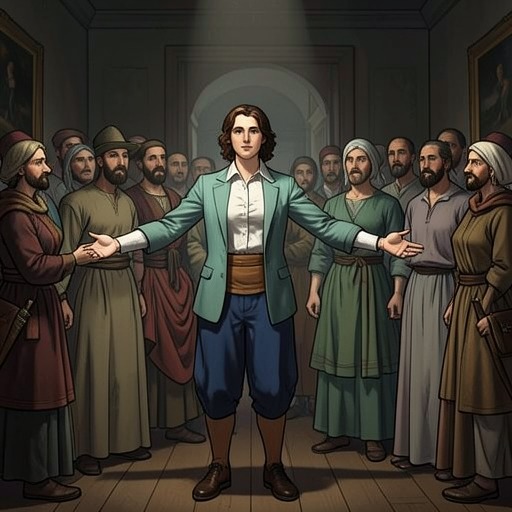
Marcela
Don QuixoteMarcela’s appearance at Chrysostom’s funeral turns a story of unrequited love into a dispute over freedom, consent, and blame. Celebrated for her beauty and pursued by numerous suitors, she refuses to treat their desire as a claim upon her. Her defense makes her more than the object of others’ stories: she speaks for herself, explains the limits of their accusations, and leaves rather than submit her choice to the mourners’ judgment.
Identity and Circumstances
Marcela is the daughter of a wealthy farmer. Her mother dies when she is born, and her father, overcome with grief at his wife’s death, also dies while Marcela is still a child. She is left in the care of her uncle, a priest. The account of her family emphasizes both her inheritance and her early vulnerability: she grows up without either parent, but with property that makes her a sought-after match.
By the time she is fourteen or fifteen, people regard her beauty as exceptional. Her reputation draws marriage proposals not only from their own village but from people of standing in the surrounding area. Her uncle presents the qualities of prospective husbands and asks her to choose, but does not force her to marry. Marcela says she is too young and does not wish to take on marriage yet; he accepts her answer and waits. The account praises him for not arranging her future against her will, even though he has control of her property.
Choosing the Shepherdess’s Life
Marcela does not remain secluded in the household. Despite her uncle’s and the townspeople’s efforts to dissuade her, she goes into the fields, joins the village shepherdesses, and tends her own flock. Her appearance in public makes her beauty visible to a wider circle, and more young men adopt the shepherd’s life in hopes of courting her. Chrysostom is among them, and his attachment is described as adoration.
The account distinguishes her open, courteous conduct from any promise of romantic favor. Marcela does not avoid conversation with the shepherds, and she treats them kindly; nevertheless, she gives none of her suitors even a small ground to expect that she will accept him. Even a proposal of marriage, conventionally proper in form, does not change her answer. Her frank refusals earn her a reputation for cruelty among those who want her to return their feelings. Their songs, laments, and declarations carved into trees make the landscape seem filled with evidence of their desire, but those displays do not establish an obligation on her part.
Her Defense at Chrysostom’s Funeral
Marcela arrives while Chrysostom’s companions are preparing his grave and handling his papers. Her sudden appearance astonishes those who have never seen her and those already familiar with her. Ambrosio addresses her angrily, accusing her of coming to look upon the death she has supposedly caused. His accusation gives public form to the claim at the center of the episode: that the rejected woman must answer for a man’s despair.
Marcela says she has come to defend herself and show that the blame placed upon her is unreasonable. Beauty, she argues, may attract love, but being loved does not require her to love in return. Nor does physical beauty guarantee that two people’s inclinations will match. Love, as she understands it, must be freely chosen rather than compelled. She also rejects the premise that her beauty is a deed for which she should be held accountable: it was given to her, not chosen by her, and does not authorize others to demand affection.
Her defense joins freedom to modesty and honor. She says she possesses wealth of her own and has no desire to take what belongs to others; she prefers liberty to constraint and neither loves nor hates any of her suitors. Her pleasures are the company of the shepherdesses and the care of her goats. She presents these as a life she has chosen, not as a disguise intended to encourage pursuit. The account thus gives her a clear distinction between kindness in ordinary company and consent to courtship: the first does not imply the second.
Departure and Don Quixote’s Intervention
When Marcela finishes, she leaves without waiting for a reply and enters a nearby wood. Some of the men, still intent on pursuing her, appear ready to follow despite what she has just said. Don Quixote intervenes, placing a hand on his sword and forbidding anyone, regardless of rank, to pursue her. He judges her arguments sufficient to clear her of blame for Chrysostom’s death and insists that she should be honored rather than persecuted.
The burial proceeds after Don Quixote’s warning and Ambrosio’s direction. Chrysostom’s papers are burned, his body is laid in the grave, and those present weep. The episode therefore ends without Marcela being made to stay and answer further accusations: her defense is followed by departure, and Don Quixote’s action protects that departure from the suitors’ pursuit.
Narrative Role and Significance
Marcela’s episode exposes the gap between a woman’s actual conduct and the meanings men impose on it. The shepherds interpret beauty as invitation and refusal as cruelty, while her account insists that neither appearance nor another person’s suffering cancels her freedom to choose. The funeral setting sharpens that conflict: grief is real, but grief does not prove that Marcela has committed a wrong. Chrysostom’s companions can mourn him without making her responsible for fulfilling his hopes.
Her public speech also reverses the position assigned to her by the surrounding story. She has been described through her beauty and through the complaints of the men who desire her; at the funeral she answers those descriptions in her own terms. Don Quixote’s defense supports the practical consequence of her argument by stopping the pursuit, even as the mourners continue the burial and memorialize Chrysostom. Marcela’s significance lies in this insistence that courtesy is not consent, that love cannot be commanded, and that an independent choice need not be justified by accepting the life others have arranged for her.