Release galley slaves
Don QuixoteDon Quixote’s liberation of the galley slaves turns his ideal of aiding the oppressed into a direct challenge to royal justice. Seeing prisoners chained together and escorted under guard, he treats their lack of choice as the decisive fact; his intervention releases them briefly, but the episode soon exposes the gulf between his charitable purpose and the consequences of acting without regard for law or obligation.
The Chain and Don Quixote’s Decision
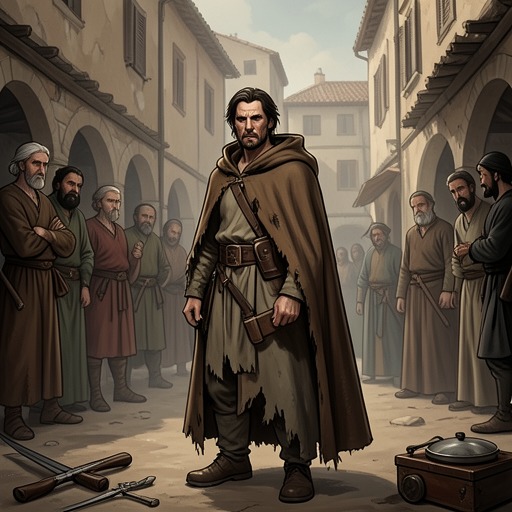
The encounter follows a discussion between Don Quixote and Sancho Panza. Raising his eyes to the road, Don Quixote sees about a dozen men walking in a chain, with manacles on their hands. Two mounted guards carry firearms, while two others on foot accompany the prisoners with weapons. Sancho identifies them as galley slaves being taken to the galleys by royal order. Their destination is not voluntary, a point Don Quixote repeats; Sancho agrees, but cautions that the king’s justice is punishing them for their crimes. The disagreement establishes the event’s central conflict: Sancho sees a lawful sentence, while Don Quixote sees people being compelled to go where they do not wish to go.</body_en
The Appeal and the Turn to Force
After asking the escort for the reasons behind the prisoners’ sentences, Don Quixote is told that they are the king’s galley slaves and that no further explanation is owed him. He listens to the prisoners’ accounts and concludes that, although they have been punished for faults, some may have suffered through weakness under torture, poverty, lack of legal advocacy, or a judge’s perverted judgment. These are his conjectures, not an established finding that the sentences are unjust. Yet they lead him to view the chain as an instance of the strong oppressing the needy and to invoke his knightly duty to aid those in distress.
Don Quixote first asks the guards and commissary to release the prisoners voluntarily, arguing that people made free by God and nature should not be enslaved. He distinguishes the guards’ role from the prisoners’ guilt: each prisoner, he says, should answer for his own sins, rather than the guards acting as instruments of punishment. But his appeal is backed by a threat to compel compliance with his lance and sword if persuasion fails. The demand thus moves from charitable intervention toward a direct challenge to royal authority.
The commissary refuses, dismisses Don Quixote’s request as nonsense, and mocks the basin he wears as a helmet. Don Quixote responds by attacking him before he can defend himself. The other guards turn against Don Quixote, while the prisoners seize the confusion to break the chain that binds them. Sancho helps Gines de Pasamonte free himself; Pasamonte takes the commissary’s sword and firearm and uses them to drive the guards away without firing. The prisoners’ release is therefore achieved not by an authorized review of their sentences but by their own break from custody amid the clash Don Quixote has provoked.
The Broken Chain and the Failed Bargain
With the guards driven off, Don Quixote gathers the now-free prisoners and frames their release as a benefit that demands gratitude. He orders them to take the chain from which they have been freed to El Toboso, present themselves to Dulcinea, and recount how her knight secured their liberty. In his imagination, the chain can be transformed from an instrument of confinement into a visible token of service and a message to his lady. The command also reveals how completely he expects the released men to enter the chivalric story he has made of the encounter.
Gines de Pasamonte answers on behalf of the group that they cannot travel together or risk appearing before the Holy Brotherhood of Toledo, which they expect will pursue them. He offers prayers for Don Quixote instead of the journey and presentation he demands. Don Quixote takes the refusal as ingratitude and insists that Pasamonte carry the chain alone. The attempted rescue thus turns sharply: the men accept their freedom but reject the obligation their rescuer attaches to it, while Don Quixote treats aid as creating a duty to obey him.
Pasamonte signals the others, and the freed prisoners pelt Don Quixote with stones. Sancho shelters behind his donkey; the prisoners take clothing and possessions from both travelers, damage the basin Don Quixote wears as a helmet, and disperse separately rather than carry the chain to El Toboso. They leave behind Don Quixote, Sancho, the donkey, and Rocinante. Sancho fears that the guards will report the attack and bring the Holy Brotherhood after them; Don Quixote, left fuming at the people he had helped, confronts the immediate consequence of having mistaken liberation for a bond of gratitude and compliance.
Freedom and Captivity Beyond the Encounter
The episode sits within a book that presents captivity in more than one form. In Captain Viedma’s account, Christian captives in Algiers include men forced to row in galleys and others held for ransom; a chain marks the latter’s status, and delays in ransom can bring forced labor. That account distinguishes a prisoner’s legal sentence from captivity imposed by war and enslavement, even as both place a person’s freedom under another’s control. The distinction sharpens the episode’s question: Don Quixote sees the chain and the prisoners’ lack of choice, but does not reckon with the legal process Sancho invokes or with what may follow once the escort is driven away.
Cervantes’s own biography supplies a further, separate resonance: captured while returning to Spain in 1575, he remained in Algiers until his release in 1580. This parallel does not establish that the fictional rescue reenacts his experience. Rather, the book’s juxtaposition of forced galley service, ransom, escape, and legal punishment makes freedom concrete and precarious. In the roadside encounter, Don Quixote can break a chain, but his intervention cannot secure the released men’s safety or make them accept the purpose he assigns to their liberty.