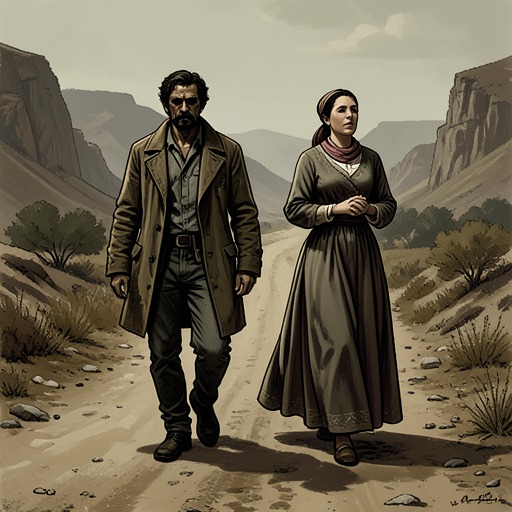
Ricote
Don QuixoteRicote is a Morisco shopkeeper from Sancho Panza’s village whose return to Spain turns the expulsion of his people into a personal story of divided loyalties and family reunion. Forced abroad by the royal edict, he comes back in a pilgrim’s disguise to retrieve buried wealth and search for his wife and daughter. The treasure matters, but he ultimately calls his recovered daughter the greater treasure; their reunion does not resolve whether they may remain in Spain.
Identity and Return
Sancho first recognizes Ricote when a foreign pilgrim embraces him and addresses him by name. Ricote is in disguise among German pilgrims, and Sancho initially fails to identify his old neighbor. After recognition, Ricote asks Sancho not to betray him: in the pilgrim’s clothing, he believes, he can pass unnoticed. He invites Sancho to join the group in a nearby grove, where they eat and drink before speaking privately.
The meeting follows Sancho’s departure from his governorship. During the pilgrims’ meal, Sancho joins their drinking, and the company’s conviviality briefly displaces his recent cares. When the others fall asleep, Ricote draws Sancho aside and speaks to him in Castilian. The private conversation changes the encounter from a chance reunion into a disclosure of what exile has done to Ricote and what he hopes to recover.
Expulsion, Exile, and Spain
Ricote explains that the expulsion edict filled his community with fear. He left Spain before the allotted time had run out, traveling alone so he could find a place to receive his family rather than make their departure in haste. He believed the proclamations would be enforced, not merely threatened, and says he understood the authorities’ concern about plots among some members of his people. He does not claim that all Moriscos were guilty: he acknowledges that some were steadfast Christians, while arguing that they were too few to counter those he considered dangerous. His account therefore holds together sympathy for his community’s suffering and a startling acceptance of the banishment imposed on it.
That acceptance does not make exile easy. Ricote says that wherever the Moriscos go, they mourn Spain, where they were born and which he describes as their natural fatherland. He recounts that they had expected welcome and assistance in Barbary and elsewhere in Africa, but encountered insult and ill-treatment instead. The experience taught him the value of the country they had lost. He had traveled to France, then Italy, and eventually Germany, where he rented a house near Augsburg and believed people enjoyed greater freedom of conscience. His account makes displacement a practical and emotional ordeal: a search for safety abroad accompanied by persistent longing for home.
The Search for Family and Treasure
Ricote’s return has two purposes. He intends to recover money and other valuables he buried outside his village, and to find a way to reach his wife and daughter, whom he believes are in Algiers. He hopes to contact them from Valencia and arrange their passage to a French port, with Germany as a possible refuge. He says his wife and daughter are Catholic Christians, and describes himself as more Christian than Moor while still praying for clearer understanding of how to serve God. Their religious identity, his own uncertain account of faith, and the family’s safety are bound up in the same search.
Sancho warns him that recovering the buried wealth may prove impossible: he has heard that a large quantity of pearls and gold was taken from Ricote’s wife and brother-in-law. Ricote’s plan thus begins under uncertainty, with no assurance that either the money or his family can be recovered. Later, after the capture of a brigantine, the search takes an unexpected turn. A Morisco Christian woman aboard the galley has just finished telling her story when an elderly pilgrim throws himself at her feet and identifies himself as her father. He is Ricote, returned to find her because he could not live without her.
Ana Felix and the Reunion
The daughter Ricote finds is Ana Felix. Sancho recognizes her father as the neighbor he met after leaving his governorship and understands that the young woman is his daughter. Unbound, Ana Felix embraces Ricote, and the two weep together. Ricote explains that he had gone abroad to find refuge for the family and had returned in disguise to seek both his daughter and the treasure. He has recovered the buried wealth, but presents Ana Felix as the discovery that makes him truly rich.
Ana Felix’s own circumstances sharpen the uncertainty of the reunion. She had been traveling in danger, and Don Gregorio, whom she loves, had been taken away from Algiers in women’s clothing. When he arrives at Don Antonio Moreno’s house, he has changed into the clothing of a captive who escaped with him. Ricote and Ana Felix welcome him; their affection is apparent in their bashfulness and exchanged looks, though they do not embrace. Ricote rewards the renegade who helped secure Don Gregorio’s rescue and the men who rowed. The renegade, in turn, is reconciled with the Church through repentance.
Aftermath and Significance
The Viceroy of Barcelona and Don Antonio discuss whether Ricote and Ana Felix can stay in Spain, given her Christian faith and Ricote’s apparent good intentions. Ricote rejects the suggestion that favor or bribes will settle the matter. He describes Don Bernardino de Velasco, entrusted with the expulsion, as unmoved by entreaties, promises, or appeals to compassion, even while acknowledging that he mingles mercy with justice. Ricote praises the policy’s execution and the king’s resolve, despite being among those made to suffer its consequences. His return has reunited him with his daughter, but has not made his family’s place in Spain secure.
The proposed arrangement is temporary: Ana Felix is to stay with Don Antonio’s wife, and Ricote with the viceroy, while Don Antonio makes efforts on their behalf. Don Gregorio refuses to leave Ana Felix permanently and agrees to go to see his parents with the intention of finding a way to return for her. When Don Antonio departs, the lovers part in tears; Ricote offers Don Gregorio a thousand crowns, but he accepts only five crowns lent by Don Antonio. Ricote’s own next destination and the family’s eventual status remain unresolved. His episode ends not with a settled restoration, but with the fragile relief of reunion amid continuing separation and uncertainty.