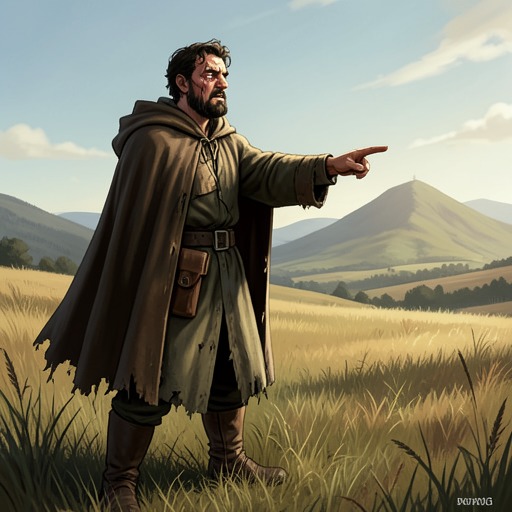
Sage Friston
Don QuixoteSage Friston is the imagined magician whom Don Quixote makes responsible for removing his books and altering the appearance of his supposed enemies. He is never independently shown performing these acts: his presence in the story takes shape through explanations that convert ordinary events into evidence of a personal, ongoing feud. Each new defeat thus strengthens Don Quixote’s account of the world rather than dislodging it.
Identity and Introduction
Friston enters the narrative when Don Quixote returns to find the room that held his books gone. The household has walled up and plastered the doorway while he was recovering, and the niece and housekeeper have prepared a story to account for the change. The niece describes a magician arriving on a cloud, riding a serpent, entering the room, and flying away through the roof amid smoke. She says the visitor identified himself as Sage Munaton and spoke of a private grudge against the owner of the books and the room.
Don Quixote supplies the name that the tale is meant to conceal: he says the magician must have been Friston. The housekeeper remains uncertain, recalling only that the name ended in “ton,” and allows that it might have been Friston or Friton. This uncertain naming matters: Friston’s identity is not established by a witnessed appearance but assembled from a household fabrication and Don Quixote’s confident correction. The narrative gives him a role in Don Quixote’s mind without confirming that any magician was present.
The Feud Don Quixote Imagines
Don Quixote describes Friston as a great magician and a personal enemy. In his account, Friston knows that Don Quixote is destined to fight and defeat a knight whom the magician favors. Unable to prevent that eventual victory, Friston supposedly tries to injure him by other means; Don Quixote counters that the magician cannot overturn what Heaven has decreed. The story of the missing library therefore becomes more than an explanation for an absent room: it supplies a continuing antagonist and a future contest around which Don Quixote can organize his expectations.
That explanation also makes contradictory evidence useful to him. If a promised deed has not occurred, or an adventure ends in failure, Friston can be blamed for interfering rather than the belief in the adventure being questioned. Don Quixote’s confidence in a coming victory sits beside his claim that an enemy is working to prevent it: setbacks do not cancel the destiny he asserts, but are folded into the struggle leading toward it.
The Mill and Sheep Explanations
After Don Quixote charges a windmill, its sail catches and breaks his lance, throwing him and Rocinante to the ground. Sancho Panza had warned him that the targets were windmills. Don Quixote nevertheless attributes the mismatch to Friston, claiming that the magician turned giants into mills to rob him of the glory of defeating them. The visible mill does not disprove the giant in his account; it is the disguise through which the enemy has acted. Don Quixote’s damaged lance and fall become consequences of Friston’s supposed intervention, while Sancho helps him rise and they continue toward Puerto Lapice.
The same explanation returns after Don Quixote attacks flocks of sheep as though they were opposing armies. Once the shepherds have driven him down and gone, Sancho again identifies the animals as sheep. Don Quixote answers that his enemy has altered and falsified appearances, turning the enemy’s squadrons into flocks. He even proposes a test: Sancho should follow the sheep and see whether they recover their original human form after some distance. The assertion makes the delusion resistant to immediate correction, because the supposed transformation can be deferred to a point beyond what has yet been observed. Before Sancho can pursue the test, Don Quixote asks him to inspect his damaged mouth; the practical injuries of the encounter remain even as their cause is assigned to magic.
Narrative Role
Friston links separate episodes through a recurring explanation for the gap between Don Quixote’s expectations and what Sancho sees. The missing room, the windmills, and the sheep are different circumstances, but Don Quixote reads each as the work of the same hostile magician. That recurrence gives his imagined enemy continuity: a defeat is not an isolated mistake but another move in a feud whose outcome, he insists, has already been ordained.
The contrast between Don Quixote’s elaborate causal account and Sancho’s direct identification of windmills and sheep makes the mechanism of this belief visible. Friston is absent from the action yet influential in how Don Quixote interprets it. The story does not establish that he caused any of these events; rather, Don Quixote’s recurring attribution shows how his chivalric imagination turns contradictions into further reasons to believe. In that pattern, the magician’s most consequential power is the explanatory role Don Quixote gives him: reality can appear to defeat the knight while, in his account, confirming the existence of an enemy determined to obstruct him.