Samson Carrasco
Don QuixoteSamson Carrasco, a young bachelor from Don Quixote’s village, turns concern for his neighbor into an elaborate attempt to end his travels: he enters the very chivalric world he hopes to interrupt, first as the Knight of the Mirrors and later as the Knight of the White Moon. The first disguise fails when Don Quixote defeats him; the second succeeds, binding Don Quixote to a year at home. Carrasco’s victory halts the knight’s adventures, but it does not bring about the recovery he hoped for.
Identity and Introduction
Carrasco has recently returned to the village after studying at Salamanca and receiving his bachelor’s degree. He is about twenty-four, slight in build, with a sallow complexion, round face, flat nose, and large mouth. The narrator associates these features with his sharp wit and taste for jokes, qualities he displays immediately when he meets Don Quixote.
Sancho Panza has told Don Quixote that their adventures have appeared in a printed history, and Carrasco confirms the report. He praises the book and its Moorish historian, Cide Hamete Benengeli, while kneeling theatrically before the knight. His mock solemnity makes him an entertaining audience for the reputation Don Quixote has acquired, even as he understands that the published account describes the pair’s actual escapades. Don Quixote receives the news with uncertainty and wonders whether an enchanter has put the story into print; Carrasco’s practical confirmation gives the imagined world another foothold in ordinary life.
Carrasco is not merely a comic visitor. He soon becomes the organizer of Don Quixote’s next departure, and later the opponent who can impose a binding limit on it. His learning, humor, and familiarity with the rules Don Quixote observes make him unusually well placed to influence the knight without persuading him to abandon those rules.
The Third Departure and the First Disguise
After discussing a third expedition, Carrasco agrees that Don Quixote should leave in three days. He promises to keep the plan secret from the village curate, Master Nicholas, Don Quixote’s niece, and the housekeeper, all of whom might prevent it. Sancho prepares to accompany his master, and Carrasco helps arrange what the journey requires, including a closed helmet. His apparent assistance is part of a plan he has already discussed with the curate and the barber: rather than restrain Don Quixote directly, they will let him set out and try to bring him home through a formal challenge.
Carrasco’s first role in that scheme is the Knight of the Mirrors. With Tom Cecial as his squire, he follows Don Quixote and eventually challenges him. The agreement is that the defeated knight must submit to the victor’s conditions. The village group expects Carrasco to win and command Don Quixote to return home and remain there; at their consultation, the proposed period is two years or until further orders. Carrasco later describes his intended restriction as a year. In either account, the design depends on a point of confidence: Don Quixote is expected to obey an agreement made according to the laws of knight-errantry.
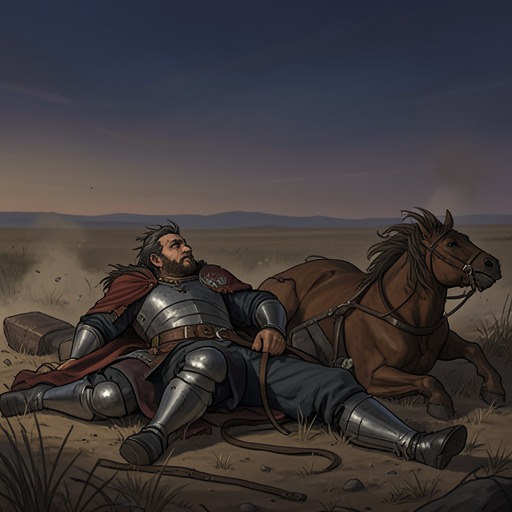
The encounter reverses their expectations. During the charge, Carrasco’s horse cannot move forward; Don Quixote strikes him down. When Don Quixote removes his opponent’s helmet, he recognizes Carrasco’s face and calls Sancho to witness what he takes to be the work of enchantment. Tom Cecial removes his false nose and reveals himself, confirming the disguises but not dislodging Don Quixote’s explanation. Once Carrasco recovers consciousness, Don Quixote requires him to acknowledge Dulcinea del Toboso’s superiority and to visit her in El Toboso, then report back. Carrasco gives the required assent, and Don Quixote leaves pleased with his apparent victory.
The failure has consequences for Carrasco as well as for the plan. He is left sorely bruised, and Tom Cecial decides to abandon the adventure and return home. Carrasco, by contrast, refuses to give up. He reaches a town where a bone-setter treats him, then remains determined to challenge Don Quixote again. His purpose is no longer only the proposed cure: after the defeat and humiliation, he also wants to settle the contest in his favor.
The White Moon and the Binding Defeat
Carrasco’s second challenge comes in Barcelona, where he appears in full armor as the Knight of the White Moon, his shield marked with a shining moon. He claims that his lady is more beautiful than Dulcinea and makes Don Quixote’s submission the stake. If Don Quixote loses, he must lay aside his arms and refrain from seeking adventures, returning to his village for one year; if Carrasco loses, Don Quixote may claim his head, horse, and armor. Don Quixote rejects the comparison but accepts the terms, preserving his faith in Dulcinea while placing his own conduct under the rules of the duel.
The Viceroy hears of the impending combat and comes to the beach with Don Antonio Moreno and others. After the Knight of the White Moon explains the challenge, the Viceroy allows the encounter to proceed. Don Quixote commends himself to heaven and Dulcinea, as he customarily does before combat. Carrasco’s horse is faster: he meets Don Quixote before the latter has covered the course, and the impact throws Don Quixote and Rocinante to the ground. Carrasco holds him to the agreed conditions. Don Quixote, bruised and stunned, continues to insist that Dulcinea is the fairest woman, but accepts that he has lost and asks Carrasco to take his life rather than strip him of his honor. The demand to return home, not to deny Dulcinea, is what makes the defeat binding.
Don Antonio follows the victor to his lodging to discover his identity. Carrasco reveals that he is the bachelor from Don Quixote’s village and explains both attempts. His original intention as the Knight of the Mirrors was to defeat Don Quixote without hurting him and send him home for a period of rest; instead, Don Quixote unhorsed him. Carrasco now believes that Don Quixote will obey the White Moon’s injunction because he scrupulously observes the chivalric code. He asks Don Antonio not to reveal who he is, so that the plan may succeed. Don Antonio agrees to keep the secret, though he doubts that enforced quiet will cure Don Quixote and remarks that the knight’s delusions provide amusement to those around him.
Return, Pastoral Plans, and Final Encounter
Don Quixote keeps the condition of defeat exactly. Back in the village, he tells Carrasco and the curate that he will not leave for a year. He proposes spending that time as a shepherd, buying sheep and giving the group pastoral names: Carrasco is to be shepherd Carrascon, while Don Quixote, the curate, and Sancho Panza receive names of their own. Carrasco and the curate encourage the new project, partly hoping that keeping Don Quixote close to home will prevent another departure. Carrasco presents himself as a poet who can make verses during their imagined rural life and suggests that each shepherd choose a woman to celebrate in song. Don Quixote readily names Dulcinea as his own ideal.
The pastoral plan is another transformation of the same impulse: Don Quixote’s life at home is still organized through an imagined literary role. Carrasco’s participation shows that he can adapt to that change rather than confront it directly. Yet the plan does not lead to a shared pastoral life. Don Quixote later falls ill, and Carrasco is among the friends present when he declares that his reason has returned and that he is Alonso Quixano, not Don Quixote. Carrasco initially treats this declaration as another change of fancy, teasing him about abandoning the shepherd project just when the group was ready to begin. Don Quixote insists that his former beliefs have harmed him, asks for a confessor and notary, and prepares to make his will. The scene places Carrasco at the close of the recovery he could not produce through combat: he had succeeded in stopping the journeys, but Don Quixote’s return to reason comes only later, during his final illness.
Relationships and Narrative Role
Carrasco’s relationship with Don Quixote is built around a double intention. He feels pity for the knight and hopes that a quiet life at home might restore him, but he tries to achieve that end by entering into the knight’s own code rather than persuading him through ordinary argument. As the Knight of the Mirrors, he submits to the risk of a genuine defeat; as the Knight of the White Moon, he makes the required withdrawal precise and enforceable. His method turns Don Quixote’s fidelity to chivalric obligations into the means of ending his adventures.
His connection with Sancho is both neighborly and comic. Tom Cecial, Carrasco’s first squire, is Sancho’s neighbor and friend, and his false nose briefly sustains the disguises before the truth becomes visible. Later, Teresa Panza’s letter to the Duchess reports that Carrasco doubts Sancho’s appointment as governor and intends to seek him out to drive the governorship from his head, just as he has tried to end Don Quixote’s chivalric delusions. The report extends Carrasco’s role beyond the two duels: in the village, he remains associated with efforts to distinguish reality from the extraordinary claims surrounding Don Quixote and Sancho.
Carrasco is at once a witty observer, a conspirator with the curate and barber, and a participant who bears the consequences of his own scheme. His disguises turn the knight’s theatrical expectations against him, but the first reversal shows that the plot cannot control its subject. Only the White Moon’s victory secures the promised year of rest, and even that enforced return does not itself cure Don Quixote. Carrasco’s part therefore makes the difference between stopping an action and changing a person: he can compel the former by the knight’s own rules, but the latter remains beyond the reach of his plan.