Samson Carrasco of the village
Don QuixoteSamson Carrasco of the village is a bachelor whose brief appearances show him moving between practical assistance, skepticism, and comedy. When news arrives that Sancho Panza has become governor, he helps the village interpret the letters and presents accompanying gifts as evidence, yet he remains unsure whether the reported island and its government are real. His scene is small, but it places him among the novel’s sharply individualized minor characters: he is not simply a functionary who delivers information, but a participant whose wit and doubts shape how the news is received.
Identity and Narrative Presence
The narrative identifies Samson Carrasco as the bachelor and presents him as a familiar figure in the village. In a broader comment on Cervantes’s characterization, Samson is named among figures who, despite limited space in the story, seem to live as individuals rather than as disposable roles. That observation fits his brief appearance: he has a recognizable comic disposition, but also an active curiosity about events beyond the village. The text gives no extended account of his background or private life here, so his characterization rests chiefly on the way he responds to the extraordinary report of Sancho’s appointment.
His name also belongs to a group of minor characters whom the narrative describes as rendered with humane individuality. The comment is significant less as a claim about Samson’s importance to the plot than as an account of the novel’s method: even a bachelor who appears briefly to hear news can bring a distinctive temperament to the scene. Samson’s mixture of practical involvement and teasing doubt makes him memorable without requiring a separate history or a dramatic personal crisis.
The Letters and the Messenger
When the page arrives at Teresa Panza’s home with letters and gifts, Teresa admits that she cannot read. Sanchica Panza proposes fetching either the curate or Samson Carrasco, expecting them to come gladly to hear news of her father. The page offers to read instead, so Samson is not present for the first reading. The page reads Sancho’s letter and then a letter from The Duchess, which describes Sancho’s good qualities and praises his conduct as governor. The correspondence brings the promise of a distant household directly into the ordinary setting of Teresa’s home.
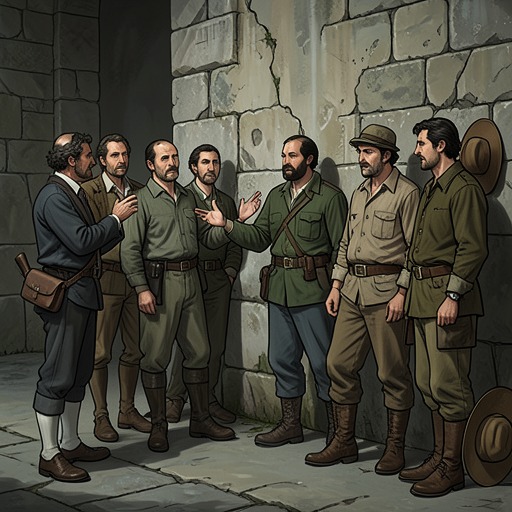
After Teresa shows the letters to the curate and Samson, the curate reads them aloud. The two men exchange astonished looks. The curate examines Teresa’s coral beads, turning them over as he tries to reconcile their apparent fineness with The Duchess’s request for acorns. Samson responds by urging that they visit the messenger and ask him about the mystery. His reaction is both investigative and comic: rather than accepting the tokens as a complete answer, he treats the mismatch between costly-looking beads and a request for a peasant gift as a question that needs explaining.
At the page’s lodging, Samson asks him to explain not only Sancho’s governorship but what it means to govern an island when most Mediterranean islands belong to the king. The question exposes the gap between the language of a grand appointment and the practical geography the villagers know. The page confirms that Sancho is governor, but declines to settle whether the place should properly be called an island, explaining that it is a town of more than a thousand inhabitants. Samson’s inquiry thus elicits a concrete qualification: the title and office are presented as real, while the word island remains doubtful.
Skepticism, Wit, and Trust
Samson is not convinced by letters merely because the villagers can handle them. He points out that he and the curate have read the messages and touched the gift, yet still suspect the whole affair may be another product of Don Quixote of La Mancha’s habit of imagining enchantment. In a teasing flourish, he proposes touching the page to learn whether he is an ambassador of the imagination or a man of flesh and blood. The joke turns the uncertainty surrounding Sancho’s appointment into a physical test, making the village’s suspicion part of the comedy rather than resolving it immediately.
The page answers that he is real and that Sancho’s appointment is a fact, while leaving the question of enchantment to the villagers. Samson’s closing appeal to a learned saying does not amount to an explicit conversion to belief. Instead, the exchange leaves him in a characteristic position: he has sought testimony, listened to the explanation, and preserved a margin of doubt. His skepticism is not simply hostility to the report; it is curiosity expressed through an inclination to joke, and the page’s answers give him further details to assess.
Teresa’s Replies and Samson’s Limits
Samson offers to write Teresa’s replies to Sancho and The Duchess. Teresa declines to put her affairs in his hands because she considers him somewhat inclined to joking. She instead gives a cake and two eggs to a young acolyte who can write, dictating both letters herself. The decision supplies a personal consequence to Samson’s comic reputation: he is willing to help, but Teresa prefers a writer she regards as less likely to make sport of her business. The episode does not establish that Samson would actually have mocked her letters; it shows only that she does not trust his humor with a task she treats as her own.
The curate then takes the page home to question him at leisure about Don Quixote of La Mancha and his doings. Samson has helped prompt the visit by urging the men to seek the messenger, but the curate, rather than Samson, is described as providing the extended opportunity for questioning. Samson’s role remains that of an alert village observer: he brings the reported governorship under scrutiny, tests its claims with humor, and offers practical help, while the scene leaves his final judgment unsettled. His limited part exemplifies the novel’s ability to make even a brief encounter carry distinct social and comic texture.