Sancho Panza’s Appointment as Governor
Don QuixoteSancho Panza’s appointment as governor converts a reward he had long anticipated into a formal promise from the Duke: he is told that he will govern an island of considerable importance. The declaration is made before the assembled company, and Don Quixote immediately gives the moment a ceremonial shape by telling Sancho to kneel and kiss the Duke’s feet. Sancho obeys. Yet the scene leaves a distinction between appointment and possession: the Duke grants the government, while the Duchess later speaks of Sancho taking his seat and entering into the governorship in the future.
From Promise to Appointment
The appointment answers a hope that had already become part of Sancho Panza’s understanding of his travels with Don Quixote. When an ecclesiastic asks whether he is the Sancho Panza to whom his master has promised an island, Sancho confirms it and argues that he deserves the reward. He supports his claim with proverbs about the company one keeps, reasoning that months spent alongside a good master have made him worthy of becoming a good governor. His confidence joins loyalty to expectation: he wishes Don Quixote a long life and imagines that his master will rule empires while he governs islands.
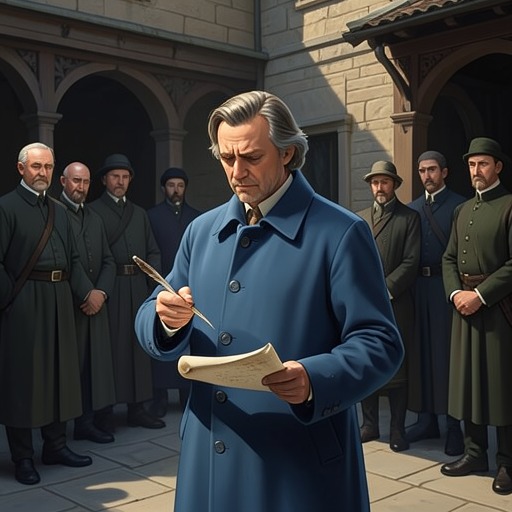
The Duke turns that expectation into a public declaration. Speaking in Don Quixote’s name, he says that he confers on Sancho the government of an island of no small importance that is at his disposal. The wording makes the appointment more than another private assurance from Don Quixote: it comes from the person who claims authority to grant the government, and it is made before witnesses. The scene does not identify the island here or show Sancho taking possession. Its decisive change is that a future reward now has an explicit donor and a named recipient.
The Ceremony and Its Interruption
Don Quixote treats the announcement as a moment requiring deference. He instructs Sancho to go down on his knees and kiss the Duke’s feet in gratitude for the favor. Sancho complies, physically accepting a new rank that he has so far discussed chiefly through proverbs and hopes. The gesture also reveals how Don Quixote frames the grant: it is not merely a practical arrangement but a favor whose authority should be publicly acknowledged.
The ecclesiastic responds with anger rather than congratulations. He condemns the Duke for sanctioning what he regards as the madness of Don Quixote and Sancho, then leaves without finishing his meal, despite the Duke and Duchess’s efforts to detain him. His objection exposes the distance between the appointment’s ceremonial presentation and its credibility to an observer who rejects the assumptions behind it. The Duke, however, laughs at the outburst. The scene therefore places Sancho’s elevation amid competing interpretations: to Sancho and Don Quixote it is a welcome fulfillment; to the ecclesiastic it is evidence of folly; to the Duke it is also a source of amusement.
Sancho’s Expectations and the Duchess’s Assurance
The Duchess later tells Sancho not to fear that the promise will be broken. Although her husband is not a knight-errant, she says, he is a knight and will keep his word despite the envy and malice of others. Her reassurance sustains the appointment as a serious commitment, even as her description of Sancho eventually seated on the island’s throne and taking possession places its practical fulfillment in the future. The scene thus distinguishes the authority of the grant from the still-pending experience of governing.
The Duchess couples reassurance with advice about responsibility. Sancho should remember that his vassals are loyal and well-born and should govern them carefully. Sancho answers that he is naturally compassionate toward the poor and will protect the good while denying the bad influence. He also admits that he has been raised to field labor rather than government, but expects that a beginning may teach him the work within a fortnight. The exchange sets his confidence against his acknowledged inexperience without resolving the tension: he regards good intentions and practical alertness as a foundation for rule, while the Duchess frames the office as a duty toward those he will govern.
The Grant’s Meaning and Limits
A later discussion clarifies one point about the terms of Sancho Panza’s appointment. After reading his letter, the Duchess objects to his suggestion that the government was bestowed in return for the lashes he is supposed to give himself. She points out that when the Duke first promised the office, no one had thought of lashes. Her correction separates the original reward from a later obligation and prevents the appointment from being understood as payment for Sancho’s self-punishment. She also criticizes what she sees as covetousness in the letter, connecting a governor’s desire for money with the risk of unjust rule.
The appointment consequently carries both honor and scrutiny. Sancho receives a public commitment that answers his hopes of advancement, but the surrounding conversations test how he understands rank: as recognition he has earned through service, as a chance to rise beyond his station, and as responsibility for other people. Don Quixote supplies the ritual of gratitude, the Duke supplies the grant, and the Duchess insists on its obligations and credibility. The contrast makes the announcement a turning point in Sancho’s fortunes without suggesting that the scene itself settles how well he will govern.