Sancho Panza’s decrees for Barataria
Don QuixoteSancho Panza’s decrees for Barataria are the practical laws he drafted as governor, turning his brief and manipulated appointment into an unexpectedly concrete exercise in public administration. Their range—from wine sales and clothing prices to wages, songs, and claims of poverty—shows him trying to make everyday conduct answerable to standards of fairness and proof.
Context and Purpose
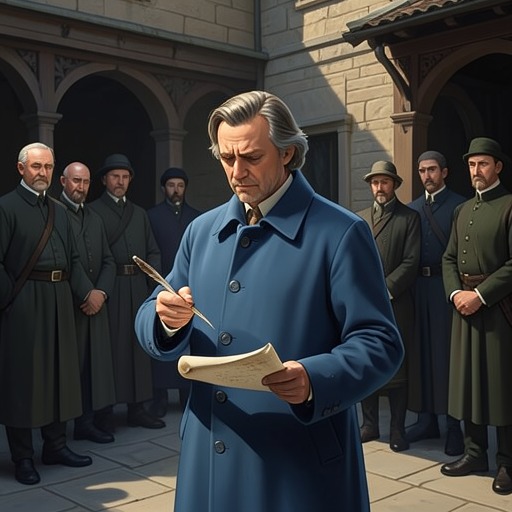
After sending a letter concerning his government and his longing to hear news of his wife and children, Sancho spent the afternoon drawing up ordinances for the island he governed. The people carrying on the joke against him were meanwhile planning how to remove him from office. The contrast is central to the decrees’ place in the story: while others treated the governorship as a trick, Sancho treated its responsibilities as real.
Trade, Prices, and Public Conduct
Sancho prohibited provision hucksters and allowed wine to be imported from anywhere, on the condition that its place of origin be declared so its price could reflect its quality and reputation. Anyone who diluted wine or misrepresented its name faced the death penalty. The rule links open disclosure to public judgment of value, while its severe punishment makes the governor’s concern for honest dealing unmistakable.
He also reduced the prices of shoes, boots, and stockings, with particular attention to shoes, which he judged excessively expensive, and fixed servants’ wages, which had become recklessly high. These measures address both the costs of ordinary goods and the terms of paid work. Rather than limiting government to punishment, Sancho’s ordinances attempt to set boundaries on prices and wages that he regarded as unreasonable.
The decrees imposed heavy penalties on lewd songs, whether sung by day or night. They also barred blind singers from composing verses about miracles unless they could produce credible evidence that the miracles were genuine; Sancho suspected that many such accounts were fabricated to the detriment of true ones. In these provisions, public expression is not simply prohibited: claims presented to the public are made answerable to a standard of conduct or proof.
Poverty, Enforcement, and Legacy
Sancho established an officer of the poor whose task was not to harass people in need but to examine whether their poverty was genuine. The ordinance distinguishes relief from the policing of appearances: Sancho’s stated purpose was to identify people who falsely presented themselves as crippled or afflicted in order to conceal that they were thieves or drunkards. As with the rules on miracle stories, the measure makes verification a tool of governance, though it also places officials in the position of judging who deserves recognition as poor.
The narrator reports that Sancho made many good rules and that they were still preserved there, known as the constitutions of the great governor Sancho Panza. That reported survival gives the decrees a comic but pointed afterlife: a temporary ruler’s practical decisions become the lasting record of his administration, even as those who appointed him by means of a joke arrange his dismissal.