Sancho Rules on the Bridge-and-Gallows Dilemma
Don QuixoteSancho Panza’s judgment in the bridge-and-gallows dilemma shows his practical reasoning at work: faced with a law that makes the same traveler both condemnable and entitled to pass, he ultimately favors mercy. The episode tests not whether Sancho can find a mechanically consistent punishment, but whether he can recognize when strict enforcement defeats justice. His conclusion draws on counsel from Don Quixote and gives compassion priority where the arguments for guilt and acquittal balance one another.
The Case and Its Stakes
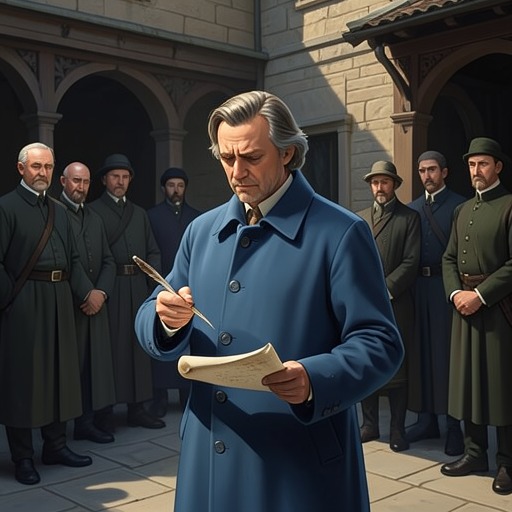
The case is brought before Sancho during his governorship by a stranger speaking in the presence of the majordomo and other attendants. The stranger describes a river separating two districts within the same lordship. A bridge provides the crossing, and at its far end stand a gallows and a tribunal where four judges administer the lord’s law. Every traveler must swear to their destination and purpose. A truthful oath permits passage; a false one leads to death by hanging.
The law’s terms appear clear until one traveler declares under oath that he is going to die on the gallows. If the judges allow him across, his prediction is false, so the law requires his execution. If they hang him, however, his statement proves true, which under the same law entitles him to pass freely. The stranger presents the judges’ uncertainty as the central problem and asks Sancho to decide what they should do. The puzzle turns the law’s demand for a simple division between truth and falsehood against itself: either outcome seems to make the opposite outcome legally correct.
Sancho Tests the Alternatives
Sancho first admits that the judges may have overestimated his intellect and asks the stranger to repeat the case so he can understand it. The request matters because his answer follows from the details of the rule rather than from a show of authority. Once the account has been repeated, he identifies the two consequences in turn. Hanging the traveler would make the oath truthful and therefore, by the law, a reason to release him; sparing him would make the oath false and therefore a reason to hang him.
At first Sancho suggests dividing the traveler conceptually: let the truthful part of the oath pass and hang the part that lied. The messenger points out that dividing the man would kill him, leaving neither the law’s conditions nor its intended procedure properly fulfilled. Sancho’s proposal makes the contradiction visible, but it cannot supply a workable sentence. Rather than pretending that the legal knot has come undone, he acknowledges that the arguments for the man’s death and for his life are equally balanced.
The Judgment: Mercy in Doubt
Sancho’s final ruling is to let the traveler pass freely. His reasoning does not depend on discovering which half of the oath should prevail; he concludes that neither the case for condemnation nor the case for acquittal outweighs the other. In that uncertainty, he says, doing good is more praiseworthy than doing evil. He would have the decision signed in his name if he knew how to sign, an admission that places his lack of formal accomplishment beside his confidence in the judgment itself.
He also identifies the source of the principle behind his decision: a precept Don Quixote gave him the night before he left to become governor. When the justice of a case is doubtful, Sancho remembers, he should lean toward mercy. The advice does not resolve the logical puzzle; it gives Sancho a standard for acting when the law’s own reasoning cannot produce a fair distinction. His decision therefore rests both on his close reading of the competing outcomes and on a remembered rule of humane judgment.
Reception and Significance
The majordomo praises Sancho’s ruling, saying that even Lycurgus could not have made a better decision, and closes the morning’s audience. Sancho responds by asking for fair treatment in the form of dinner, then declares himself ready for more cases once he has eaten. The exchange returns the episode to the material circumstances of his governorship: before hearing the petition, Sancho had been made to break his fast on a little conserve and four sips of cold water, a meal he would have gladly exchanged for bread and grapes. Hunger had made him resent the government and the man who gave it to him, yet he still reaches a measured decision and invokes mercy rather than punishment.
The episode joins the comic form of a verbal puzzle to a serious question about governing. A rule intended to sort truthful travelers from liars collapses when the traveler’s statement makes either verdict contradict the rule. Sancho does not claim that the contradiction can be eliminated by force of intellect. Instead, he uses the balance of the arguments as grounds for restraint. His answer also shows Don Quixote’s influence at a moment when Sancho must judge independently: the counsel has become a usable principle, not merely a saying repeated by a dependent. The case thus presents Sancho’s governorship through a specific decision in which practical scrutiny and remembered moral guidance converge.