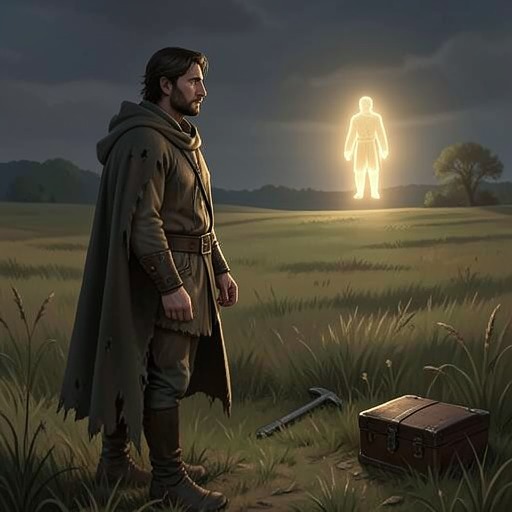
Sancho's Embassy to Dulcinea
Don QuixoteSancho Panza’s embassy to Dulcinea del Toboso is a failed delivery that becomes a rescue mission. Sent from the Sierra Morena with a love letter composed by Don Quixote, Sancho cannot produce it when asked: the notebook containing it has never left his master’s possession. That practical mishap turns the absent letter into an opening for the curate and the barber to invent a reply and draw Don Quixote away from his chosen penance.
The Letter and the Departure
Don Quixote writes the letter in a notebook, then calls Sancho over and offers to read it aloud so that he can commit it to memory in case he loses the written version. Sancho admits that his memory is unreliable and asks instead for the letter to be written down for him to carry. Don Quixote reads it to him nonetheless. Its language presents the knight as wounded by absence and dependent on Dulcinea’s response, while making Sancho the bearer who is to explain the depth of his master’s distress. The letter closes in the name of the Knight of the Rueful Countenance, carrying Don Quixote’s adopted identity into an ordinary errand.
Sancho asks Don Quixote to sign the message. Don Quixote says that his flourish will serve as a signature, but the exchange does not settle who will physically carry the notebook: Sancho assumes he will receive it, and Don Quixote never hands it over. The oversight will determine the course of the mission. Its beginning rests on a document that has been written, read aloud, and discussed, yet is not actually in the messenger’s hands.
Before Sancho leaves, Don Quixote asks him to witness some of the madness he intends to perform during his penance. Sancho resists seeing his master strip and proposes that any demonstration be brief and clothed. He nevertheless turns back after setting out, explaining that a witness to at least one mad act would let him report the truth without a troubled conscience. Don Quixote then performs a short display, and Sancho, satisfied that he has seen enough, rides on. Their leave-taking is affectionate and tearful; Don Quixote also charges him to care for Rocinante as carefully as he would care for himself.
Marking the Way Back
Sancho worries that he will not find his way back to the remote place where he is leaving Don Quixote. Don Quixote tells him to observe the landmarks and recommends laying branches of broom at intervals as signs. Sancho follows this instruction, creating a trail through the landscape that serves first as a practical guide and later as the means by which the curate and the barber can reach the penitent knight.
The outward journey thus carries two kinds of information: Sancho is meant to deliver a message to Dulcinea, but he also preserves a route back to Don Quixote. He travels on Rocinante while his master remains in the mountains. The trail does not resolve the mistaken assumption about the letter; instead, it makes the return journey possible after the failure is discovered.
The Missing Notebook
On the road to El Toboso, Sancho reaches the inn associated with the earlier blanket incident. He hesitates to enter, though he wants a hot meal after days of cold food. Outside, he encounters the curate and the barber from his village, who recognize both him and Rocinante and ask where Don Quixote is. Sancho initially keeps the location and circumstances secret, describing his master as occupied with an important matter. The barber threatens to suspect him of having robbed or killed Don Quixote, since Sancho is riding his horse.
Sancho then explains that Don Quixote is doing penance in the mountains and that he has been sent with a letter to Dulcinea del Toboso, whom he identifies as Lorenzo Corchuelo’s daughter. When the curate asks to see the message so that he can make a fair copy, Sancho searches his clothing for the notebook and discovers that it is missing. The narrator clarifies the cause: Don Quixote kept it and never gave it to him. Sancho had not noticed the omission before setting out. His alarm is immediate, and he speaks of having lost three ass-colts, a loss whose importance reflects his hope of reward as well as his attachment to the errand.
The mission has therefore failed before Sancho reaches its destination: he has neither the letter nor, as the scene makes clear, a written message to present. Yet his account gives the curate and the barber what they need to understand where Don Quixote is and how to approach him. Sancho’s report transforms a private act of penance into a problem his neighbors can try to remedy.
The Embassy Becomes a Rescue Plan
The curate proposes that he and the barber coax Don Quixote out of the mountains. Their plan is to exploit the knight’s own sense of duty: one of them will appear as a distressed damsel requesting his help against a wicked knight, while the other plays her squire. They expect that Don Quixote will accept such a request and travel with them, allowing them to bring him back to his village and see whether his madness can be remedied.
The two men adjust their disguises after the curate objects to dressing as a damsel, and Sancho guides them back toward the place where he left his master. At the broom-branch markers, they instruct Sancho not to reveal their identities. They also prepare him for Don Quixote’s likely question about the letter: he is to say that he delivered it, and that Dulcinea, who cannot read, answered orally by commanding Don Quixote to come see her at once. This is an invented message, not a response received from Dulcinea. Sancho accepts the deception and commits the story to memory, pleased that the curate and barber intend to encourage Don Quixote toward becoming an emperor rather than an archbishop, since he believes an emperor can reward a squire more generously.
The embassy’s outcome is consequently a reversal of its stated purpose. Sancho does not deliver Don Quixote’s letter, and no answer from Dulcinea is obtained. Instead, the failed errand supplies the curate and the barber with a route, a pretext, and Sancho’s cooperation in a staged message. The episode joins the comic gap between intention and execution to a practical act of care: a letter that remains in its writer’s possession helps set in motion a plan to bring him home.